Get Full Government Meeting Transcripts, Videos, & Alerts Forever!
Get email alerts on the Arts Accessibility Youth Summer Programs topic
No spam. Unsubscribe anytime.
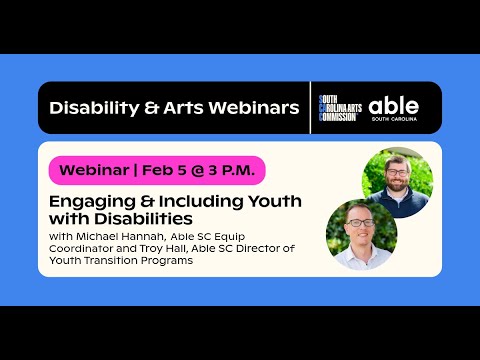
South Carolina Arts Commission webinar outlines steps to make youth arts and summer programs accessible
Summary
Presenters from the South Carolina Arts Commission and ABLE South Carolina reviewed federal laws that apply to summer arts programs and offered practical, low‑cost steps—walkthroughs, safety plans, communication practices, peer leadership and quiet spaces—to help arts organizations include youth with disabilities.
Amanda Noyes, Arts and Education Accessibility Director for the South Carolina Arts Commission, opened a webinar on accessibility for youth in arts programs by urging organizations to treat accessibility as a program design priority: “We know that we can't have equitable access to the arts if arts programs and facilities are not accessible.”
The session, led by Troy Hall, director of youth transition programs at ABLE South Carolina, and Michael Hanna, senior youth programs coordinator at ABLE South Carolina, combined a brief legal primer with practical guidance for organizations running summer programs, camps and year‑round youth workshops. “It covers most summer programs,” Hall said of the Americans with Disabilities Act, stressing that privately run camps open to the public are often covered and must provide equal access and reasonable modifications.
Why it matters: Many arts organizations lack experience serving youth with disabilities and may not realize which laws apply or how to adapt programs. Presenters said modest changes in planning and staffing can broaden participation and reduce last‑minute barriers without large capital investments.
Key legal context and when it applies
- Michael Hanna outlined four federal laws to keep in mind: the Americans with Disabilities Act (ADA), Section 504 of the Rehabilitation Act of 1973, the Individuals with Disabilities Education Act (IDEA) and the Family Educational Rights and Privacy Act (FERPA). He advised organizations that receive federal funds or partner with public schools to review those statutes for required accommodations, confidentiality and individualized education plan (IEP) obligations.
Practical steps for organizers
- Pre‑event walkthroughs: Physically navigate program routes, check slopes, surface materials, lighting, sound sources and seating to identify barriers before participants arrive.
- Safety and individualized emergency plans: Create evacuation and medical contingency plans that account for mobility, hearing, vision and behavioral needs; ensure alarms and communication include visual and tactile methods when appropriate.
- Communication with families and support networks: Ask about accommodations on applications, provide multiple ways to communicate (email, phone, text, video), send plain‑language tip sheets and follow up to clarify needs rather than relying on families to volunteer details.
- Alternative and augmentative communication: Prepare simple communication boards, train staff in basic supports and encourage participants to use their devices during activities.
- Collaborative rules and peer leadership: Build group expectations with youth to create shared ownership; train peer leaders separately so they can support new participants without infantilizing them.
- Accessible workspaces and quiet zones: Offer varied seating, task lighting, clear wheelchair spaces, noise‑reducing options and a supervised low‑stimulation area where participants may step away to regroup.
- Program design and behavior supports: Use clear, specific rules; favor restorative and positive behavior interventions; create individualized support plans and rely on peer mediation where possible.
Presenters emphasized iterative improvement: if an unanticipated accommodation is needed on day one, organizers should adapt and secure longer‑term supports for subsequent sessions. Hall said the presenters would circulate the slide deck and resources later the same day to attendees.
Quotes and attributions in context
- Amanda Noyes, Arts and Education Accessibility Director, South Carolina Arts Commission: “We know that we can't have equitable access to the arts if arts programs and facilities are not accessible.”
- Troy Hall, Director of Youth Transition Programs, ABLE South Carolina: “It covers most summer programs,” referring to the ADA’s broad applicability to camps and recreation that are open to the public.
- Michael Hanna, Senior Youth Programs Coordinator, ABLE South Carolina: presenters noted, “we are not lawyers,” while offering commonly encountered legal requirements and practical steps organizations can take.
Next steps and follow up
The South Carolina Arts Commission announced a webinar reflection hour scheduled for February 6 from 3 to 4 p.m. Eastern for case studies and follow‑up discussion, and presenters said the slide deck and resources would be distributed to registrants later that day. The session invited attendees to contact SCAC and ABLE South Carolina for one‑on‑one assistance.
Ending note: The webinar framed accessibility as achievable through planning, modest staffing adjustments and routine program design changes rather than solely through major capital work; organizers were urged to begin with walkthroughs, safety planning and clear communication with families.