Lifetime Citizen Portal Access — AI Briefings, Alerts & Unlimited Follows
DOJ final rule means digital accessibility, audits, grants for South Carolina arts groups
Loading...
Summary
Panelists at a South Carolina Arts Commission webinar summarized the Department of Justicefinal rule on digital accessibility, advised arts organizations to use WCAG 2.1 as the compliance baseline, warned against one-line overlay "fixes," and described audit and grant resources available through ABLE South Carolina and the Arts Commission.
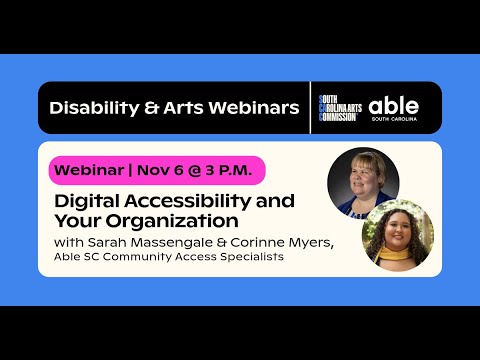
Amanda Noyes, Arts and Education Accessibility Director for the South Carolina Arts Commission, and accessibility consultants told arts organizations in a Nov. webinar that the Department of Justicefinal rule now requires many public and federally funded digital resources to meet formal accessibility standards.
The webinar opened with Noyes outlining the state Arts Commissionmission and partnerships: "The mission of the South Carolina Arts Commission is to promote equitable access to the arts and support the cultivation of creativity in South Carolina," she said, and noted the Commissionhas worked with ABLE South Carolina and launched an "Arts for All SC" grant to help organizations improve accessibility.
Why it matters: the panel explained that the DOJfinal rule extends ADA-related requirements into the digital realm, using the Web Content Accessibility Guidelines (WCAG) as the conformance standard. Panelists said compliance timelines vary by organization size and funding, failure to act can trigger complaints or lawsuits, and practical steps (automated scans, manual audits, staff training) are available now.
The webinar framed the technical standard and the practical steps organizations should take. Sarah Massengale, an accessibility consultant with S and M Accessibility Consulting, said the final rule "is something that was established by [Attorney General] Merrick B. Garland and the Department of Justice as sort of an extension of the Americans with Disabilities Act" and that the final rule uses WCAG as the conformance baseline. Panelists emphasized the rule text references WCAG 2.1 even though WCAG 2.2 exists.
Panelists described what digital accessibility covers and how it is measured. Corinne Myers, a community access specialist with ABLE, said digital accessibility includes "web, digital documents, software platforms, ticketing platforms" and must be usable by people who are deaf, blind, have motor or cognitive disabilities, or who use assistive technologies.
The presenters explained WCAGprinciples (perceivable, operable, understandable, robust) and the three conformance levels (A, AA, AAA). They said organizations should generally aim for WCAG 2.1 Level AA. The Rehabilitation Act's Section 508 also was cited as a federal standard that applies to federal agencies and their electronic information and technology.
Practical testing advice: panelists described automated tools (examples cited: Axe DevTools, WAVE, color-contrast checkers) as useful for baselines but not a substitute for manual testing with assistive technology and usability testing with qualified testers who have disabilities. Massengale said, "Automated testing tools do sometimes manufacture false negatives and false positives," and urged organizations to pair automated scans with manual reviews.
Warning on overlays: presenters warned against relying on single-line-of-code accessibility overlays. Corinne Myers described an example testing the overlay Recite Me: an automated scan showed about 40 issues on the site without the overlay and more than 400 issues after the overlay was enabled. Massengale called overlays "scary, and they are deceptive" and said they can mask or introduce accessibility failures, especially for screen-reader and keyboard-only users.
Timelines and exemptions: Myers summarized compliance timing given in the webinar: the final rule published in April and took effect in June 2024; public entities with populations of 50,000 or more should work toward compliance by April 20, 2026, while smaller public entities and many special districts have until April 20, 2027. Panelists clarified exemptions that can apply (archived content, some preexisting electronic documents and social media posts published before April 20, 2026, and certain individualized password-protected content), and stressed that organizations must still provide accessible alternatives when an individual requests information behind a password wall.
Third-party platforms: the panel recommended that organizations ask vendors for a Voluntary Product Accessibility Template (VPAT) or an Accessibility Conformance Report (ACR) when evaluating ticketing or scheduling platforms, and suggested ABLE SC can help interpret those documents.
Enforcement and risk: presenters noted the DOJ has not set a specific penalty schedule, but individuals can file ADA complaints and courts can order modifications and damages or attorney fees. Myers said, "Individuals with disabilities still hold the right to sue government entities under the ADA for inaccessible websites and apps."
Resources and funding: Amanda Noyes and Mary (a webinar panelist/staff member) told attendees about funding and support. Noyes said the Arts Commission offers a rolling accessibility grant that provides $2,500 with a 1-to-1 match for initial audits and remediation work, and that additional grant opportunities are in development for spring. ABLE South Carolina was repeatedly offered as a low-cost audit resource and technical assistance partner.
What organizations should do now: panelists recommended these immediate steps: run automated scans to establish a baseline; schedule a manual accessibility audit that includes assistive-technology testing; prioritize fixes that remove major barriers; train staff on accessible content creation; and avoid quick-fix overlays as a replacement for remediation.
The webinar concluded with presenters offering follow-up contacts, an accessibility office hour on Nov. 21 (3:00-4:00 p.m.), and links to prior recorded sessions for organizations seeking an introductory overview. The panelists encouraged groups to reach out to the Arts Commission or ABLE South Carolina for help interpreting VPATs, conducting audits, or applying for grants.