Get Full Government Meeting Transcripts, Videos, & Alerts Forever!
Get email alerts on the Arts Accessibility topic
No spam. Unsubscribe anytime.
South Carolina Arts Commission, ABLE staff urge simple, advertised steps to make arts more accessible
Summary
Panelists from ABLE South Carolina and the South Carolina Arts Commission told arts organizations that small operational changes—accessibility statements, staff training, advertised accommodations, advisory councils and tech options—can expand participation for people with disabilities.
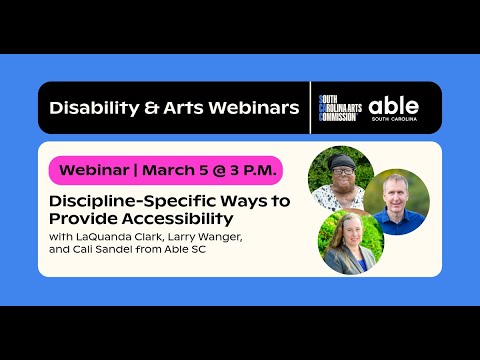
Amanda Noyes, arts learning and accessibility director for the South Carolina Arts Commission, opened a webinar on accessibility in the arts with a call for arts organizations to make participation easier for people with disabilities.
Panelists from ABLE South Carolina described practical, low-cost measures arts venues can use to reduce barriers to concerts, exhibits, classes and museum visits, and stressed the importance of publicizing those changes so people with disabilities know they are welcome.
"If you are an arts organization in South Carolina and you're not sure where to begin or feel you need additional support or assistance in your accessibility work, please feel free to contact me," Noyes said, introducing a conversation with ABLE staff about common challenges and fixes.
Laquanda Clark, director of Independent Services at ABLE South Carolina, described problems Deaf and hard-of-hearing patrons face when exhibit descriptions or labels are not available in plain language or ASL-accessible formats. Clark said, "your descriptions can sometimes be a hindrance to that community." She urged organizers to consider scan-to-interpret options and to present exhibit information in ways that match American Sign Language syntax.
Callie Sandle, director of Community Integration at ABLE South Carolina, and Larry Wenger, vice president of Advocacy and Independent Living Services at ABLE South Carolina, recommended a set of straightforward operational practices: publish an accessibility statement and a contact person, train front-line staff in disability awareness, offer predictable, high-contrast or tactile placement of QR codes, and provide alternatives (emailed audio files, USB/thumb drives or on-site assistance) when QR codes or web pages are inaccessible.
"1 in 4 people and here in South Carolina, 1 in 3 people have a disability," Wenger said, noting the size of the audience that accessible practices can reach and recommending advisory councils of people with lived disability experience to advise museums and theaters.
Panelists highlighted several concrete options organizations can adopt without major capital investment. Examples discussed included early-access hours for crowded exhibits, basic audio description that can be delivered via smartphone apps (Wenger cited a simple livestream approach), touch tours or 3-D printed tactile surrogates for sculptures, and the strategic use of technology such as Aira or image-description apps for patrons with low vision. Panelists cautioned that paid services like Aira may be costly for individuals and suggested institutions consider sponsoring access for visitors when feasible.
Speakers also urged arts organizations to advertise accommodations and partner with disability organizations to spread the word. Callie Sandle said she is likelier to attend events that are described as nonvisual or explicitly inclusive; Clark and Wenger emphasized that training staff to ask a brief set of questions and to listen (for example, confirming whether an animal is a service animal and what task it performs) improves customer experience.
Panelists noted some restrictions that can unintentionally limit access: strict no-photo policies that do not account for assistive-image apps; exhibit text written in dense, complex language that does not translate easily to ASL users; and inaccessible media players or websites reached from QR codes. Several panelists recommended predictable placement and tactile cues for QR codes, and offering alternate delivery of audio description at check-in for people who cannot use the codes.
The session closed with presenters urging arts organizations to start with small changes—an accessibility statement, a named contact, basic staff training and outreach to disability groups—and to view accessibility work as an ongoing, community-informed process rather than a one-time fix.