Get Full Government Meeting Transcripts, Videos, & Alerts Forever!
Get email alerts on the Assistive Technology And Accessibility topic
No spam. Unsubscribe anytime.
South Carolina webinar spotlights low-cost and high-tech assistive tools to widen arts access
Summary
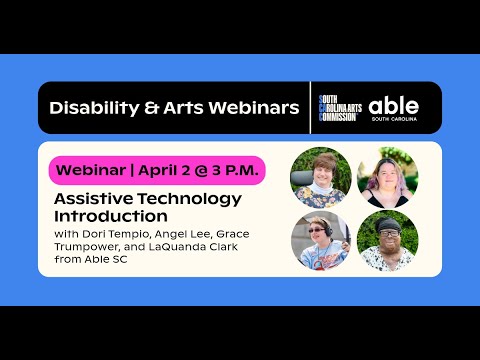
The South Carolina Arts Commission and ABLE South Carolina convened a statewide webinar on April 2, 2025, demonstrating assistive-technology options — from $2 do-it-yourself hacks to eye‑tracking and voice‑controlled design tools — and urging arts organizations to plan inclusive, ADA‑aligned events.
The South Carolina Arts Commission and ABLE South Carolina on April 2, 2025, held a webinar showing how a range of assistive technologies and low‑cost “life hacks” can make arts programs and venues more accessible to people with disabilities.
The webinar — the sixth session in the second year of the commission’s disability and arts series — combined demonstrations, personal stories and practical suggestions for arts organizations, with an emphasis that accessibility can be low‑cost as well as high‑tech. “Assistive technology is the great equalizer,” said Dorey Tempio, senior director of community education at ABLE South Carolina.
Why it matters: panelists said accessible programming helps arts organizations meet obligations under the Americans with Disabilities Act and removes practical and attitudinal barriers that keep many people from participating. Presenters urged arts centers, theaters and community programs to consult directly with people with disabilities when planning events and to use accessible design strategies that let participants join alongside family, friends and peers.
Panelists described three broad sets of solutions: low‑tech adaptations, mid‑range assistive devices and emerging digital tools. Low‑cost examples included magnetic trays, rubber grips and dowel handle extensions that organizers can assemble for a few dollars. “You could go and get a magnetic tray ... you can put that on there, and it allows the person to put their paintbrushes, their sculpting instruments, and it will stick,” Dorey Tempio said during her demonstration. The webinar included concrete price examples: a thrifted metal tray and magnetic sheet, or a wooden spatula, crayons and tape, each assembled for a few dollars versus hundreds for commercial products.
Mid‑range and high‑tech tools discussed included electronic drawing tablets (for example, Wacom or an iPad with Apple Pencil), adaptive styluses and grips, tactile graphic displays for blind or low‑vision artists, adaptive switches and eye‑gaze/head‑tracking systems that let people paint or draw with their eyes or head movements. A recorded example shown to participants combined eye‑tracking with a robotic canvas system that allowed an artist without arms to create a digital painting.
Panelists also outlined assistive approaches for music, theater and performance. Dorey Tempio described Sound Beam devices that map movement to sound, haptic metronomes that vibrate for deaf musicians, and wheelchair‑accessible stages and automated height‑adjustable platforms. Gabe Pizzo, an equip leader at ABLE South Carolina, described audio‑description devices used at an accessible movie night that connect to headphones and provide narration of visual action; he called the device “very small” and said it “really helped me, as someone who couldn't really see, like, what was going on behind the scenes.”
Speakers emphasized digital accessibility and in‑event supports: live captioning, real‑time transcription and sign‑language interpretation. Isabelle Boudoirs, a supervisor at ABLE South Carolina, recounted attending a live podcast event that provided closed captions onscreen and said that immediate captioning “made that event so much more special for me.” Grace Trumpower, youth program assistant at ABLE South Carolina, stressed that many built‑in accessibility features on smartphones and tablets are free and effective, such as iPhone accessibility options and assistive touch.
Panelists repeatedly urged arts organizations to ask participants what they need rather than assume requirements. They cited the Department of Justice’s interpretation of the Americans with Disabilities Act when describing that integrated programming is required and that running separate “special” activities is permitted but discouraged. Amanda Noyes, arts learning and accessibility director for the South Carolina Arts Commission, reminded attendees that the commission offers grant funding for accessibility projects through its Arts for All SC program and encouraged organizations to reach out for help applying.
The webinar included practical implementation notes: allow breaks during longer workshops, ensure seating and workspace are maneuverable for wheelchairs, provide adjustable tables and consider transportation access. Panelists also noted implementation challenges: staff training time, the learning curve for new technology and the reality that “one size doesn’t fit all.”
The session closed with resources and next steps. The commission and ABLE South Carolina offered to consult with arts organizations on accommodations and said more funding information is available through the Arts for All SC grant program. The hosts also announced the next webinar in the series, set for May 7, 2025, on making programs accessible in spaces that organizations do not own.
Ending: The presenters framed accessibility as practical, creative problem solving rather than an all‑or‑nothing technical barrier, and they encouraged arts groups to start with low‑cost adjustments while exploring mid‑ and high‑tech solutions as needed. “When we listen to the community, that allows us to see what they need,” Tempio said.