Get Full Government Meeting Transcripts, Videos, & Alerts Forever!
Get email alerts on the Operational Energy Strategy topic
No spam. Unsubscribe anytime.
Fairfax reports steady operational energy gains: 19% reduction since FY2018, $8 million avoided annually; solar and VPPA needed to meet targets
Summary
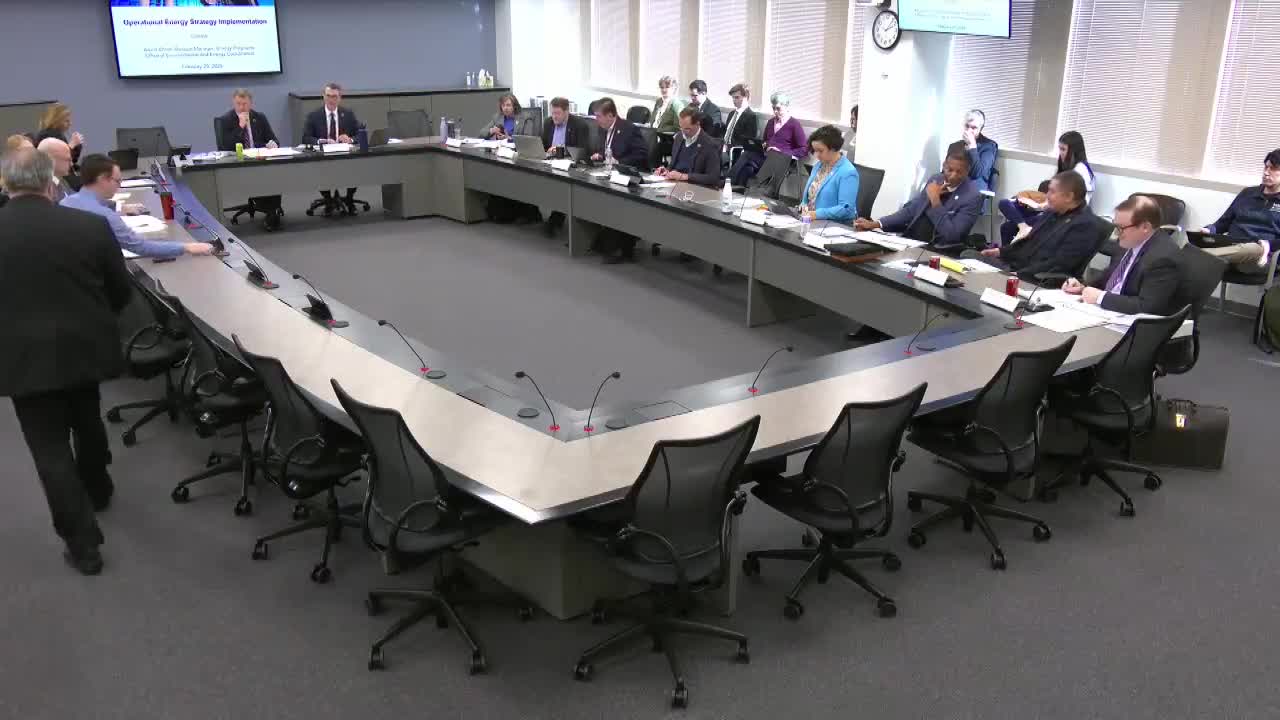
Kevin Smith of OEEC told the Fairfax County Board of Supervisors’ Environmental Committee on Feb. 25, 2025 that county government buildings cut energy use 19% from the FY2018 baseline and that the work has produced about $8,000,000 in annual avoided energy costs.
Fairfax County staff reported progress on the county’s Operational Energy Strategy (OES) to the Board of Supervisors’ Environmental Committee on Feb. 25, 2025, citing a 19% reduction in portfolio energy use versus the FY2018 baseline and roughly $8,000,000 in annual avoided energy costs.
Kevin Smith, division manager for energy programs in the Office of Environmental and Energy Coordination (OEEC), told the committee that the county achieved the 19% reduction in FY2024 despite a net increase in building floor area and that meeting the remaining 6 percentage points needed to reach the OES FY2030 goal of 25% will be more complex and likely costlier than earlier gains.
"This reduction has resulted in approximately $8,000,000 in annual avoided energy costs," Smith said, noting that many early savings came from measures such as LED streetlight conversions and lighting controls that had lower cost and quick paybacks. He said future progress will rely on continued ESCO-led energy retrofits and expanded recommissioning and continuous-commissioning programs to optimize existing equipment.
Staff highlighted completed energy-performance projects by the county’s ESCOs: the Spring Hill RECenter retrofit (July 2024) included a geothermal heat-pump system, pool dehumidification upgrades, envelope work and rooftop solar PV and is contractually required to reduce energy use by 24% with an expected 36% greenhouse-gas reduction and $85,000 in annual avoided costs. An October 2024 project at Reston Community Center, Hunters Woods combined rooftop solar PV with hot-water and lighting upgrades; the center self-funded the project and will retain the utility-bill savings. An earlier project at Cub Run RECenter achieved a roughly 60% energy-use reduction in its first year and received regional and national awards.
Solar progress to date included roughly 600 kilowatts of on-site solar PV completed in FY2024, with an expectation to nearly triple that by the end of the fiscal year. Staff said on-site rooftop installations alone are unlikely to meet the OES target of 54 megawatts by FY2030; OEEC intends to pursue large-scale off-site solutions such as virtual power purchase agreements (VPPAs) to make up the gap. John Morrill of OEEC described a VPPA as a contract that secures renewable energy credits from a planned project and noted the county is exploring joint procurements with neighboring jurisdictions to increase project scale and lower costs.
"In a VPPA, Fairfax County would enter a contract with a renewable energy developer for a fixed rate," Morrill said. "Because the payments to the renewable developer are designed to break even over time, the ongoing cost of the program are essentially 0," with only a small upfront consultant fee expected for procurement support.
On waste and sustainable procurement, staff reported progress toward operational zero-waste goals: the county is approaching roughly 30% waste diversion from landfills at county facilities (calendar-year reporting), and 82% of departments submitted 2024 action plans and annual reports. OEEC noted reusable foodware at more than 60 events in 2024, and new recycling pilots for batteries and cigarette butts. The Department of Procurement and Material Management completed a scope‑3 greenhouse‑gas analysis, and 110 major suppliers have joined Fairfax County’s supply-chain corporate social responsibility program.
Staff also briefed the committee on two grant-related items the board will see in future meetings: an apply/accept agenda item for a federal charging and fueling infrastructure grant administered through a MWCOG-led cohort (subaward pending) and a May 2025 status report on CCAP and the Resilient Fairfax plan tied to community-wide implementation.
Board members asked for additional financial detail and payback analyses for retrofit projects and for clearer coordination with Fairfax County Public Schools (FCPS) on school‑system energy projects. Paul Scott of FCPS reported that schools have ongoing solar and ESCO projects and estimated large cumulative energy-cost savings since 2014.
The committee directed staff to continue ramping retrofit, recommissioning and solar efforts, to pursue VPPA options (potentially in partnership with nearby jurisdictions), and to return with additional financial metrics, district‑level project lists and an update on the MWCOG EV grant subaward.