Get Full Government Meeting Transcripts, Videos, & Alerts Forever!
Get email alerts on the Accessibility topic
No spam. Unsubscribe anytime.
Arts organizations urged to plan accessibility for events in rented or borrowed spaces
Summary
Presenters from ABLE South Carolina told a South Carolina Arts Commission webinar that arts organizations are responsible for making programs accessible even when they do not own venues, detailing legal obligations, practical checklists, communication tools and low‑cost fixes.
Presenters at a South Carolina Arts Commission webinar told arts organizations that they must plan accessibility into events and programs even when they rent or borrow facilities, pointing to legal obligations and practical steps organizations can take immediately.
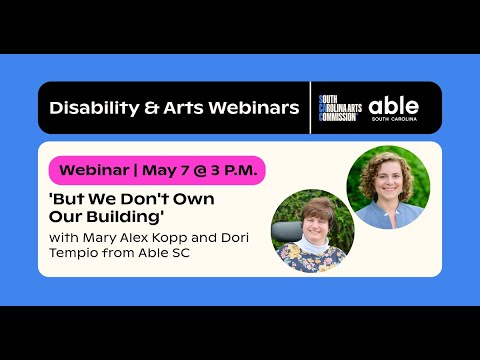
The guidance came from Dori (Presenter, ABLE South Carolina) and Mary Alex Kopp (Presenter, ABLE South Carolina) during a webinar focused on accessibility strategies for arts groups that do not control their venue space. Dori said, "If you run the program, you are responsible for making it accessible even if it's a rented space." Mary Alex Kopp added that asking participants about needs in advance helps organizers plan: "The asking is absolutely the best way to know what you should provide."
Why this matters: webinar presenters urged arts groups to think of accessibility as a program‑level responsibility, not only a property owner’s issue. They cited Title III of the Americans with Disabilities Act and the Rehabilitation Act of 1973 (sections 504 and 508) to explain that public programs and federally funded activities must be accessible. They also recommended following Web Content Accessibility Guidelines (WCAG) for digital and communication materials.
The presenters prioritized a proactive, program‑design approach over ad hoc accommodations. Key recommendations included using accessible registration platforms (examples named: Google forms, Eventbrite, JotForm), offering accessible marketing and alt text for images, providing captioning and ASL interpreters for events, and training staff and volunteers before events. Dori distinguished planning with universal design from reactive reasonable accommodations, saying universal design reduces last‑minute barriers.
Practical, low‑cost fixes discussed included portable folding ramps, borrowed seating configured to leave space for wheelchairs, measuring and marking accessible parking (including van‑accessible spaces and hash marks), temporary signage or a phone contact to assist with heavy doors, and portable adjustable podiums (music stands were offered as a practical example). For outdoor events, presenters advised siting quiet spaces well away from sound sources, ensuring accessible routes to those areas and, where needed, tents with walls for privacy or lactation needs.
On communication and digital access, Mary Alex Kopp recommended adding detailed venue information in advance (parking, nearest bus stop, accessible entrances, location of restrooms and changing places, whether food will be allergen friendly). She explained alt text vs. longer image descriptions and warned that auto‑generated AI alt text should be checked for accuracy. For visual materials presenters recommended high‑contrast colors, sans‑serif fonts and larger type (about 18‑point for presentations; 14–16 point for other messaging when feasible).
Presenters also urged organizations to budget for accessibility early, to include accessibility line items in grant applications, and to write an accessibility statement on event websites that explains ongoing efforts and provides a contact for accommodations. They encouraged organizations to share accessibility improvements with the community and to treat inclusion as an ongoing practice.
The webinar included real‑world examples: a local theater that asked a landlord to add a ramp, provided ASL interpreters for opening night and recruited performers with disabilities; a community choir that moved rehearsal space to an accessible location, installed a sound field system for a member and provided large‑print scores; and art camps that offered flexible schedules, calming tents and access coordinators to confirm needs before activities.
No formal actions or votes were taken at the webinar; the session was instructional and oriented to technical assistance and planning. Presenters closed by inviting attendees to follow up via ABLE South Carolina’s office hours and resource lists.
The webinar materials list links and resources including the U.S. Access Board, WCAG guidance, ADA technical assistance, captioning and ASL interpreter services, and loanable adaptive tools for community arts centers. Presenters emphasized that incremental changes benefit many groups beyond people with disabilities, citing the "curb‑cut effect" for parents with strollers, aging patrons, temporary injuries and others.