Get Full Government Meeting Transcripts, Videos, & Alerts Forever!
Get email alerts on the Environmental Advisory Report topic
No spam. Unsubscribe anytime.
EQAC presents 2024 annual report, urges clearer climate priorities and more funding for county programs
Summary
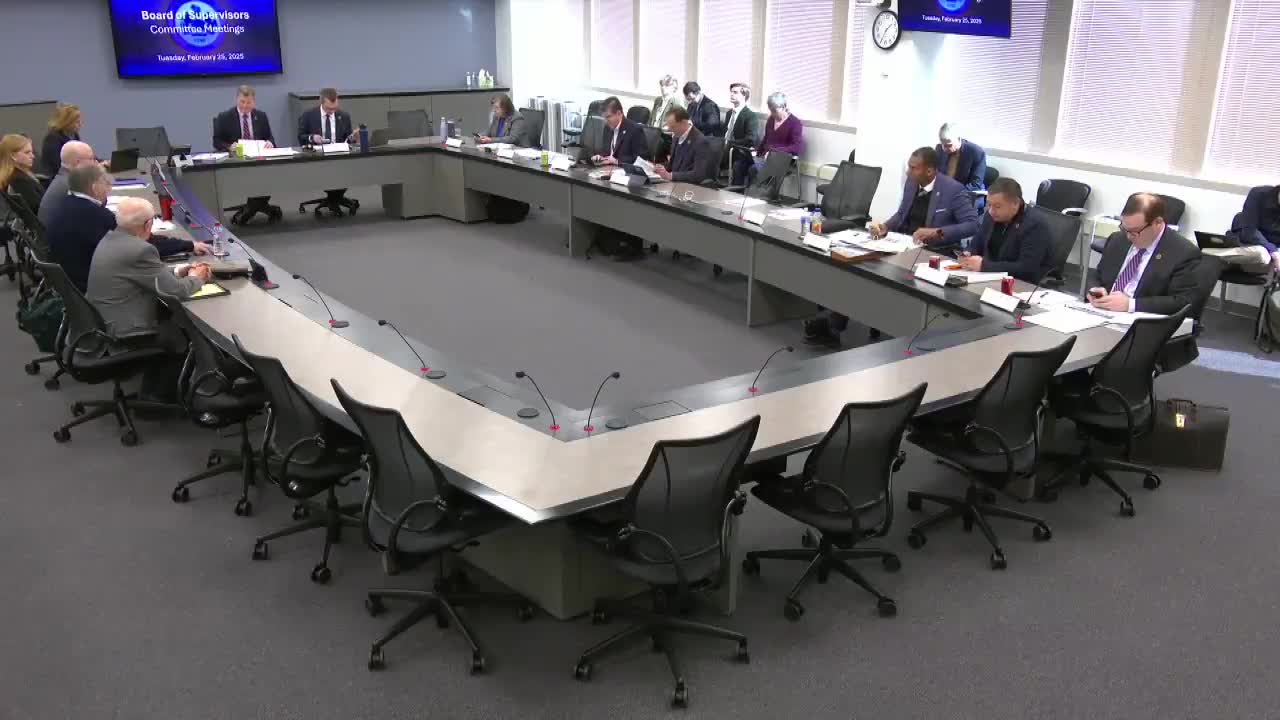
EQAC Chair Larry Zaragoza presented the Environmental Quality Advisory Council’s 2024 annual report to the Fairfax County Board of Supervisors’ Environmental Committee on Feb. 25, 2025, urging clearer public messaging on climate priorities and increased, stable funding for several county programs.
EQAC Chair Larry Zaragoza presented the Environmental Quality Advisory Council’s 2024 annual report to the Fairfax County Board of Supervisors’ Environmental Committee on Feb. 25, 2025, urging clearer public messaging on climate priorities and increased, stable funding for several county programs.
The council recommended more funding for county climate programs, increased resources for stormwater and flood reduction, setting wastewater treatment fee rates to meet maintenance needs, and more stable funding for the Fairfax County Park Authority. EQAC also recommended simpler public-facing materials for the county’s Community-wide Energy and Climate Action Plan (CCAP) and Resilient Fairfax and urged regular convenings of business leaders in the climate and energy sector.
"It's our intention to provide you with a useful document to advise the board on the environment," Larry Zaragoza said, outlining the council’s two core advice mechanisms: the annual report and memos to the board. He described the council’s priorities in two groups: budget-limited recommendations that require new funding and other priorities that need further discussion and scoping.
On budget-limited items, EQAC urged funding for CCAP and Resilient Fairfax implementation, more resources for active transportation planning, and increased stormwater program funding tied to the consolidated countywide flood reduction program. Zaragoza noted the council’s recommendation that the fee collected for wastewater treatment be set to meet documented maintenance and capital needs.
The council called for clearer public materials explaining CCAP and Resilient Fairfax so residents can better understand and support county goals. Zaragoza said, "CCAP is a big program. It's complicated, and I think it's important that people be able to relate to it." EQAC also recommended periodic convenings—perhaps quarterly—bringing together business sector experts and county staff to share successes and practical approaches.
Several board members praised the report. Chairman McKay thanked EQAC for improving the executive summary and singled out the council’s memoriam to Diane Hoffman. Chairman McKay also expressed interest in EQAC’s recommendation to convene business leaders and cited uncertainty in federal funding as a potential challenge to county programs. "We're gonna need to be looking at creative other sources of potential revenue to fund some of the environmental programs," he said.
John Morrill of the Office of Environmental and Energy Coordination (OEEC) briefed the committee that the county’s Green Business Partners program counts more than 50 members and already runs webinars and meetings that help mobilize private-sector interest.
The report highlighted other priorities for the year ahead including EV-charging network planning to serve residents without home charging, prioritizing protection of fragile lands in policy-plan language, addressing illegal dumpsites (a board matter recently sponsored by Chairman McKay was acknowledged), and continued tracking of wildlife services, stream restoration, trash and trees in transportation right-of-ways, and data center impacts.
Zaragoza thanked county staff and board liaisons for support, noting that EQAC’s membership vacancies have been largely filled. He also commended individual staff and volunteers by name for their contributions to the report and the council’s work.
The committee and EQAC members discussed coordinating more closely with the Planning Commission on comprehensive-plan review and policy-plan language to avoid redundancy and conflicting statements, and to make the plan more user friendly for staff and the public.
The presentation closed with agreement that EQAC will continue to track and advise on CCAP, Resilient Fairfax, floodplain and stormwater issues, and the policy plan review, and the board thanked EQAC for the report and recommended ongoing engagement with business partners and other stakeholders.
EQAC provided the full 134‑page report and an improved executive summary to the board; supervisors encouraged the council to continue outreach and to help the county identify nonfederal funding options if federal sources diminish.