Get Full Government Meeting Transcripts, Videos, & Alerts Forever!
Get email alerts on the Federal Layoffs Economy topic
No spam. Unsubscribe anytime.
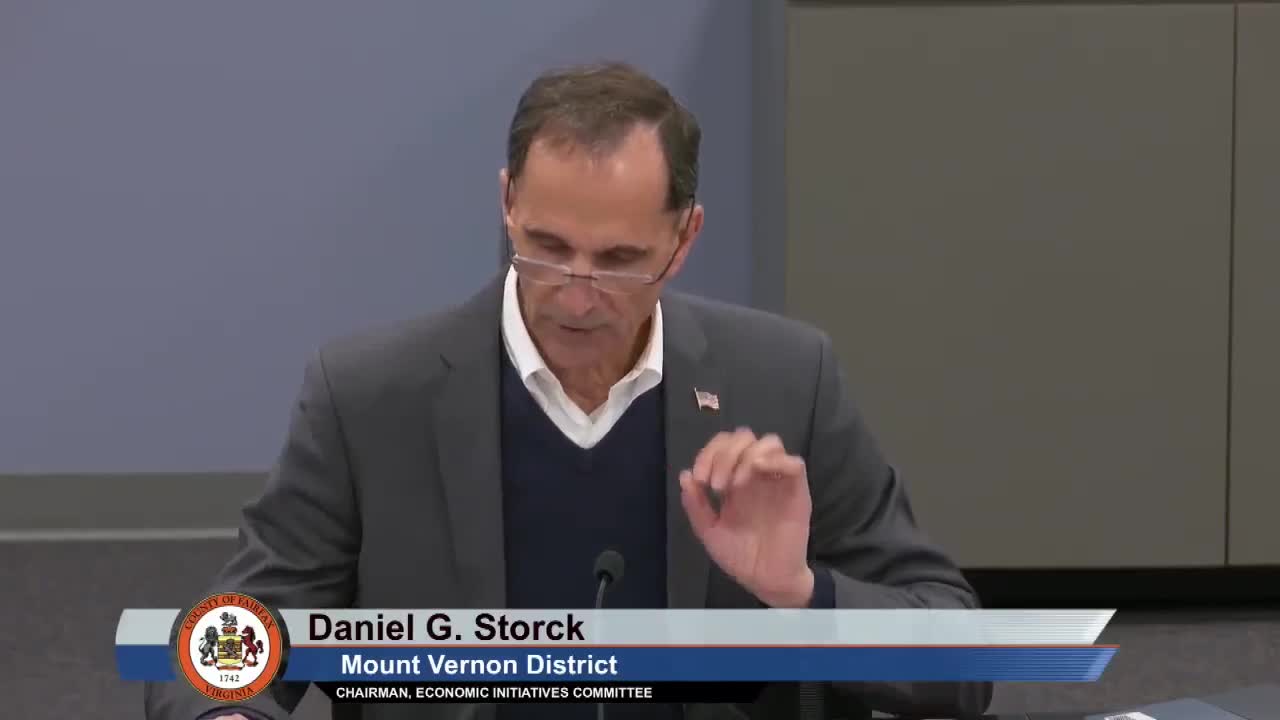
Fairfax officials warn large economic hit if federal workforce shrinks; staff outline outreach and rapid-response options
Summary
County staff and regional workforce leaders told the Economic Initiatives Committee that scenarios tied to federal workforce reductions could cost tens of thousands of jobs and billions in output in Fairfax County, and described outreach, advertising and state rapid‑response steps being pursued.
Fairfax County officials and regional workforce leaders told the Economic Initiatives Committee that reductions in the federal civilian workforce and cancelled government contracts could produce large local economic losses unless state or federal mitigation arrives.
The committee heard a county-commissioned scenario analysis showing that a 20% reduction in federal civil‑service jobs and related contractor work could translate to roughly 57,000 direct job losses and, after ripple effects, more than 82,000 resident job losses in the county. "At the 20% level, you can see that figure is close to 57,000 potential job losses," said Steven Todidi, the consultant presenting the model results. Todidi’s presentation estimated more than $11 billion in lost wages and benefits and a total output loss that the consultant said would be roughly 6% of the county’s GDP under that scenario.
The study and subsequent discussion stressed that the model scenarios are simplified and lag official data. "This situation is evolving by the moment," County Chairman Jeff McKay said at the start of the meeting, noting a Supreme Court decision and fast‑moving contractor notices as examples of changing conditions. County staff said they used Census, Bureau of Labor Statistics and contract‑cancellation data and applied a contractor‑to‑federal‑employee ratio drawn from a recent institute study to estimate secondary impacts.
Committee members and presenters described a range of near‑term and medium‑term responses. David Hunt, executive director of Virginia Career Works Northern Region, described workforce operations: "We have five American Job Centers...that really serve as the hub of our services, for individuals either dislocated, as well as, those who are needing additional skills to come into the workforce." Hunt said regional centers and a new targeted landing page for federal workers and contractors are intended to speed enrollment in training and job search services.
Staff and outside partners also described a public outreach campaign: metro rail and bus advertising, QR codes linking to a tailored landing page, and coordinated messaging between the county, the Economic Development Authority and the Commonwealth’s VirginiaHasJobs site. Alex Iams, executive vice president of the Fairfax County Economic Development Authority, said demand from prospective firms has increased in part because companies are trying to "get ahead" of uncertainty and move projects forward sooner.
County leaders said they pressed the Virginia General Assembly’s Emergency Committee on Federal Impacts — chaired by Delegate David Bulova — to consider a list of HHS and social‑service supports patterned on measures used during the 2020 pandemic. The requests included childcare subsidies, emergency rental and utility assistance, and additional funding for community‑based nonprofits to handle increased demand. Chairman McKay said the county was pushing state leaders because federal relief is uncertain and the Commonwealth has a current surplus.
Officials repeatedly cautioned that key metrics lag and that some affected workers have not yet applied for unemployment or job services because of ongoing litigation, appeals, or hopes of reinstatement. Hunt said the region had recorded roughly 500 federal workers or contractors contacting centers across Northern Virginia at the time of the meeting, but he and others warned that counts could rise once RIF (reduction‑in‑force) notices trigger WARN processes and 60‑day clocks.
Committee members pressed staff on the composition of WARN notices and the limits of that dataset: smaller subcontractors often do not trigger WARN reporting and therefore early official tallies may undercount impacts. Staff noted that of the recent contract cancellations they were tracking, a large share affected small businesses; one slide showed that roughly 57% of cancelled contracts in a recent sample were tied to small firms.
Leaders highlighted immediate practical steps: (1) a planned VirginiaHasJobs/WMATA advertising campaign and local outreach to drive affected workers to Career Works centers; (2) upcoming job fairs (a May 3 event organized by Rep. Don Beyer’s office and a May 9 Fairfax County/Career Works fair at the Government Center); (3) requests that the governor authorize rapid‑response and national emergency workforce grants that would free federal dislocated‑worker funding; and (4) longer‑term economic development pivots (AI, space, TalentUp expansions) to retain and rehire skilled workers.
No formal motions or votes were taken during the committee meeting; presenters and supervisors agreed to continue tracking data and to coordinate follow‑up with the state committee and the county budget team as more information becomes available.
The meeting closed with staff saying they would continue outreach, finalize the advertising campaign and supply additional updates to the board. "We need to be very careful that we have numbers that are representative," McKay said, "but the big takeaway is this is a serious issue that needs a serious response."