Get Full Government Meeting Transcripts, Videos, & Alerts Forever!
Get email alerts on the Pedestrian Safety Rrfb topic
No spam. Unsubscribe anytime.
VDOT and Fairfax Officials Outline Criteria and Costs for Rapid‑Flashing Pedestrian Beacons
Summary
VDOT and Fairfax County staff described how they evaluate requests for rectangular rapid‑flashing beacons (RRFBs), emphasized engineering study requirements, and reviewed a county partnership under which Fairfax handles routine RRFB maintenance while VDOT covers emergency response and major replacements.
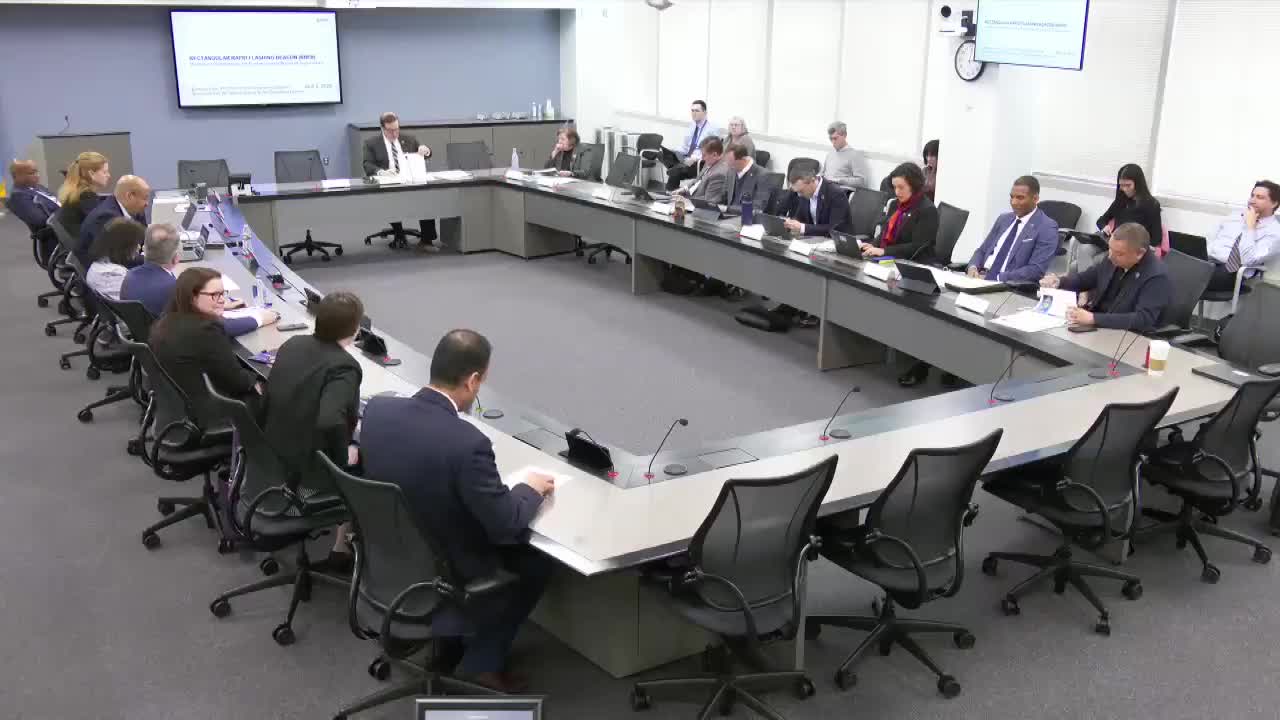
Virginia Department of Transportation (VDOT) Northern Virginia District staff briefed the Fairfax County Board of Supervisors Transportation Committee on the agency's process for reviewing requests for rectangular rapid‑flashing beacons (RRFBs), the technology's maintenance tradeoffs, and evolving state and federal guidance.
Jessica Perez, VDOT district traffic operations engineer, said RRFBs are a pedestrian‑warning device intended to supplement marked crosswalks; the devices flash yellow when activated by a pedestrian but do not, by themselves, require drivers to stop. Perez said VDOT is still operating under prior Virginia MUTCD guidance and interim approvals while the federal and state MUTCD updates proceed; the eleventh edition of the MUTCD is expected to be adopted by January 2026.
The agency stressed that site‑specific engineering studies guide deployments. Amir Shappar, VDOT deputy (traffic), described VDOT Instructional and Informational Memorandum (IIM) 384 and a tiered evaluation table used to determine appropriate countermeasures based on traffic volumes, speeds, crossing distance and sight lines. RRFBs are one of several countermeasures VDOT considers alongside visibility enhancements, refuge islands, roadway reconfiguration and pedestrian hybrid beacons. Shappar said that in some locations a refuge island or reconfiguration better serves safety goals and that an RRFB is not always the right choice.
VDOT and Fairfax highlighted a formal maintenance partnership: Fairfax County agreed to assume routine, annual preventative maintenance and minor troubleshooting for RRFBs in the county; VDOT retains responsibility for emergency response after knockdowns and for major replacements under task orders, with VDOT costs reimbursed by Fairfax County. Jessica Perez said the district has spent about $60,000 repairing or replacing RRFB equipment at four Fairfax locations over the past two years.
Committee members pressed VDOT about perceived under‑ and overuse. The committee chair observed that Northern Virginia has more installed RRFBs than other parts of the state and said, “it seems to me like we aren't anywhere close to overuse.” VDOT staff responded that the raw lane‑mile total is not directly comparable because many miles are interstates or high‑speed facilities that are not candidates for RRFBs, and they pledged continued collaboration with Fairfax staff to identify appropriate locations.
VDOT showed case studies where seemingly similar locations yielded different recommendations because of crossing distance, existing signals, presence (or lack) of refuge islands and sight line constraints; one example was rejected because horizontal and vertical curves prevented sufficient sight distance. VDOT staff said upcoming guidance—an updated statewide IIM and a district clarification document—should reduce confusion about the “and/or” language in current tables and make study requirements clearer.
Supervisors asked practical questions about costs and process. VDOT staff said costs vary by site: solar‑powered RRFBs reduce recurring electric bills but typically require periodic battery maintenance and replacement; hardwired installations carry monthly energy costs but different life‑cycle tradeoffs. Perez recommended early engagement between county designers and VDOT to select countermeasures that balance safety and life‑cycle costs and noted that bundling projects can reduce per‑location construction costs.
Committee members requested follow‑up items including the exact locations of recent RRFB knockdowns and continued coordination on the district clarification document; VDOT said Fairfax staff participated in a district workshop and will be included in final guidance. Several supervisors suggested the Board consider a formal letter backing broader RRFB deployment in Northern Virginia; VDOT said such advocacy could be useful and noted the agency is already working to clarify guidance and study procedures.
No votes were taken on RRFB installations at the meeting; requests for specific device installations continue to require engineering studies and VDOT approval under IIM 384 and forthcoming MUTCD guidance.