Get Full Government Meeting Transcripts, Videos, & Alerts Forever!
Get email alerts on the Economic Development Blueprint topic
No spam. Unsubscribe anytime.
Fairfax County reviews ‘Blueprint for the Future’ to shore up tech and headquarters advantage
Summary
County officials reviewed a year-long economic analysis by Camoin Associates that recommends targeted roles for the County Department of Economic Initiatives to retain corporate headquarters and technology firms, strengthen innovation and real estate capacity, and coordinate local partners.
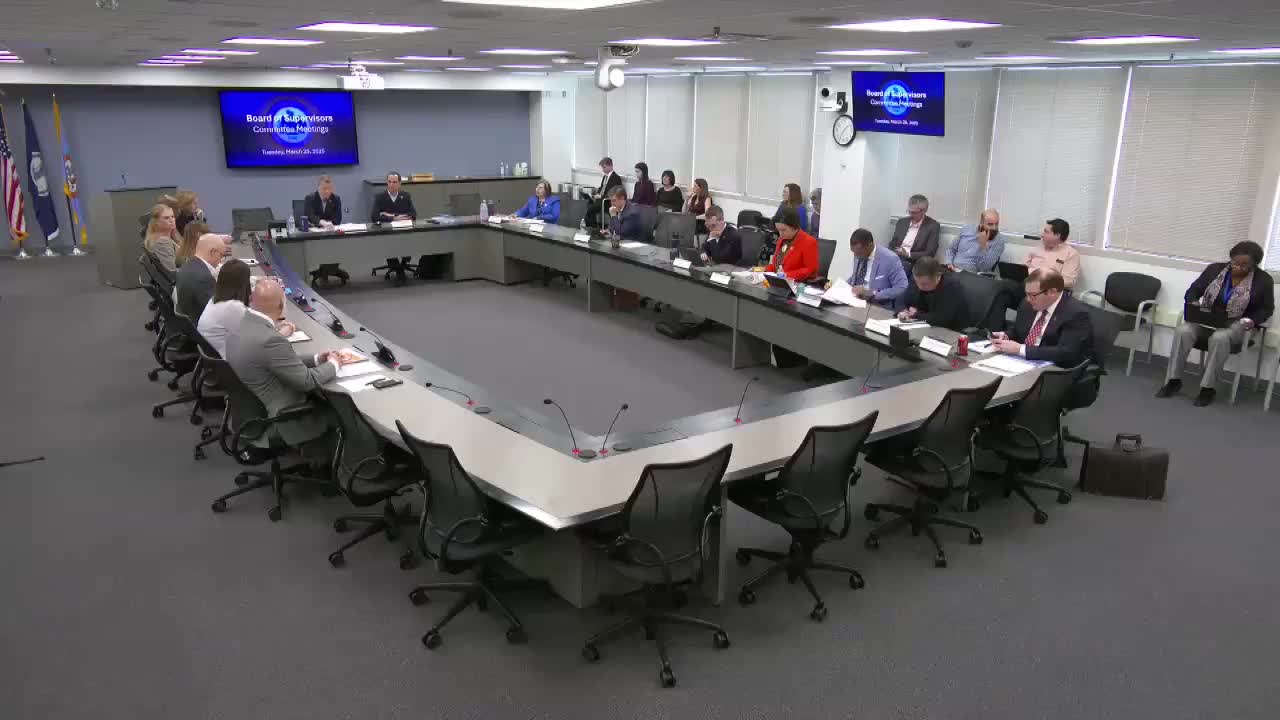
Fairfax County supervisors on March 25 heard a final presentation of the Department of Economic Initiatives’ “Blueprint for the Future,” an outside analysis intended to guide county strategy to retain corporate headquarters and technology firms and to build a more innovation-focused, resilient local economy.
The study, delivered by consultants from Camoin Associates, finds Fairfax County remains a national leader in headquarters and IT talent but faces faster-growing competitor regions and structural limits tied to a largely built-out land base. Rebecca Mowgry, Director of the Fairfax County Department of Economic Initiatives, said the blueprint was designed to identify “the primary opportunities and gaps in our economic development ecosystem” and to recommend the optimum role for the department in addressing short- and long-term needs.
Why it matters: Fairfax accounts for a large share of the region’s corporate and technology employment and contributes substantially to the Northern Virginia economy. The consultants told supervisors that without a deliberate, coordinated effort — including new emphasis on innovation, real estate strategy and business retention — the county risks losing momentum to faster-growing peer regions.
Camoin Associates’ findings and recommendations Camoin Associates, led in the presentation by Rachel Celski (CEO) and Dan Gunderson (Senior Vice President), benchmarked Fairfax against several high-performing peer counties and analyzed local clusters, governance and programs. The consulting team reported that Fairfax ranks first among peers on IT and headquarters talent pools but trails emerging peer regions on growth metrics such as venture capital, patenting and university commercialization.
The consultants said their work shows two priority industry clusters for Fairfax: corporate headquarters/consulting and IT/emerging technologies. The presentation noted that between 2018 and 2023 the county’s corporate headquarters, consulting and services industries added about 13,000 jobs (a 22% increase), and that roughly 16% of county employment is in IT and emerging-technology sectors, which account for roughly a quarter of the county’s gross regional product.
Camoin recommended that the county and the Department of Economic Initiatives (DEI) pursue a set of actions across three domains: - Built environment: lead analyses of real estate market needs and quantify economic and fiscal impacts of major development proposals; continue to administer the Economic Opportunity Reserve; support partners in housing and site development. - Business environment: emphasize retention of headquarters and tech firms, foster a startup and innovation ecosystem (including an evaluation of an innovation program), and build a stronger regional and international brand while improving internal awareness of local opportunities. - Community environment: create networks of local community-based groups to support place-based economic development, support incentives for targeted redevelopment areas, and promote walkable, mixed-use neighborhoods.
Supervisor reaction and staff next steps Supervisor Stork, who chaired the meeting, framed the county’s risk as being “stuck in neutral” and pressed the consultants on how ‘quality of life’ inputs were weighted in the competitiveness index. Rebecca Mowgry and the Camoin team said the quality-of-life metric combined multiple data points, including cost of housing, cost-of-living indices and education metrics. The consultants also told supervisors the region’s slower projected growth in IT relative to some peers is driven largely by geographic constraints — Fairfax County is largely built out while peer counties have available land for rapid expansion.
Multiple supervisors raised implementation questions about the practical division of responsibilities among DEI, the Economic Development Authority and other agencies. Dan Gunderson said the full report offers a more nuanced breakout of roles and noted that an economic-impact review of development proposals is used in other communities to help officials evaluate long-term fiscal and public-service consequences.
Direct quotations from the meeting include: - Rebecca Mowgry, Director, Fairfax County Department of Economic Initiatives: “We launched this Blueprint for the Future Analysis about a year ago.” - Supervisor Stork (chair): “Our greatest concern is being stuck in neutral.” - Rachel Celski, CEO, Camoin Associates: “We did a deep dive into 2 primary… clusters or groups of industries and sectors. Those were corporate headquarters consulting and services as well as IT and emerging technologies.”
What’s next: Mowgry said DEI will work with internal and external partners to convert the blueprint’s recommendations into specific proposals and implementation options, and will present the completed, detailed final report to supervisors for follow-up over the coming six to 12 months.
Ending note Supervisors said the blueprint provides a starting point for debate about whether Fairfax needs modest “tweaks” to current strategy or a more substantial shift. The county will receive and review the full written report and return with implementation options, including clearer role definitions among DEI, the Economic Development Authority and other partners.