Get Full Government Meeting Transcripts, Videos, & Alerts Forever!
Get email alerts on the Homelessness Encampment Policy topic
No spam. Unsubscribe anytime.
Fairfax Continuum of Care board backs shelter-before-removal standard, raises limits on outside witnesses and storage proposals
Summary
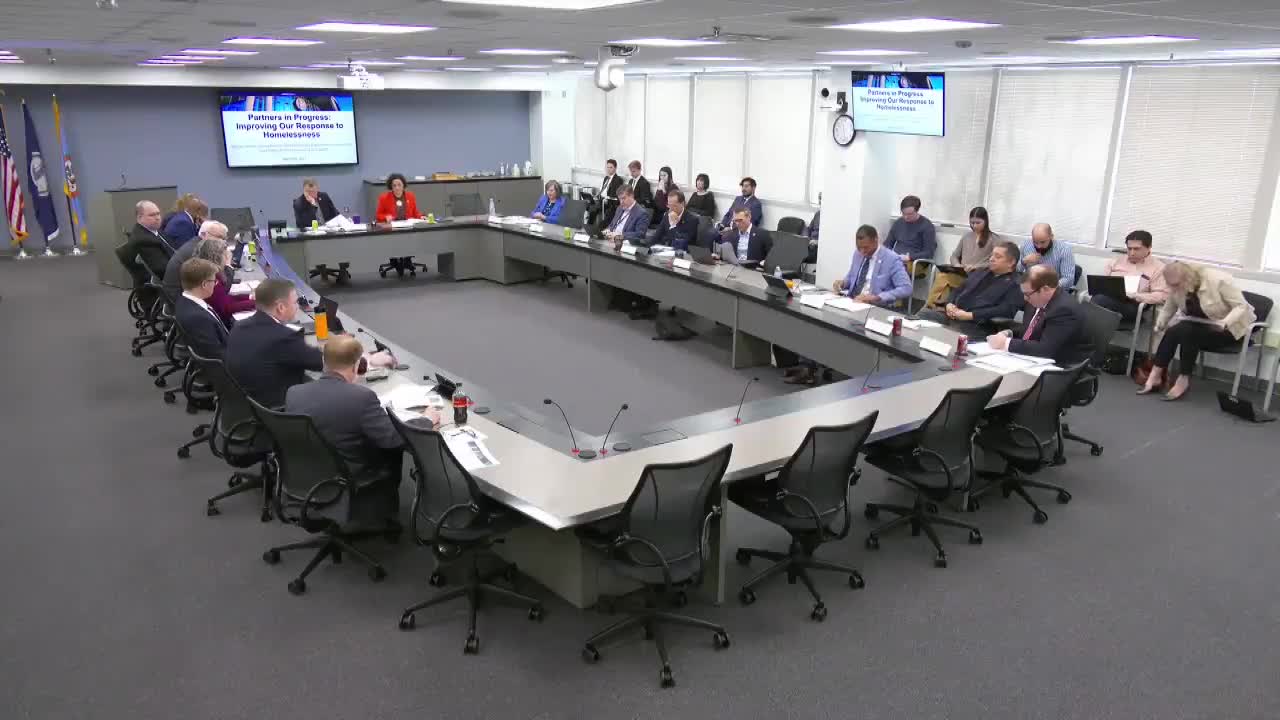
The Continuum of Care Board and county staff told the Fairfax County Housing Committee on March 25 that the county should offer shelter before clearing encampments, include mental-health co-responders during closures, and prefer advance notice while declining to require outside witnesses at removals.
The Continuum of Care Board and county staff presented a set of responses to six recommendations from the NAACP about encampment closures to the Fairfax County Housing Committee on March 25, emphasizing that shelter should be offered before clearing an encampment, that mental-health co-responders should accompany closures when possible, and that the board does not support mandating outside witnesses during removals.
David Meyer, chair of the Continuum of Care Board and a former mayor, told the committee: "The Board agrees, with this, that, the shelter, that, shelter should be provided for individuals in an encampment, before it is closed." The board also acknowledged constraints on shelter capacity, fire-code limits for floor-space use and operational resources for nonprofit shelter partners.
Key points from the Continuum of Care response - Shelter before removal: The board agreed that the county should provide indoor shelter (including overnight accommodation and, for vulnerable individuals, daytime shelter) before an encampment is closed, but it noted that current bed capacity is insufficient to guarantee shelter for every adult and that significant additional resources would be needed. - Notice: The board said advance public notice of planned removals is important and that more than two weeks' notice is preferred; county staff and deputies said the two-week standard is the target but can be waived for public-safety reasons. - Co-responders and outreach: The board endorsed use of co-responders from the Community Services Board (behavioral-health staff) and officers trained in de-escalation, calling this alignment "a best practice." Tom Barnett and other staff described outreach visits that can occur well before a closure to build trust and connect people to shelter options. - Outside witnesses: After four months of discussion, the board concluded it did not support the NAACP recommendation to require external witnesses (for example, representatives from civil-rights organizations) at closures, saying trained county and nonprofit staff and trained law-enforcement co-responders are the preferred actors to preserve dignity and avoid overwhelming the site. - Storage of belongings: The board found the idea of county-run 60-day storage for belongings to be laudable in intent but impractical in execution because of limited space, operating hours, differing storage timelines and theft/damage risk; a survey of 14 cities where such programs were attempted informed that view. The board suggested voluntary nonprofit solutions could be explored.
Federal funding and operations County staff and CoC officials reported that HUD announced Continuum of Care awards in January that increased funding to Fairfax grantees (described in the presentation as about a 17% increase and more than $12 million), but that HUD committed only 90% of renewal needs in that announcement and that CoC Builds supplemental funding may not materialize because of federal budget uncertainty. Staff warned that those gaps could affect projects and staffing supported by CoC grants.
Operational notes and next steps - Hypothermia program and capacity: Staff said the county is adding almost 50 adult hypothermia beds with operations timed to the Fair Ridge Family Shelter opening and that the hypothermia prevention program ends on March 31. County staff said they will work with nonprofit providers to place individuals whose CoC-funded projects are sunsetting. - Panhandling survey: The county awarded a panhandling survey to the Urban Institute; staff said the survey will run through spring and summer with results expected in late summer. - Coordination and cross-jurisdictional response: Board members and supervisors emphasized cross-jurisdiction coordination (for example, with the City of Fairfax and VDOT) and encouraged proactive community engagement, including faith-based hypothermia partnerships, to prevent encampment growth.
Supervisor and staff follow-up Supervisors pressed staff on privacy, use of police body-worn cameras, ways to expand the hypothermia model with nonprofits and faith partners, and outreach to residents who encounter people living outside. County staff said the department routinely coordinates outreach with police, the Community Services Board and nonprofit providers and that the two-week notice standard can be waived in public-safety emergencies.
Ending note: the Continuum of Care Board and county staff said they will begin a community engagement and strategic planning process over the summer, and the CoC Board's strategic recommendations will be returned to the Board of Supervisors later in the year for consideration.