Get Full Government Meeting Transcripts, Videos, & Alerts Forever!
Get email alerts on the Tobacco Retail Policy topic
No spam. Unsubscribe anytime.
Fairfax health and planning staff recommend 1,000-foot buffer for new tobacco retailers near schools; board questions scope and enforcement
Summary
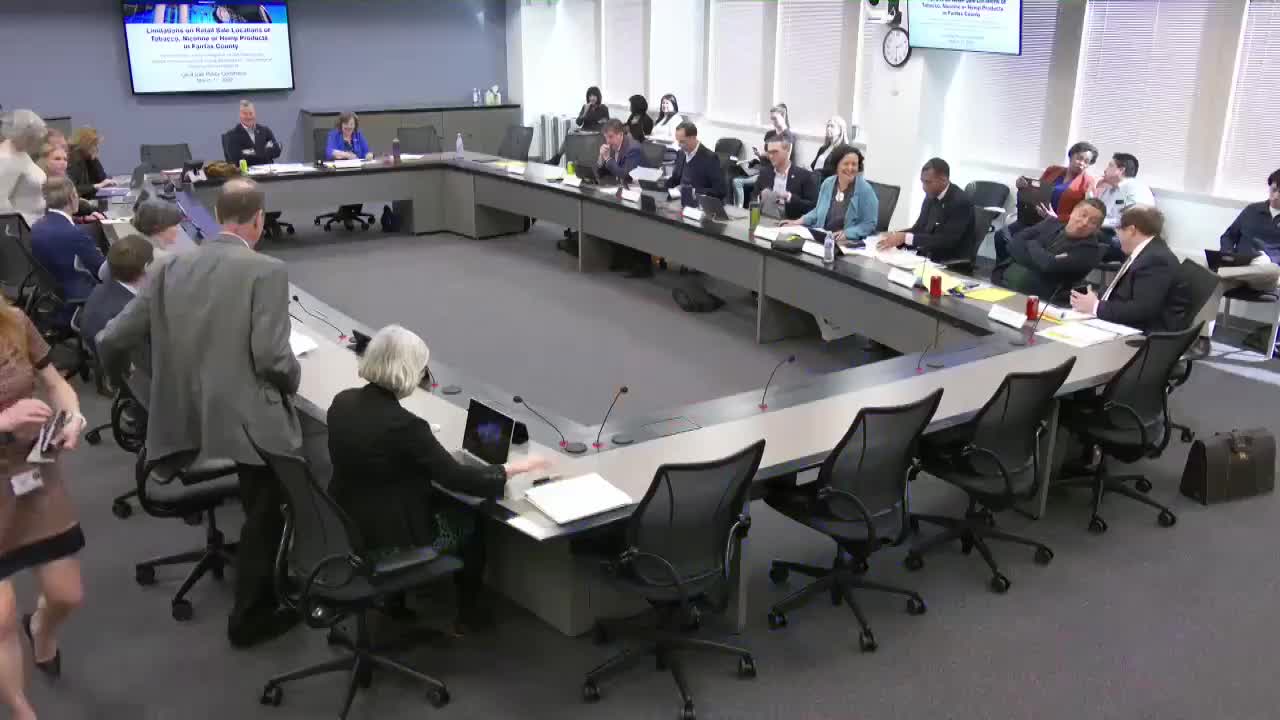
Brandy Temple, an epidemiologist with the Fairfax County Health Department, presented findings and recommendations from a multi-agency work group convened after a December 2024 joint board matter to study retail limitations on tobacco, nicotine, and hemp products.
Brandy Temple, an epidemiologist with the Fairfax County Health Department, presented findings and recommendations from a multi-agency work group convened after a December 2024 joint board matter to study retail limitations on tobacco, nicotine, and hemp products.
Temple told the committee that Virginia law authorizes localities to prohibit retail tobacco sales within 1,000 feet of youth learning facilities but that any regulation would not affect retailers operating prior to July 1, 2024. “Any regulation would affect only newly operating retail, which may limit the impact to the current built environment,” Temple said.
The work group identified about 497 existing tobacco retail locations in Fairfax County and found retail density concentrated in census tracts with higher poverty; staff reported approximately 1.3 tobacco retail locations per square mile countywide. The Health Department presented youth-exposure research and school-proximity mapping showing that inclusion of different facility types changes the regulation’s reach: using K–12 public schools only would reduce available area for new retailers by about 9% and encompass roughly 13% of existing retailers; adding private schools increases that to a 15% area reduction and 23% of existing retailers; adding child day centers would reduce available area by about 28% and include about 47% of existing retailers.
Temple said compliance checks between 2020 and 2024 showed a 23% successful purchase rate when officials posed as minors and that retailers most commonly selling tobacco were gas stations (34%), convenience stores (21%), and grocery stores (21%), noting these mixed retail settings increase youth exposure to marketing.
Andrew Hushauer, Assistant Zoning Administrator, told the committee the work group’s recommendations include regulating all retail locations that sell the restricted products; defining youth learning facilities to include public, private and parochial K–12 schools and child day centers; measuring the 1,000-foot buffer from the school building perimeter to the retail entrance; and implementing regulation by county code rather than a zoning change. Hushauer said that under county code, staff would have more flexibility to limit reestablishment of exempt retailers after closure (a shorter reestablishment window than the zoning ordinance’s 24 months) and that administration would rely on building- and occupancy-permit workflows to identify new retailers.
Staff also warned of practical challenges: existing data sources for retailers and child-care/school facilities are updated at different rates, requiring workflow and IT changes to the permitting system; enforcement would largely rely on complaints because there is no real-time monitoring to detect changes in product sales after occupancy; and a zoning-text amendment would be required as a companion to any county-code change.
During discussion, a board member said they did not support moving forward because of implementation costs and limited immediate effect on existing retailers; others said the proposal is a useful tool to reduce youth exposure over time. Supervisors debated whether child day centers should be included: some argued childcare proximity is important because many centers serve children up to age 12; others said including child day centers would substantially increase the number of affected retail locations and complicate enforcement. Several supervisors asked staff for additional information before deciding, including: a map showing high-poverty areas with concentrated tobacco-retail density, a clearer tally of the number of retail locations that would be affected under each inclusion scenario, potential cross-jurisdiction enforcement issues along county borders, and an estimate of staff-time and other costs to implement and enforce the regulation.
Staff said the earliest realistic adoption would be late fall if the Board directs staff to proceed, and they would need time for zoning-text work, outreach to existing retailers, and IT changes to permitting workflows. The committee did not vote on a regulation at the meeting and requested follow-up information.