Get Full Government Meeting Transcripts, Videos, & Alerts Forever!
Get email alerts on the Federal Workforce Cuts topic
No spam. Unsubscribe anytime.
Fairfax leaders, regional partners mobilize after federal layoffs and contract cancellations hit local economy
Summary
At a meeting of the Fairfax County Board of Supervisors' Economic Initiatives Committee, county officials, regional agencies and business and nonprofit leaders described the scale and early local effects of recent reductions in federal workforce positions and federal contract cancellations and outlined immediate resource and monitoring efforts.
At a meeting of the Fairfax County Board of Supervisors' Economic Initiatives Committee, county officials, regional agencies and business and nonprofit leaders described the scale and early local effects of recent reductions in federal workforce positions and federal contract cancellations and outlined immediate resource and monitoring efforts.
The committee heard detailed counts and estimates of the federal footprint in Fairfax County — including resident federal employees, contract dollars flowing to local contractors, and leased federal office space — and discussed data lags in unemployment claims, the disproportionate regional exposure to the federal sector, and short-term supports for affected workers.
The figures discussed at the meeting underscore the county’s exposure. Steven Tarditi, director of market intelligence for the Fairfax County Economic Development Authority, said about 80,000 Fairfax County residents are federally employed (roughly 13% of the resident workforce) and that in fiscal 2024 Fairfax-based contractors received about $41 billion in federal contract awards across roughly 3,800 establishments. Tarditi also cited the GSA lease inventory showing about 6,000,000 square feet of federal-leased space in Fairfax County, about 4,000,000 square feet of which is office space; he said roughly 400,000 square feet may be exposed to early-termination clauses.
Jill Kaneff, senior regional demographer at the Northern Virginia Regional Commission, emphasized data-method differences across sources and the resulting uncertainty: OPM, BLS and Census figures each measure different concepts (place-of-work vs. residence vs. excluded agencies such as national-security units), so regional and county impacts will take time to quantify. Kaneff and NVRC staff also reported that weekly and county-level unemployment-claims data can lag or be incomplete; she said the monthly county data (with about a one-month lag) is more reliable but will delay a clear picture of job losses.
Presenters and supervisors cited early signals of disruption. Tarditi said his team is tracking contract cancellations and reported “106 cancellations across 82 contractors” in public sources; he also noted early administration cuts tied to USAID and the Consumer Financial Protection Bureau and highlighted the Department of Defense as the single largest contract recipient. Victor Hoskins of the county economic development authority said the region’s job-posting site showed a drop from roughly 92,000 listed jobs to approximately 44,000 in recent weeks, a change he attributed to contractors removing openings that are no longer available.
Speakers stressed that official unemployment-claims counts understate near-term pain because of processing lags, special federal reporting channels, and categories of affected workers that are harder to capture in claims data — for example, subcontractors and small businesses whose work depends on now-canceled contracts, or workers who accept lower-paying work and never file claims. “This is not theoretical,” EDA staff said, noting the resource fair hosted by Congressman Don Beyer drew nearly 1,000 people over a single weekend and that many attendees reported immediate, real-world impacts.
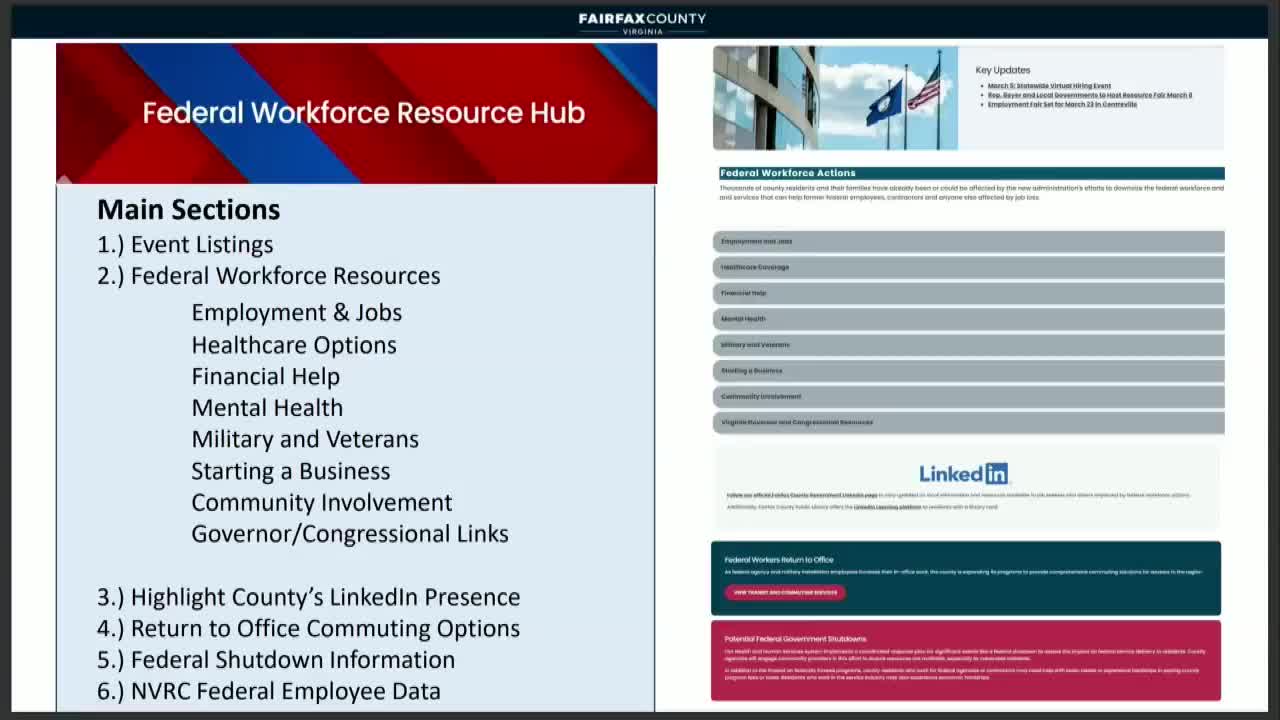
County short-term responses already in place include a Fairfax County federal workforce resource hub (first posted Feb. 18 and updated Feb. 28) that aggregates job listings, mental-health and financial help, and events; printed flyers and boosted social-media messaging; and recorded and live webinars to help affected workers with job search, reskilling and entrepreneurship. Tony Castrilli, director of public affairs for Fairfax County, said the hub exceeded roughly 29,000 page views since launch and that county communications and partner outreach will continue to amplify available services. The EDA and partners are running lunchtime and evening webinars, entrepreneurship “101” sessions, and a Talent Up program that aims to accelerate reskilling and work-based learning.
Committee members and presenters described near-term next steps rather than formal policy actions. Rebecca Madre (committee staff) said the EDA is working with a third party on an economic impact study and that a follow-up meeting is planned for March 25 to review further findings; a separate session with a state-level committee was noted as tentatively planned for April 8 in Northern Virginia. Supervisors discussed possible state-level requests, including a suggestion to ask the governor to consider an emergency increase in weekly unemployment benefits; no motion or vote on such a letter was recorded.
Several supervisors and presenters urged a region-wide, coordinated response and repeated the need to diversify Northern Virginia’s economy beyond federal contracting. Julie [last name not specified], president and CEO of the Northern Virginia Chamber, called the moment a “clarion call” to accelerate growth in emerging sectors (for example, AI and space commercialization) and to expand reskilling and affordable-housing efforts to retain workers and their families.
The presenters and committee emphasized two practical constraints: (1) the most reliable economic indicators will take weeks to months to reflect the full scope of layoffs and contract losses because of reporting lags and data-method differences; and (2) many downstream impacts — lost small-business revenue, reduced local services, household income decline and migration of affected families to lower-cost areas — will be difficult to measure precisely.
The committee closed with a pledge to continue monitoring and to bring additional federal and state officials, contractors and workforce partners into future meetings. County staff said they will post recordings of EDA webinars and continue to expand the NVRC and county federal-monitoring dashboards so members of the public and employers can track developments.