Get Full Government Meeting Transcripts, Videos, & Alerts Forever!
Get email alerts on the Industrial Land Use topic
No spam. Unsubscribe anytime.
Fairfax staff report limited industrial land, recommend strict criteria for conversions to housing
Summary
County planning staff presented consultant findings that industrial demand has shifted toward large warehouse and data center uses while available industrial parcels in Fairfax are limited; draft policy plan language would require community benefits and higher affordable-housing thresholds for any conversion of industrial land to residential.
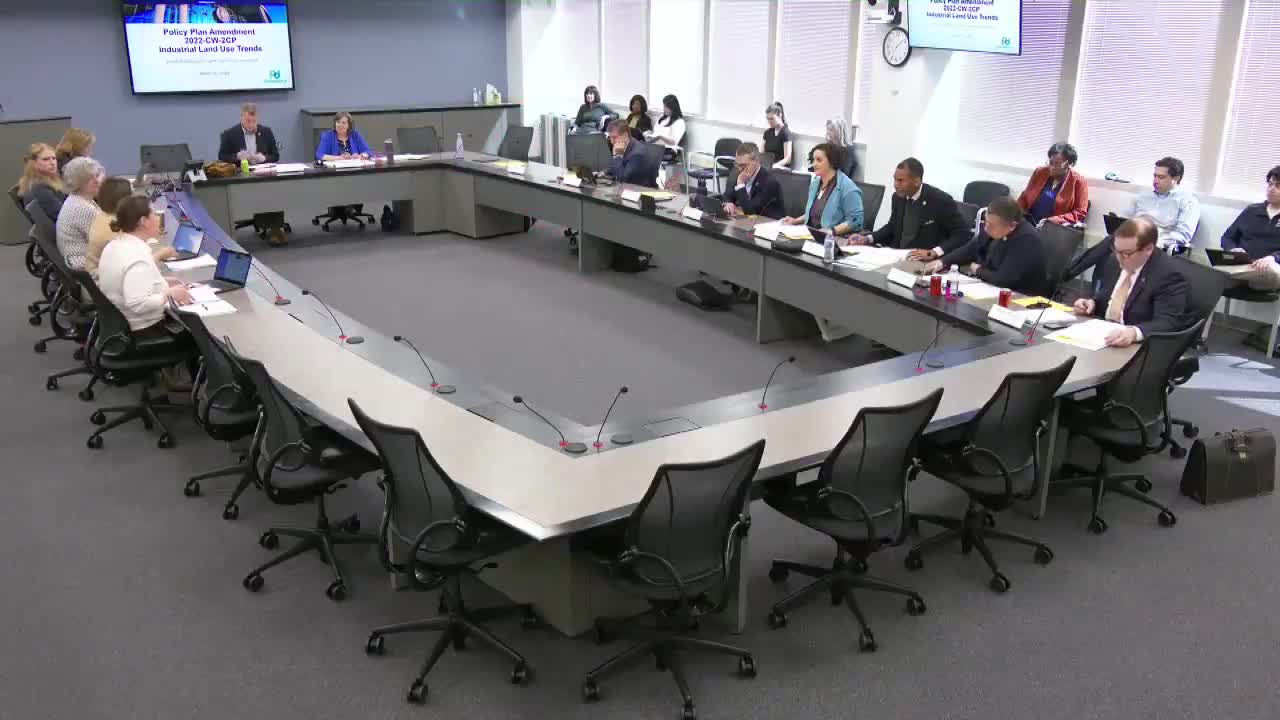
Kelly Atkinson, of the Fairfax County Department of Planning and Development, told the Land Use Policy Committee that DPD retained Clarion to review industrial land use trends and inform the county’s comprehensive plan update.
The consultant found recent industrial demand concentrated in warehouse and distribution (notably 100,000–500,000 square-foot facilities), auto and construction machinery supply chains, and data centers. “Warehousing and distribution represented the largest demand for space at 22%,” Atkinson said, and the report highlighted that data centers can pay higher land prices and require large tracts.
The study also found a tight local market: the county’s industrial inventory is about 38,000,000 square feet and the countywide industrial vacancy rate is roughly 4.9%, Atkinson said. She told the committee the county has about 8,200 acres zoned industrial (roughly 3% of the county) and about 3,700 acres shown as planned industrial on the comprehensive plan map. Staff reported roughly 250 acres of zoned industrial vacant across 67 parcels, with an average vacant parcel size of about 4 acres and the largest around 21 acres.
Clarion’s recommendations, which DPD is using to draft policy-plan text, include keeping most designated industrial land for industrial uses and requiring that any nominations to convert industrial land to residential be tied to commensurate community benefits. As explained to the committee, such benefits could include using the high end of a site’s density range and providing a larger percentage of affordable units or units at a lower area median income threshold.
The report recommends priority reviews and possible area-plan amendments in industrial concentrations—Beltway South, the I-95 corridor, and Ravensworth—and clarifying land-use vision for special planning areas such as Tysons, the Dulles Suburban Center, and areas along the Orange and Silver metro lines. Staff emphasized that recommendations for area-plan changes would need separate Board authorization.
Supervisors and the committee debated two policy approaches: retaining industrial zoning where feasible versus assessing whether some existing uses currently in industrial zones could be relocated or rezoned to free land for heavier industrial uses. The committee chair urged staff to analyze which industrial parcels are occupied by uses that do not require industrial zoning and therefore could be candidates for reclassification.
Several supervisors asked staff to add an “as-built” column to maps—distinguishing planned/zoned industrial from what is actually built and occupied—and to evaluate industrial parcels near transit stations differently from isolated heavy-industrial sites. Committee members stressed compatibility questions where residential growth abuts industrial uses and asked staff to identify where light industrial, office-park conversions, or mixed-use scenarios might be appropriate.
Tracy Strunk, Director of the Department of Planning and Development, said staff has reviewed ZMOD and use permissions and agreed further work would be appropriate to identify nonessential uses occupying industrial zones.
Staff said they are actively drafting plan text, will publish a community feedback report later this month, will continue outreach through May as draft text is released, and are targeting public hearings this fall as directed by the Board. The committee did not take formal action at this meeting; staff sought input to refine draft policy language.