Get Full Government Meeting Transcripts, Videos, & Alerts Forever!
Get email alerts on the Fy2026 Budget topic
No spam. Unsubscribe anytime.
Fairfax officials propose FY2026 budget that would raise real‑estate rate, fund negotiated pay increases and hold potential meals tax discussion
Summary
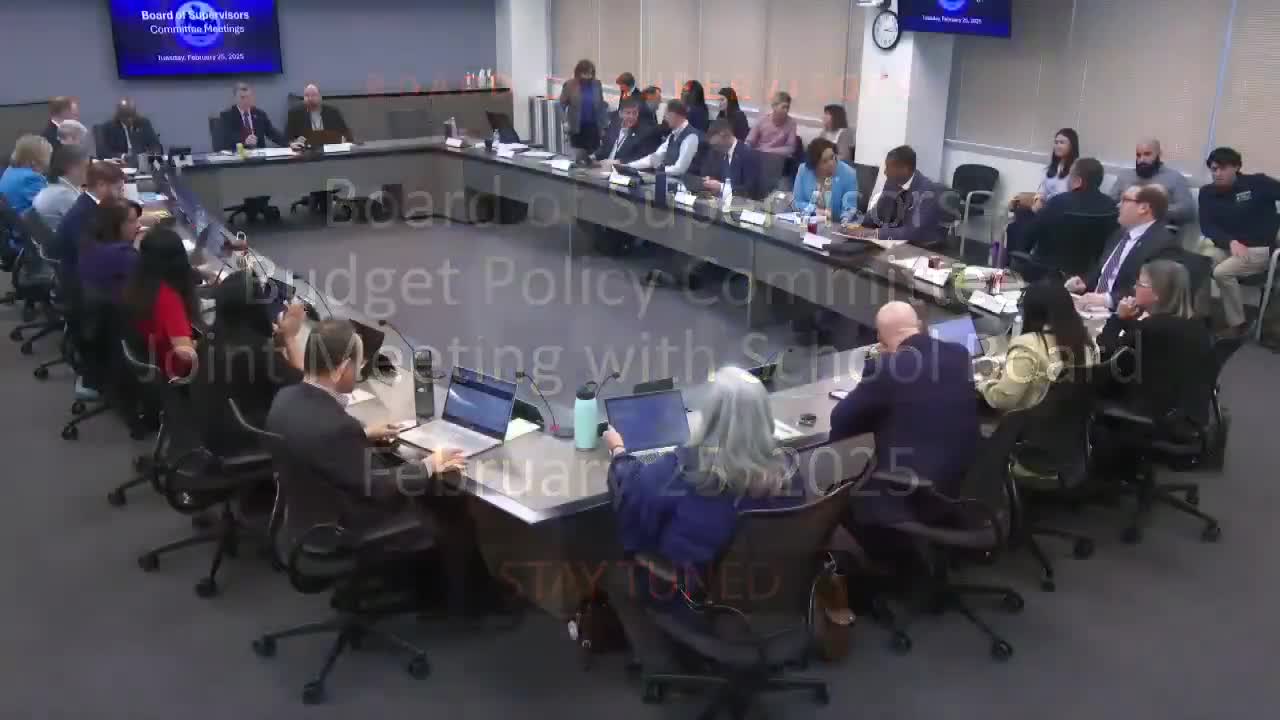
Fairfax County and Fairfax County Public Schools on Feb. 25 released their advertised FY2026 budgets, proposing a 1.5‑cent real‑estate tax increase to $1.14 to help fund negotiated pay increases and other priorities, while school leaders warned that uncertainty over roughly $170 million in federal grants could force deeper cuts.
Fairfax County and Fairfax County Public Schools on Feb. 25 released their advertised FY2026 budgets, proposing a 1.5‑cent increase in the real‑estate tax rate to $1.14 per $100 of assessed value, new and held increases in hospitality taxes, and funding to fully pay negotiated compensation increases for public‑safety employees and school staff.
The county presentation said the 1.5‑cent real‑estate increase would generate about $51,000,000; officials also proposed adding another quarter‑penny dedicated to affordable housing (bringing affordable‑housing dedication to 1.25 pennies). The county proposal would raise the current rate to $1.14 and, officials said, would result in an average tax‑bill increase of about $638 for homeowners.
Why it matters: the advertised budgets try to balance rising personnel costs — including fully funding collective bargaining for public‑safety employees and negotiated school compensation — with shrinking revenues in some categories and growing uncertainty about federal support that schools and county programs now rely on.
County officials told the joint committee that most of the revenue growth driving the proposal comes from real estate: the county’s tax base is projected to grow 5.34% for FY2026, driven by residential equalization of 6.17%; residential property now represents about 78% of the county real‑estate base. At the same time, commercial equalization continues to soften and “office elevator” property values are down, the presenters said.
Christina Jackson, Fairfax County chief financial officer, summarized the county package and the offsets included to cover other priorities: “This budget does share available revenue proportionally with the schools,” she said, and it includes funding for compensation programs, contract adjustments, IT investments and lease escalations, offset by nearly $60,000,000 in agency reductions. She told the committee the proposed 1.5‑cent change plus other adjustments reflect the county’s attempt to fund compensation and school transfers while holding other spending in check.
School leaders outlined a larger set of risks facing FCPS. Lee (Leigh) Burden, FCPS chief financial officer, said the school system’s advertised request includes a county transfer request of about $268.26 million (up from roughly $254 million the prior year) and assumes the governor’s introduced budget projections for state aid and a 3% state compensation assumption. Burden noted that the state typically pays roughly 20% of salary increases the schools receive; the remainder must be funded locally.
School Board budget chair Carl McDaniel warned that federal funding uncertainty poses an immediate, material risk. “Right now, FCPS depends on about $170,000,000 of federal funding,” McDaniel said. “We could wake up tomorrow and realize that money is gone.” In public remarks and later discussion he broke that federal total into program components cited by staff: roughly $58,000,000 for school nutrition, about $50,000,000 for special education and roughly another $50,000,000 for English‑learner supports. McDaniel and other school officials said loss of those dollars would directly affect meals, special‑education staffing and English‑learner programs.
The school board and county presentations also described the compensation environment. School negotiators and FCPS said the schools’ bargaining coalition negotiated a three‑year contract that averaged roughly 7% in year one (a number negotiators reduced from a 12.5% opening demand), with smaller, specified increases in years two and three; FCPS staff estimated the advertised budget leaves a roughly $121,000,000 gap between baseline resources and what would be needed to fully fund all school compensation needs as presented. County officials said the county proposal includes funding to fully fund negotiated agreements for public‑safety employees (average increases between 5.5% and 6.5%) and a 2% cost‑of‑living adjustment for non‑represented county employees.
Officials also presented potential new or increased local taxes as options. The county proposed increasing the transient‑occupancy (hotel) tax from 4% to 6%; of that 2‑point increase, staff recommended 1 percentage point could be used for general purposes and the other 1 point be reserved for tourism‑related uses pending further discussion. Staff recommended the Board consider advertising a food‑and‑beverage (meals) tax to allow public debate; staff estimates each 1% on a meals tax would yield about $35,000,000 in a full year and that a 3% tax could generate net new revenue in a half‑year of roughly $48,000,000 (because any 2026 implementation would be half‑year), a level that could eliminate the need to raise the real‑estate tax rate in FY2026 under some scenarios.
The county budget also shows an extensive reduction exercise: officials said the FY2026 proposal eliminates 208 positions and incorporates about $59,000,000 in agency reductions; combined with prior years, county officials said reductions total roughly $100,000,000 over the past three fiscal years. FCPS officials said the schools have pursued cost avoidance, fee adjustments and vacancy management to capture roughly $51,000,000 in base savings for the coming year and that the division has cut about $850,000,000 over the past decade through reductions and efficiencies.
Board members on both sides pressed staff on details and next steps. Several elected officials emphasized the Commonwealth’s role in school funding and the county’s limited authority to offset state shortfalls; School Board Chair Jeff (Carl) Frisch urged collaboration with Richmond to fund recommended changes by JLARC, noting a prior JLARC estimate that full implementation of its recommendations would provide substantially more state funding for K‑12 in Fairfax County. County Chair Bryan J. McKay (Chairman MacKay) underscored timing for county decisions: the Board must advertise a maximum real‑estate tax rate and authorize advertisement of any meals tax by March 18, and the Board’s budget adoption is scheduled for May 13. “The board has until March 18 to make that decision,” MacKay said.
Formal actions recorded at the meeting were limited and procedural. The Fairfax County School Board voted unanimously to approve written requests from two members to attend the Feb. 25 meeting remotely for medical reasons: the board approved Ms. Anderson’s remote attendance and Ms. Marin’s remote attendance; school board minutes showed both requests passed unanimously by board members present.
What’s next: the Board of Supervisors has two additional budget committee meetings scheduled on March 11 and March 25; March 18 is the statutory advertisement deadline for a tax‑rate ceiling and for authorizing advertisement of any new meals or transient‑occupancy tax changes. Final board adoption of the FY2026 budget is planned for May 13.
Reported numbers and program names are those presented to the joint committee; where staff used shorthand (for example, “SOQ” for the Commonwealth’s Standards of Quality funding), the article uses the same terms when quoting presenters but notes that many school funding decisions are conditioned on the General Assembly’s final budget actions.