Get Full Government Meeting Transcripts, Videos, & Alerts Forever!
Get email alerts on the Transit Student Programs topic
No spam. Unsubscribe anytime.
Free student bus‑pass program nears 4 million rides; county pilot offers 50% fare reduction for eligible riders
Summary
Fairfax County’s free student bus‑pass program has generated nearly 4 million Connector trips since 2015, and county staff described a state‑funded pilot that halves fares for eligible riders as officials seek to expand outreach and infrastructure where student ridership is concentrated.
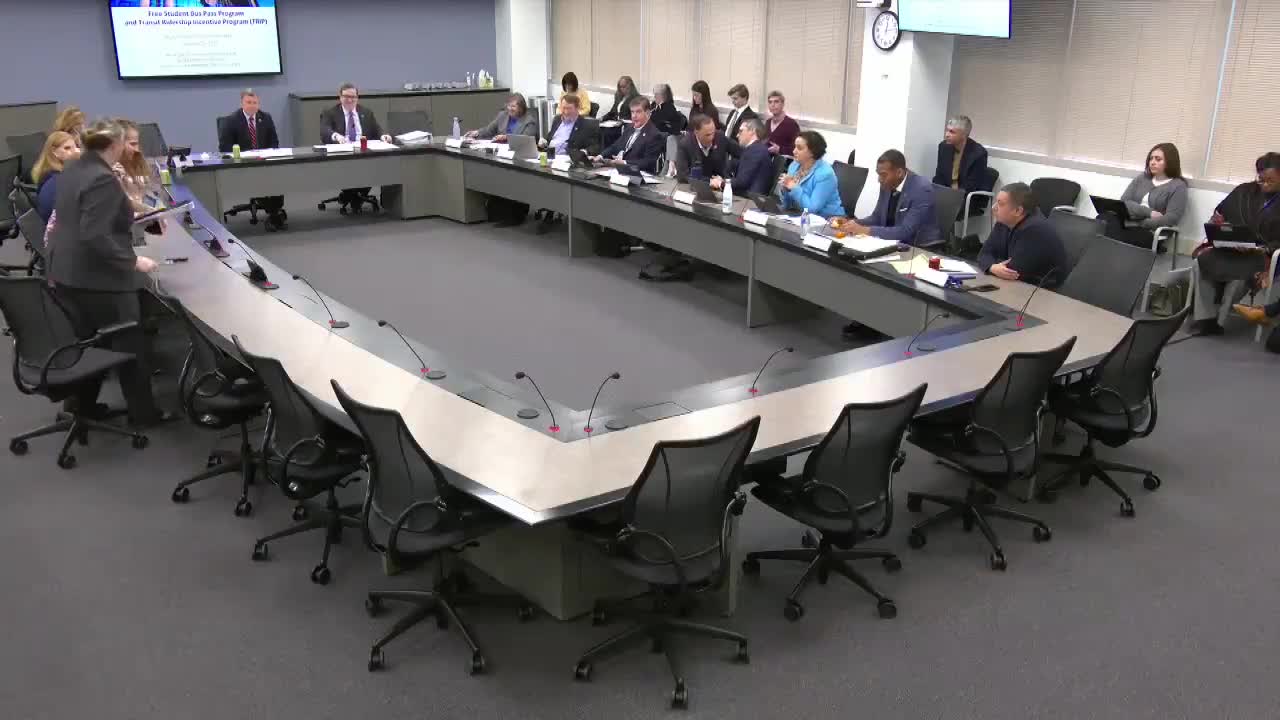
Fairfax County transportation staff told the Transportation Committee that the county’s free student bus‑pass program and a separate fare‑reduction pilot aimed at lowering cost barriers to transit have produced thousands of rides and are candidates for expanded outreach.
Olsias, who identified himself as coordinator of the free student bus pass program, said the student pass program has accounted for about 3.5 million trips since 2015. Staff also described a “plus Metrobus” expansion launched in September 2022 that extended free access at selected schools near Metro service; that expansion has added roughly a half‑million trips. Taken together, staff said the two programs will surpass 4 million trips in February 2025.
The county also described Trip, a ridership incentive program funded through a Virginia Department of Rail and Public Transportation grant. Trip provides a 50 percent fare reduction for eligible Fairfax Connector riders; eligibility is determined using neighborhood‑level criteria from the county’s Transportation Options Programs and Services (TOPS) program. Director Greg Stevenson said Trip began in spring 2023 and has grown from initial months of a few hundred rides to roughly 1,000 rides per month in 2024; staff said they are targeting growth into the 2,000–3,000 rides per month range.
“Often a subsidy is a big draw for people,” Sam Chansman said during an earlier discussion of TDM strategies — a point staff repeated when discussing how the student and Trip programs reduce cost barriers. In public examples cited during the presentation, a parent at Chantilly High School described appreciation that a son could use the Connector to travel for free, and a Robinson Secondary School student said, “this program enables her to get to her part‑time job,” a specific instance staff used to illustrate day‑to‑day benefits.
Staff described continuing outreach and promotion: multilingual printed materials and animations, school visits, participation in community fairs, social‑media posts and partnerships with nonprofit and service providers such as Neighborhood and Community Services and the Office to Prevent and End Homelessness. Supervisors urged staff to assess which middle and high schools lack convenient Connector or Metrobus stops, to ensure stops are proximate to school entrances and to prioritize passenger amenities such as shelters and trash cans at high‑use locations. Several supervisors suggested exploring connections with bike‑share or other first‑mile/last‑mile services where appropriate.
On funding, staff said Trip was established with a DRPT grant that funded specialized smart cards and outreach materials; the grant subsidizes half of the fare for eligible users and is a multi‑year step‑down award that expires in 2026. Staff said they will evaluate options for continuing or expanding funding as the grant end date approaches and will report back on user counts and per‑user trip rates requested by supervisors.
There was no formal committee action during the presentation.