Get Full Government Meeting Transcripts, Videos, & Alerts Forever!
Get email alerts on the Active Transportation topic
No spam. Unsubscribe anytime.
Fairfax releases draft Active Transportation network; staff seeks public feedback
Summary
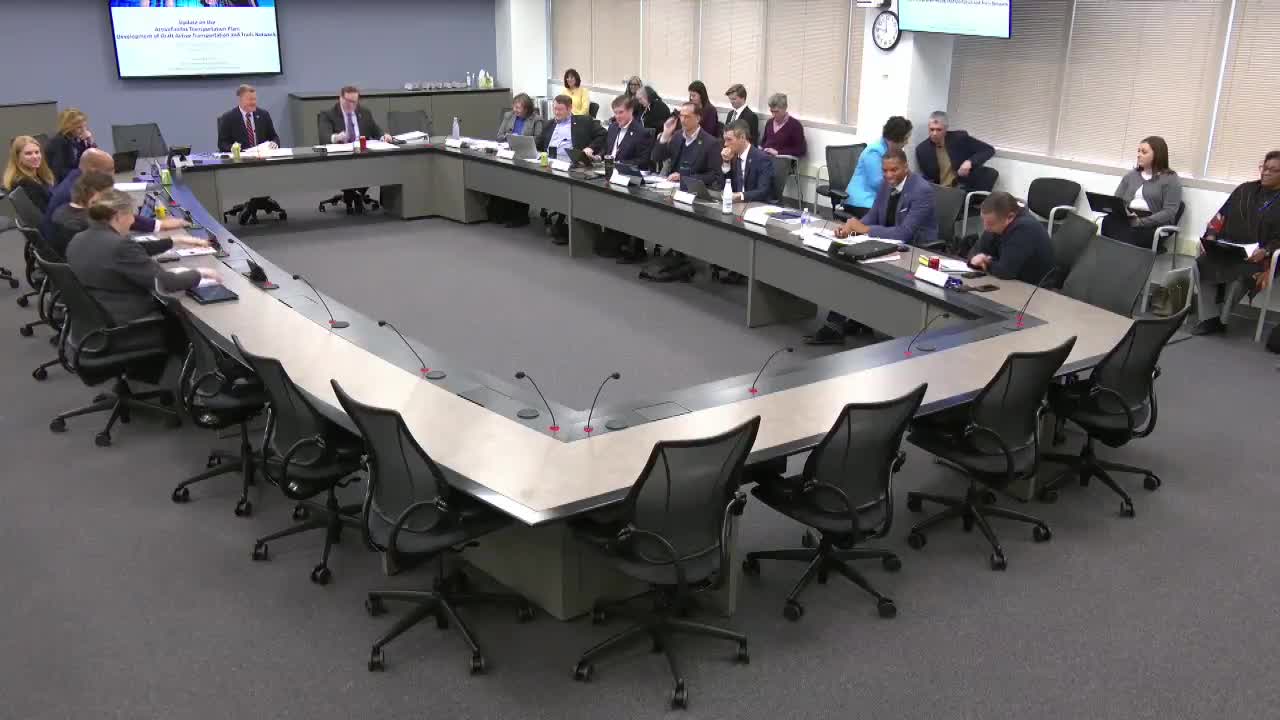
Fairfax County Department of Transportation presented a draft Active Fairfax network and engagement results to the Transportation Committee, describing public preferences for physically separated bicycle facilities and improved sidewalks. Staff is seeking feedback before a comprehensive plan amendment.
Fairfax County staff presented a draft countywide active‑transportation and trail network and associated draft comprehensive‑plan language, and asked the Transportation Committee for review and comment before moving toward plan‑amendment authorization.
Nicole Winans, an active transportation planner with the Fairfax County Department of Transportation, said the project combined geospatial analysis, interdepartmental coordination and an extensive public engagement program that ran from August–December 2024. The engagement included 12 in‑person open houses, four virtual meetings, an interactive map that drew about 599 comments and an online survey completed by 425 respondents. Winans said survey respondents showed a strong preference for physically separated bicycle facilities and for enhanced sidewalks: 89 percent of respondents ranked enhanced sidewalks as most comfortable.
Staff said they revised the draft network after the outreach to add clearer map symbology, to provide a baseline facility recommendation (rather than a generic route) while preserving flexibility in the map notes and facility‑selection table, and to change shared‑street recommendations to include lower speed limits and additional speed‑management interventions where shared facilities are proposed. Winans said public comments that were outside county jurisdiction or about map cartography would be catalogued and passed to responsible agencies when appropriate.
The board’s discussion touched on representation and implementation. Chairman McKay asked whether survey and map responses were geographically mapped; staff confirmed the interactive map comments are location‑specific (but anonymous) and that the survey included demographic questions but not a required location field. McKay and other members urged broader outreach and suggested adding a short location field (for example ZIP code) to improve geographic representativeness.
Supervisors raised implementation questions including: how to capture and prioritize smaller, low‑cost “spot” fixes such as crosswalk upgrades; how to work with VDOT on state‑owned roads where VDOT requirements affect design and cost; and whether the county can estimate implementation costs and produce multi‑year priorities. Staff said they will pass public comments about existing conditions to responsible agencies and will use higher‑level comments to inform the policy and programmatic recommendations that are still in development. The presentation listed several ongoing special‑area planning efforts (which will be reflected into the active‑transportation network as they progress), including the Centerville study, the Lord and Coors study, and the Fairfax Center area study.
Winans said staff would welcome committee feedback on the draft network by March 14 and that, after addressing outstanding issues and coordinating with special‑area plans, the county would seek comprehensive‑plan amendment authorization and further public engagement.
There was no formal committee vote at the meeting.