
House Education committee passes SB 625, adds caps and appeal process for Education Freedom Accounts
Get AI-powered insights, summaries, and transcripts
Subscribe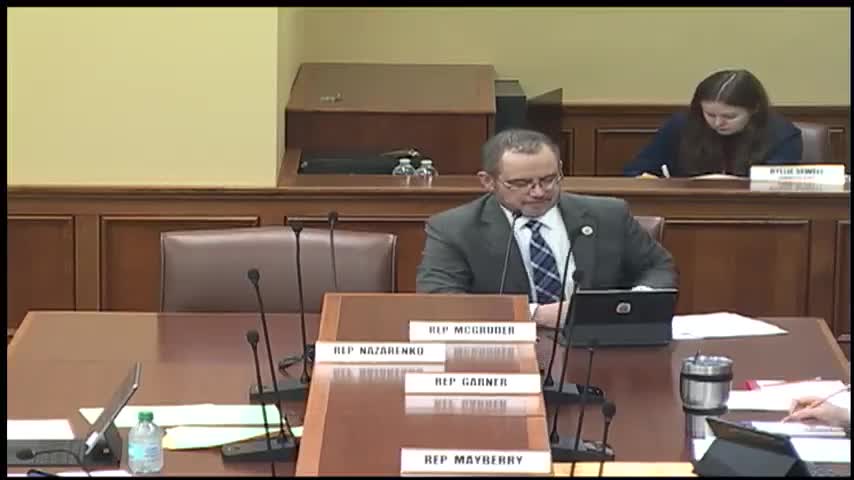
Summary
The Arkansas House Education Committee voted to adopt amendments and pass Senate Bill 625, which clarifies administration of Education Freedom Accounts (EFAs), adds a 25% cap on transportation and extracurricular spending, and creates an appeal route to the State Board for account closures.
LITTLE ROCK — The Arkansas House Education Committee voted to adopt amendments and pass Senate Bill 625 on a voice vote after a multi-hour hearing that included department testimony, lawmakers’ questions and public comment from homeschool families and school-choice advocates.
The measure, presented by state Representative Keith Brooks, makes several changes to the administration of Education Freedom Accounts (EFAs), including specifying an initial application window, adding language that requiring evidence of "intentional misuse" before the Department of Education pursues sanctions, and limiting transportation and extracurricular reimbursements to 25% of a student’s EFA in a year.
Why it matters: EFAs are a state-funded program that provides families with a flexible account to pay for private school tuition, courses, therapies and other approved education expenses. Supporters say the bill clarifies rules and strengthens program sustainability as enrollment grows; opponents and some parents said the new limits and expedited implementation could disrupt families midyear.
Representative Keith Brooks, the bill sponsor, told the committee the bill “does nothing to change the amount of dollars that flow to the family for the benefit of the student,” and said the measure seeks to “enhance what we’re doing in the state of Arkansas for long term sustainability of our EFA program.” Brooks also described the change to the initial application window, moving the main filing period to February 1 through June 1 and allowing the department discretion to accept later applications for specific situations such as students moving into the state.
Courtney Salas Ford, a Department of Education staff member who joined Brooks at the table, described how the department and the account vendor, Class Wallet, will collaborate on safeguards and reviews of suspicious transactions. She said staff review daily approval activity but acknowledged that with nearly 40,000 participating students the department cannot manually review every purchase and must rely on software flags and follow-up investigations.
On misuse and appeals: SB 625 inserts the phrase "evidence of intentional misuse" where the law previously referred to evidence of misuse, language intended to distinguish clerical or accidental errors from deliberate fraud. Brooks said the clarification is meant to ensure the department does not penalize families for simple mistakes. The bill also allows a parent to appeal a decision to close a participating student’s account to the State Board under rules the board will adopt.
On spending caps: Brooks explained that transportation reimbursements are set at 52¢ per mile and that the bill limits transportation and extracurricular spending to 25% of the yearly EFA amount. He gave figures in committee to illustrate the cap: 25% of the EFA this coming year is "$1,713," which he described as roughly $150 per month; he said that amount would increase next year as the EFA allocation rises. (The committee record did not include a department-produced table showing the program’s full per-student allocation.)
Public comment and concerns: Multiple homeschool parents and program advocates spoke during public comment. Paula Bean, a homeschool mother, said she supports EFAs and urged caution about news coverage that she said mischaracterized how families use funds: “I am so thankful for the state of Arkansas. I am so thankful for the EFA,” Bean said, describing a mix of curriculum, therapy tools and music lessons funded for her child. Alicia Wilkins, another homeschool parent, asked lawmakers to “trust us with the funds.” Tiffany Gaines, representing the Arkansas homeschooling community, criticized what she called incomplete reporting about EFA spending and urged the committee to let the program run so its effects can be fully observed.
Outside expert testimony: Dr. Matthew Ladner, who advised Arizona’s original ESA program and identified himself as an independent senior adviser, urged caution about strict caps on enrichment spending. “ESAs in every state operate as a system of ordered liberty, not as a free-for-all,” he said, and presented national comparisons showing low documented fraud in similar programs.
Committee action and outcome: The committee adopted the floor amendment language presented by Brooks and the Department of Education, then voted to pass SB 625 as amended on a voice vote. Representative Brooks moved adoption and later moved the committee to pass the bill as amended; members responded on voice votes with no recorded roll-call tallies in the committee record.
Votes at a glance: The committee’s record also shows earlier voice votes to concur in senate amendments to several House bills during the same meeting. Those items were handled by voice vote with no roll-call tallies provided in the transcript: concurrence in the Senate amendment to HB 1810 (concurred), concurrence in two Senate amendments to HB 1812 (amendments adopted, concurrence recorded), concurrence in the Senate amendment to HB 1484 (concurred) and concurrence in the Senate amendment to HB 1642 (concurred).