Get Full Government Meeting Transcripts, Videos, & Alerts Forever!
State highlights new universal functional-assessment tool for IDD waiver after five years of testing
Summary
State presenters described a five-year development and testing process for a new universal assessment (MFEI) to determine functional eligibility for the intellectual and developmental disability (IDD) waiver, reporting high concordance with the current BASIS assessment and outlining a phased rollout for new and existing participants.
Dr. Windhamel, the project presenter, told stakeholders the state has developed a universal assessment intended to determine functional eligibility for the IDD waiver and to produce comparable data across multiple waiver programs. “Our goal is to have a universal assessment, with a common core of items that can apply across all populations,” she said, describing a five‑year, iterative development process that included advisory boards, focus groups and software testing.
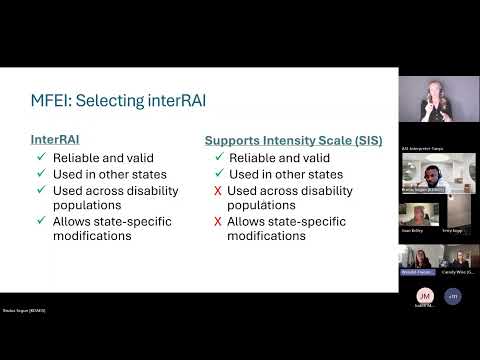
The new instrument (referred to in materials and the webinar as the MFEI) was selected and modified to preserve existing institutional level‑of‑care criteria and to allow state‑specific adaptations, presenters said. That approach, they said, avoids creating two parallel assessment systems and gives the state comparable data across previously siloed waivers.
Why this matters: advocates and family members on the call pressed for clarity about whether the MFEI would change who qualifies for services, how behavior is measured, and whether assessment data could be used for rate setting. Presenters said the tool’s primary function is to determine functional eligibility for the IDD waiver, but that policymakers are still discussing whether MFEI or the related care‑planning data will inform acuity‑based rate setting.
State presenters described how the tool was chosen and changed. Project staff reviewed several instruments used by other states, including the Supports Intensity Scale (SIS) and options based on the BASIS/DDP, and selected a vendor instrument that permitted state modifications and a single software environment. That…
Already have an account? Log in
Subscribe to keep reading
Unlock the rest of this article — and every article on Citizen Portal.
- Unlimited articles
- AI-powered breakdowns of topics, speakers, decisions, and budgets
- Instant alerts when your location has a new meeting
- Follow topics and more locations
- 1,000 AI Insights / month, plus AI Chat