Get Full Government Meeting Transcripts, Videos, & Alerts Forever!
Get email alerts on the Waiver Functional Assessment topic
No spam. Unsubscribe anytime.
State highlights new universal functional-assessment tool for IDD waiver after five years of testing
Summary
State presenters described a five-year development and testing process for a new universal assessment (MFEI) to determine functional eligibility for the intellectual and developmental disability (IDD) waiver, reporting high concordance with the current BASIS assessment and outlining a phased rollout for new and existing participants.
Dr. Windhamel, the project presenter, told stakeholders the state has developed a universal assessment intended to determine functional eligibility for the IDD waiver and to produce comparable data across multiple waiver programs. “Our goal is to have a universal assessment, with a common core of items that can apply across all populations,” she said, describing a five‑year, iterative development process that included advisory boards, focus groups and software testing.
The new instrument (referred to in materials and the webinar as the MFEI) was selected and modified to preserve existing institutional level‑of‑care criteria and to allow state‑specific adaptations, presenters said. That approach, they said, avoids creating two parallel assessment systems and gives the state comparable data across previously siloed waivers.
Why this matters: advocates and family members on the call pressed for clarity about whether the MFEI would change who qualifies for services, how behavior is measured, and whether assessment data could be used for rate setting. Presenters said the tool’s primary function is to determine functional eligibility for the IDD waiver, but that policymakers are still discussing whether MFEI or the related care‑planning data will inform acuity‑based rate setting.
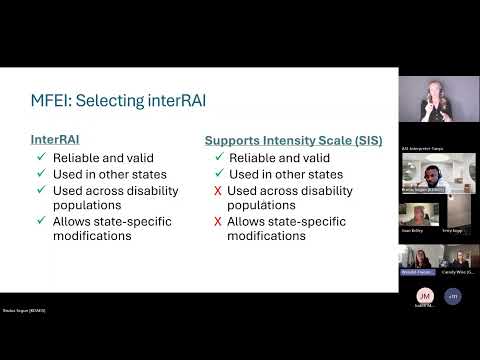
State presenters described how the tool was chosen and changed. Project staff reviewed several instruments used by other states, including the Supports Intensity Scale (SIS) and options based on the BASIS/DDP, and selected a vendor instrument that permitted state modifications and a single software environment. That flexibility allowed the team to add measures Kansas stakeholders said were missing — for example, items to assess vulnerability to victimization, emergency judgment, and age‑appropriate expectations for youth — and to include an employment supports/referral section not present in BASIS.
Testing and results: assessors and consumers tested the draft tool across urban and rural settings. According to the presentation, testing included about 450 adults and 189 youth. Presenters said assessors received training and provided qualitative feedback; the team adjusted the instrument and scoring algorithm through repeated rounds of testing and advisory‑board review. For adults, presenters reported that both the new tool and BASIS agreed on eligibility in roughly 96.2 percent of cases (both screened in) and 2.2 percent of cases (both screened out), with less than 1 percent of cases where the new tool screened in and BASIS screened out and about 0.7 percent in the reverse — yielding an overall concordance the presenter described as about 98.4 percent. For youth, presenters reported a similarly high match (about 98–99 percent in testing).
Behavior measurement and algorithm changes: presenters said a major redesign was how behavior is scored. BASIS focuses on frequency of behaviors; the new instrument emphasizes intensity and level of support required (how often and what level of support is needed), which the project team said should reduce year‑to‑year score fluctuation tied to support availability. Presenters said the algorithm derives from documented support needs rather than a raw frequency count.
Data collection details and supports: presenters said behavioral data in the assessment use a three‑day lookback for regular behavior items, with an option to indicate a behavior is “present but not exhibited in the last three days.” They also said that a documented behavior support plan — which must include more than a three‑day data window under regulation — remains a separate requirement and should inform the assessment.
Implementation timeline and grandfathering: presenters said new functional‑eligibility assessments for the IDD waiver would use the MFEI beginning July 1, 2025. Existing waiver participants’ current tiers would carry forward and not be affected immediately; presenters said that protection for current participants would remain at least until July 1, 2026 while the state completes transition planning.
Frequency of reassessment: presenters said annual reassessments remain a federal requirement tied to Centers for Medicare & Medicaid Services (CMS) rules; the team reviewed whether less frequent reassessment might be possible, but said CMS approvals of a two‑year cadence are not clearly available now. Presenters noted process improvements — for example, carrying forward prior assessment information so assessors focus on changes rather than re‑asking every item — as a way to reduce burden.
Care plans and software: project staff said the person‑centered support plan (PCSP) format will be revised in coordination with Charting the LifeCourse work led by a contracted partner (UMKC). The state will continue stakeholder workgroups to align PCSPs with the assessment and to ensure consistency where support needs are documented and met.
Family and stakeholder concerns: family members on the call asked whether guardians could access the assessment form, whether youth might be rated differently on the new tool, and whether someone could lose waiver eligibility and return to the wait list. Presenters said families’ requests (for access to the assessment instrument) would be taken back for state consideration; they emphasized testing results that showed a very low risk of losing eligibility because the new instrument matched BASIS closely in testing and noted that, if discrepancies occur, families retain appeal rights and the state can review cases where BASIS and the new tool differ.
Rate setting and data use: participants asked whether MFEI data might be used for acuity‑based rate setting. Presenters said the MFEI’s primary function is eligibility determination, but that policy discussions are ongoing and that the assessment and care‑planning data could be used by policymakers as part of future rate‑setting work. The presenters said they would revise public language to reflect that the MFEI’s primary purpose is eligibility while acknowledging potential future policy uses.
Next steps: presenters said recordings and materials from the webinar will be shared, that leadership and policy staff will continue stakeholder engagement, and that the state will review wording about how assessment data could be used for rates. The project team urged providers and families to ensure PCSPs accurately reflect current supports, since consistency between the assessment and the PCSP will be important during transition.