Get Full Government Meeting Transcripts, Videos, & Alerts Forever!
Get email alerts on the Property Taxes Reassessment topic
No spam. Unsubscribe anytime.
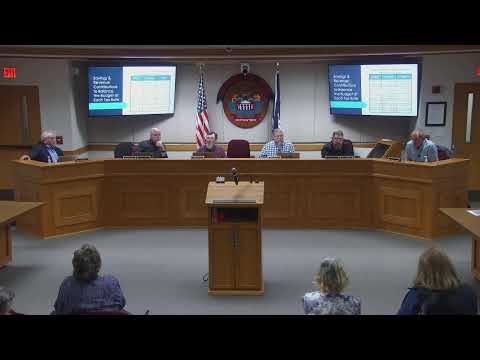
Carroll County supervisors hear widespread public concern over reassessments as budget options reviewed
Summary
Residents told the Carroll County Board of Supervisors during a March 24 public hearing that recent reassessments caused steep tax increases; supervisors and staff discussed advertised tax-rate scenarios, use of savings, and potential new revenue sources including a cigarette tax.
Residents packed the Carroll County Board of Supervisors’ public hearing March 24 to protest recent property reassessments that many said would sharply raise their tax bills, while county staff and supervisors reviewed budget options and how much of county savings might be used to lower the advertised tax rate.
The most immediate concern came during the advertised-tax-rate public hearing. “I live in Fancy Gap, and my taxes went up 60%,” said Tony Marshall, a Fancy Gap resident. Other residents described single-parcel increases they said reached 49% and higher. “My house and the land the value increased $70,000, which was like a 49% increase,” said Nancy Beasley. Aaron Hager, who said he built a house three years ago, told the supervisors: “As it stands right now, even if the tax rate was reduced to 40¢, my real estate taxes will increase 40%.”
The concerns focused on how reassessments were calculated, inconsistent increases among neighboring parcels, and limited public notice of appeal and hearing procedures. A resident who filed an appeal said she had been told the reassessment hearing would be on a different day; another said many people in the county did not know how to file appeals. “Your website ... it's very confusing,” said Angela Boyette of Woodlawn, urging clearer public notice of hearings and appeal opportunities.
Why it matters: The board must set a tax rate to fund schools, emergency medical services (EMS) and county operations. Staff presented revenue scenarios tied to different real-estate tax rates and how much of the county’s savings would be needed to balance the budget at each rate. Several supervisors warned that drawing heavily on savings this year would increase pressure on future budgets.
Budget review and options
County staff and the board discussed a range of tax-rate options, with staff materials showing scenarios from roughly 40¢ (revenue neutral) up to the advertised 49¢. Staff reported that the board previously transferred $5,500,000 from the capital improvement plan (CIP) into the general fund after removing the pool and changing an EMS facility project; that transfer is already reflected in the current fund balance. Staff said modest expenditure cuts and one-time uses of savings would reduce the needed rate from a theoretical mid-70¢ level (if no reassessment changes were made) down toward the advertised number, but not without drawing on reserves.
Justin (staff member) said staff had cut about $200,000 from the draft budget through reduced tourism and events spending and other line-item trims. On possible new revenue, staff estimated a local cigarette tax could yield roughly $200,000 annually, but cautioned receipts vary by local participation and retail activity. The board discussed whether to use unallocated savings to soften the property-tax impact; supervisors repeatedly noted that using large amounts of fund balance this year would require either new revenue or additional savings in subsequent years to avoid breaching fund-balance policy.
Supervisors stressed competing priorities. “We all voted two months ago to fully fund our EMS,” said Supervisor Early, noting the draft budget includes a roughly $640,000 increase for EMS that the board had previously committed to. Other supervisors said state-driven school funding changes and mandated cost increases — including retirement and benefit rates — add recurring pressure to the county budget.
Appeals, assessment process and next steps
Public commenters and several supervisors asked for clearer outreach about appeal deadlines and the board of equalization, which residents were told would be advertised; staff said roughly 3,000 appeals had been filed and that further review through the board of equalization could extend past the date the first tax bills are mailed. Staff said that if an appeal is resolved after a tax bill is issued, successful appellants generally receive a credit on the second half of their bill or a refund.
The board did not vote on a tax rate at the March 24 session; state rules require a separate advertised hearing at least seven days before a final vote. Supervisors asked staff for updated projections, including the effects of property-value changes, potential cigarette-tax revenue, and how long various fund-balance drawdowns would be sustainable.
Ending: Supervisors agreed to continue budget work in the coming weeks, schedule additional budget-committee and one-on-one meetings, and ensure appeal and board-of-equalization information is advertised to the public.