Get Full Government Meeting Transcripts, Videos, & Alerts Forever!
Get email alerts on the Advance Care Planning topic
No spam. Unsubscribe anytime.
DPH revises MOLST training slides, coordinates EMS education to clarify DNR and form use
Summary
Department of Public Health staff and EMS educators reviewed and revised MOLST presentation slides, agreed wording changes to emphasize that MOLST/DNR orders must be followed by EMS, and planned next steps for screenshots, narration and legal review.
Department of Public Health staff and EMS educators reviewed and revised training materials for the Medical Orders for Life-Sustaining Treatment (MOLST) form and planned a coordinated EMS education rollout, meeting participants said.
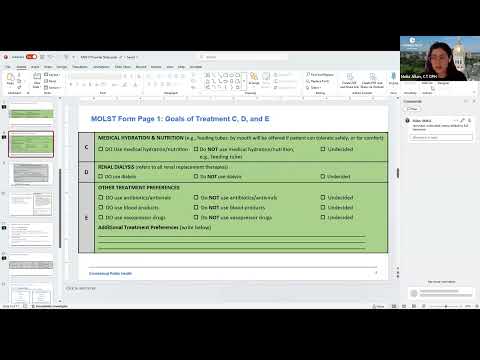
The changes, discussed during a DPH working-group meeting, included swapping slide content, inserting screenshots of the current MOLST form, clarifying the relationship between MOLST and do-not-resuscitate (DNR) orders, and preparing versions for both instructor-led and self-directed learning for EMS personnel. Joel Demers, education coordinator for EMS at the Department of Public Health, led the EMS slide review and told the group, "We took the core, presentation that you had, made a few edits to it, and inserted some language about DNR orders."
Why it matters: MOLST forms and DNR orders guide clinicians and emergency responders about a patient’s treatment preferences at critical moments. The group said clearer slides and consistent screenshots should reduce confusion among EMS clinicians about when to follow orders, where valid forms are kept and how MOLST and DNR interact in prehospital care.
Participants agreed on several substantive changes and follow-up tasks. The group directed staff to replace some text that used permissive language with stronger language clarifying that EMS should honor valid medical orders. At one point Dr. Sussman asked, "For the most, should we say must be honored by EMS?" and participants agreed to adopt firmer wording that mirrors the regulations that the DPH enforces. The team also decided to remove a slide that created potential confusion about pediatric applicability after members agreed the provider slide already covered the point and that including both slides might cause hesitation among EMS staff.
The EMS slides were adjusted for practical use in the field: the presenters highlighted the narrow scope of DNR (applicable at respiratory or cardiac arrest) versus MOLST, which can document broader goals of treatment to be followed before arrest. Demers said EMS staff frequently encounter different forms and storage locations for advance orders and recommended showing screenshots so clinicians would have consistent visual cues. He told the group the training will be offered by a network of about 900 certified EMS instructors and made available on the DPH training platform both as instructor-led and self-directed modules.
Group discussion included form-specific wording and narration notes to avoid unintended barriers. Barbara Jacobs (committee member) asked for clearer language on who should review the MOLST after a patient transfers settings, noting clinicians cannot always know immediately when a patient is admitted elsewhere. "When I read this, I thought that the patient would review it with the individual if they're going to a different setting, not the person who was filling it out initially," Jacobs said; the team agreed to soften the text to emphasize periodic review rather than making review a condition of validity.
Other edits agreed in the session included: using screenshots of the current form to keep slide visuals consistent, spelling out "cardiopulmonary resuscitation" in at least one place for clarity, bolding CPR where helpful, and updating a video clip from CT-train with the DPH logo or re-recording it if the speaker prefers. The group asked for legal review of final wording; a staff member suggested involving Dante to confirm legal sufficiency before publication.
Next steps assigned during the meeting include: Joel Demers to insert the final screenshots and share a live slide link; Melia to circulate the updated deck for live edits; legal review to confirm regulatory language and use of the term "DNR order" where applicable; and the DPH communications staff to post the form on the web when the form is finalized. The group agreed the web page will be updated when the form goes live so the downloadable MOLST is the current official version.
The session produced no formal votes or ordinance-level actions; participants reached consensus on wording changes and slide deletions and assigned staff tasks to finalize the materials and legal review. The revised materials are expected to be used in upcoming EMS instructor sessions and on the DPH learning platform.