Get Full Government Meeting Transcripts, Videos, & Alerts Forever!
Get email alerts on the Battery Energy Storage topic
No spam. Unsubscribe anytime.
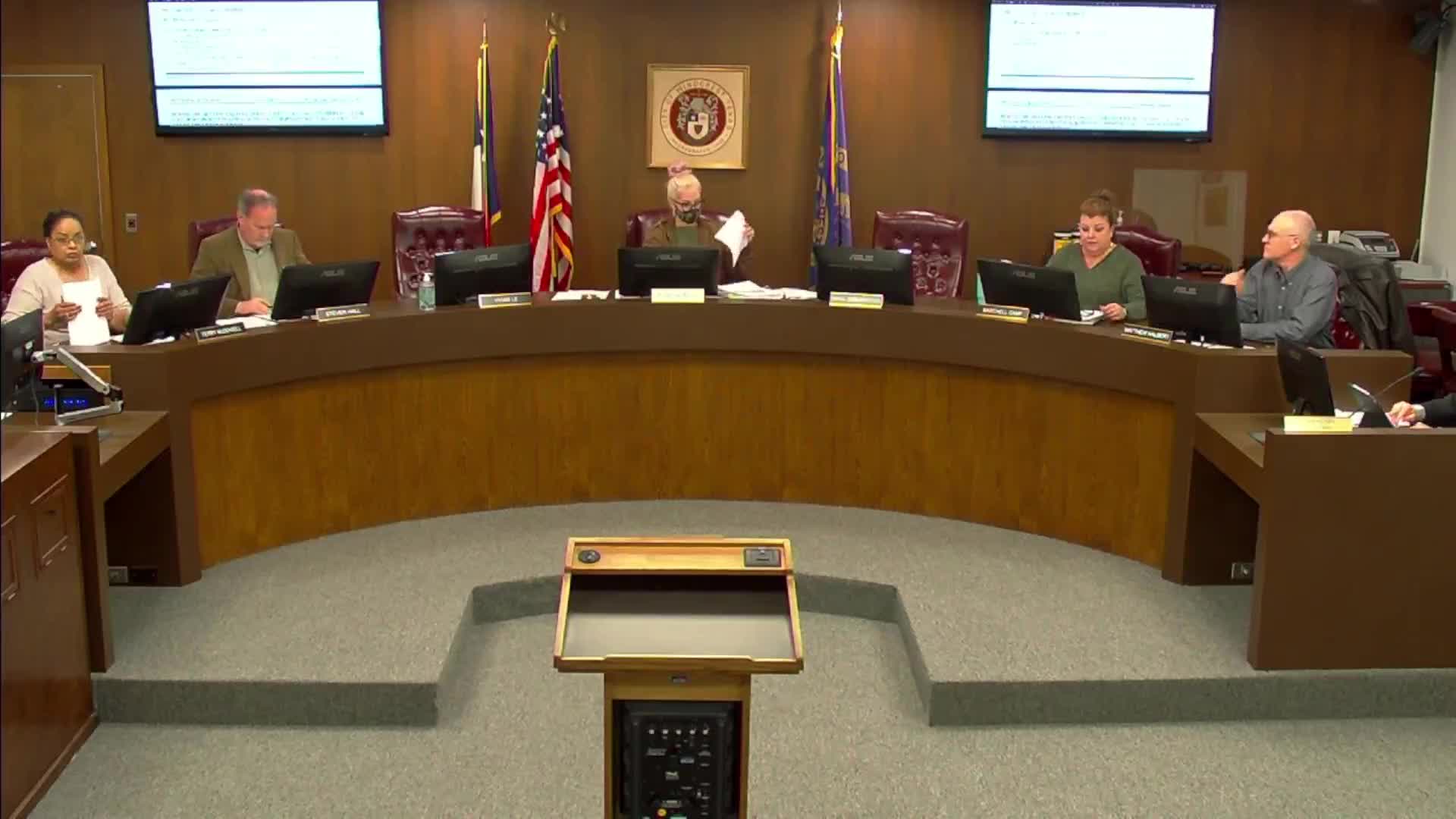
Windcrest planning commission recommends denying rezoning and special-use permit for proposed battery storage at Crestview Baptist property
Summary
After more than an hour of public comment and technical testimony, the Windcrest Planning and Zoning Commission voted unanimously to recommend that City Council deny a request to rezone 8101 Eagle Crest Boulevard and to deny a special-use permit for a battery energy storage facility proposed by Convergent Energy.
The Windcrest Planning and Zoning Commission on Jan. 15 unanimously recommended that the City Council deny a request to rezone 8101 Eagle Crest Boulevard from R-1 (single-family dwelling) to B-1 (neighborhood business) and also recommended denying a special-use permit to allow a battery energy storage facility on a portion of the parcel.
The vote followed a public hearing that drew dozens of residents, multiple technical presenters from the applicant team and a presentation from the city fire marshal. Commission members said their recommendation reflected resident safety and land-use concerns and uncertainty about long-term impacts.
Convergent Energy representatives said the company responded to a CPS Energy request for proposals to support a nearby CPS substation and proposed a battery facility on a roughly 2-acre portion of the Crestview Baptist Church parcel at 8101 Eagle Crest Boulevard. Company representatives described the system as a utility-scale battery installation tied into an adjacent substation; during Q&A the company described the project as a roughly 15-megawatt system and referenced “40 megawatt hours” in discussion of storage capacity. The company said the project would be constructed inside weatherproof, containerized units with internal firewalls, HVAC cooling and ‘‘a 24/7 battery monitoring system’’ and that the operator would offer training and an emergency response plan for local first responders.
Those technical descriptions did not ease residents’ concerns. Dozens of speakers during both the rezoning and the special-use permit hearings said the site is immediately adjacent to homes, a park and a pond, and they told commissioners they feared fire, toxic emissions, noise and reduced property values. Multiple commenters cited previous large battery fires elsewhere and asked why the facility could not be located where larger fire departments and infrastructure exist. “Our community is under an imminent threat,” resident Donnie Thompson said during public comment. Other frequent themes included effects on wildlife, stormwater runoff into Rosillo Creek and whether the small municipal fire department could respond effectively.
Tim Zellnick, Windcrest’s fire marshal, told the commission the city’s response capabilities would be “greatly impacted” by a major battery fire. “You pretty much just let it burn out,” he said, describing industry guidance for certain thermal-runaway incidents and noting that prolonged suppression could require millions of gallons of water and would produce decontamination costs for protective gear.
Company representatives said they meet applicable industry standards and guidance (including FM and UL standards and NFPA guidance referenced during the hearing), that off-gassing would occur only during a fire, and that emergency procedures would include notification to HAZMAT and third-party monitoring for air and water if an event occurred. The applicant said cabling to the substation would use existing overhead poles in the right-of-way, that maintenance contractors would be locally available within about an hour, and that Convergent planned to purchase the two-acre parcel from Crestview Baptist Church if approvals were granted.
Commissioners discussed alternatives including denying the rezoning now and allowing the applicant to replat and reapply for zoning of only the smaller parcel. Staff explained the current zoning code requires an applicant to request rezoning of the full parcel if it has not yet been subdivided; a special-use permit can be limited to a portion of a parcel only after replatting. Commissioners said that procedural constraint informed, but did not change, their recommendation.
Votes at a glance: The commission voted unanimously to recommend denial of the rezoning request (vote recorded as unanimous) and then unanimously to recommend denial of the special-use permit. Both recommendations will be forwarded to the Windcrest City Council for final action.
Next steps: The Planning and Zoning Commission’s recommendations are advisory; the City Council will receive the commission’s report and may accept or reject the recommendation, or take alternative actions such as approving the rezoning with conditions. Commissioners and staff noted that if a rezoning were approved by council, the commission’s denial of the special-use permit would not itself prevent City Council from considering the SUP later.
The hearing record includes city staff documents, the applicant’s site plans and a protected-species/field assessment; those documents were discussed but the commission did not approve or adopt additional study requirements at the meeting. The matter will move to City Council with a formal recommendation from the commission.