Get Full Government Meeting Transcripts, Videos, & Alerts Forever!
Get email alerts on the Municipal Finance topic
No spam. Unsubscribe anytime.
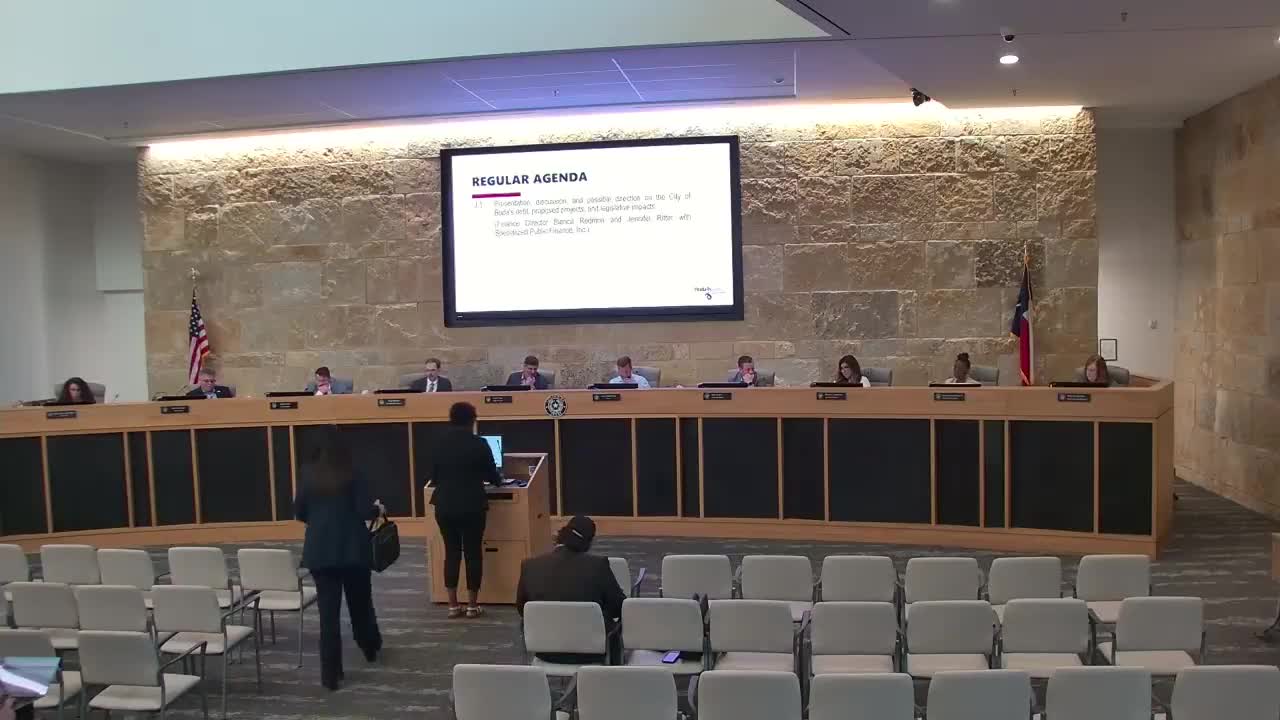
House Bill 19 would cap tax‑supported debt; Buda council weighs selling GO bonds now to avoid restriction
Summary
City staff and financial advisors told council that draft House Bill 19 would limit annual tax‑supported debt service to 20% of the three‑year average property tax collections, a constraint that could block most Texas issuers and prompt Buda to consider issuing voter‑approved bonds before a law takes effect.
City finance staff warned the Buda City Council about pending state legislation (House Bill 19) that, as drafted, would cap a local government’s annual tax‑supported debt service at 20% of the average property tax collections for the preceding three fiscal years.
Finance staff said the city’s three‑year average property tax collections are roughly $8.9 million, making the 20% cap about $1.8 million in annual debt service. By contrast, adopted FY2025 debt service on the city’s current tax‑supported debt is close to $8 million in the presentation, and the city still has about $38 million of authorized 2021 GO bond capacity that hasn’t been issued.
Why it matters: if a bill like this were enacted it would curb Buda’s ability to issue future tax‑supported debt for streets, parks, public safety and other general‑fund capital projects. Staff noted an administrative window — debt issued prior to the new law’s effective date (the draft cited Sept. 1) would be exempt — and that timing could allow the city to issue authorized voter‑approved GO bonds before the cap takes effect.
Council discussed options: issue the remaining voter‑authorized bonds now and accept a near‑term tax‑rate impact, delay issuance and risk losing financing capacity if the law passes, or pursue alternatives (relying on utility revenue bonds for water/wastewater projects, or seeking statutory exceptions). Several council members said they opposed raising tax rates but that selling the bonds now may be the only way to preserve voter‑approved projects if the legislation passes.
Ms. Redmond (staff) said the city’s advisors ran models showing the remaining 2021 GO debt issuance would create annual debt service payments in excess of the hypothetical $1.8 million cap. Jennifer Ritter (financial advisor, present for questions) and staff recommended council consider the legislative schedule and give direction on whether to prepare to issue bonds before any statutory change becomes final.
Ending: council asked staff to monitor the bill closely, coordinate with outside municipal advocates and return with a clearer schedule and recommended action at the May 20 meeting. Council members also signaled they may authorize staff to proceed if the bill looks likely to pass after the legislative deadline.