Get Full Government Meeting Transcripts, Videos, & Alerts Forever!
Get email alerts on the Signs And Banners topic
No spam. Unsubscribe anytime.
Seagoville staff propose broad revisions to city sign ordinance to ease rules for businesses
Summary
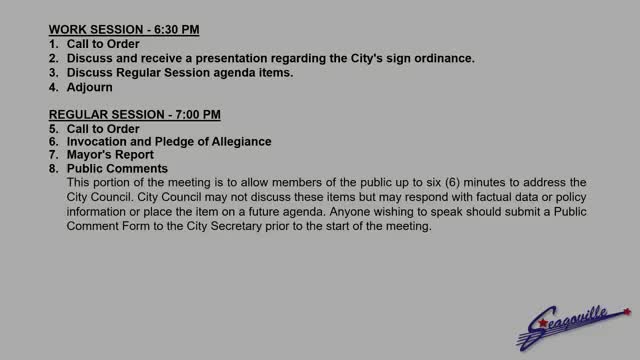
Seagoville Building Official Kaylee Lampkin presented draft revisions to the city’s sign ordinance at a City Council work session Monday night, outlining changes she said are meant to clarify existing rules and give businesses more flexibility while preserving the city’s appearance.
Seagoville Building Official Kaylee Lampkin presented draft revisions to the city’s sign ordinance at a City Council work session Monday night, outlining changes she said are meant to clarify existing rules and give businesses more flexibility while preserving the city’s appearance.
“I’m coming to y’all today to present and kind of workshop with y’all the sign ordinance,” Kaylee Lampkin said as she opened the presentation. Lampkin reviewed a range of proposed edits and asked the council for feedback and for input from local business owners.
The proposal would change several temporary-sign provisions. Lampkin noted the current banner limit is 60 square feet (6 by 10 feet) and is restricted to one banner per business for 60 days; she said the draft would allow two banners per business and extend individual display periods to as long as 90 days in some cases. “The banners are only meant to be used as temporary signage. That’s why we have the the days, the maximum time,” Lampkin said.
She also proposed clearer rules for garage-sale signage, including a stated maximum size of 4 square feet and an explicit prohibition on using cardboard boxes as signs, which staff described as a recurring code-enforcement problem. Lampkin said the draft borrows examples from Kaufman, McKinney and other nearby cities to specify allowable placement relative to rights of way and sidewalks.
For commercial property and drive-through businesses, the draft increases flexibility for small on-site signs. Lampkin said she updated provisions for mini boards and menu boards, allowing two pre-order boards and two menu boards, and raising the maximum wall-mounted area for those boards to 6 square feet from 4.
Monument and pole (pylon) signs were another focus. Lampkin told council members the draft separates monument-sign rules for nonresidential, multifamily and planned developments and sets a 10-foot maximum height for most monument signs. For larger pole or pylon signs visible from highways, she proposed extending the allowable setback from the highway right of way from about 50 feet to 500 or even 1,000 feet to accommodate businesses set back from major roads. “I put 500 for now, but I think if, especially if we want to develop further… I actually think a thousand would be better,” she said.
The draft also addresses promotional pennants and flags, increasing temporary allowances from 15 days per event to 30 days and clarifying frequency limits; sandwich-board rules would keep a 3-foot height limit but raise the maximum face area to 12 square feet, allow up to two boards per street frontage, require nightly removal, and remove the permit requirement to make them easier for small businesses to use.
On wall signage, Lampkin proposed a different calculation for storefronts with many windows: allowing up to 20% of the wall surface or 40 square feet — whichever is larger — with an existing overall maximum (expressed in the draft as 250 square feet) retained for very large facades. "I can change that number. That is not set in stone by any means," she said when asked about specific dimensions.
Lampkin also sought to clarify “vehicular signs,” noting that businesses may use branded delivery vehicles but that the ordinance would continue to prohibit vehicles being used as de facto permanent signs parked in public view. She recommended updating permit application language and the digital submission process to bring the ordinance into line with current city practices.
Councilmembers asked procedural questions and recommended seeking input from the volunteer sign committee and from business owners, especially operators of shopping centers and highway-facing properties. Several councilmembers noted the city’s recent growth and said consistent, clearer rules would help new developments and avoid ad hoc variances.
No formal motions or votes were taken during the work session. Lampkin asked council members to provide feedback and business-owner input before staff returns with a formal draft ordinance for possible public hearings and adoption.
The work session adjourned at about 7:04 p.m.; the council planned to reconvene in regular session at 7:09 p.m.