Get Full Government Meeting Transcripts, Videos, & Alerts Forever!
Get email alerts on the Animal Control topic
No spam. Unsubscribe anytime.
Seagoville leaders discuss dog running-at-large enforcement, household limits and staffing
Summary
City staff described citation options, impoundment practice and limitations of enforcement when owners are not identified; staff also cited a single animal-control officer handling 15-18 calls per day and noted a sterilization ordinance.
The Seagoville City Council heard a briefing on enforcement of the city's animal-control ordinances, including how officers handle dogs running at large, limits on animals per household and constraints on enforcement.
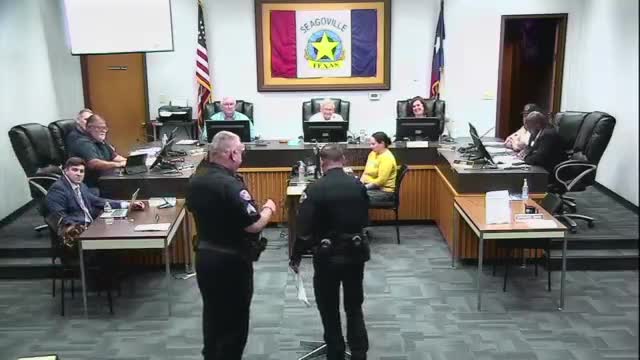
Carl Bailey introduced the topic and said he and Sergeant DeBelly would summarize enforcement practices. Sergeant DeBelly described three enforcement responses: an on-the-spot citation when an owner is known, a certified-mail citation when the owner's identity is known but not present, and impoundment when officers capture a stray. He said certified citations are difficult when an owner is not known unless the dog is impounded and the owner later identifies themselves at the shelter.
DeBelly told the council that if an Animal Control Officer did not directly witness the dog running at large, the city generally relies on a signed "citizen's desire to prosecute" form from the complainant before pursuing a citation in court. He said many complainants decline to sign because they do not want to escalate neighbor disputes. "We just want people to come in compliance. We're not ... out there to try to write everybody's citations," he said.
The city prosecutor, who identified himself as the prosecutor for the court, explained that criminal defendants have the right to cross-examine accusers; as a result, prosecutions typically require a complaining witness to appear in court. He added that the courts have additional enforcement tools for repeat offenders, but the prosecutor said the city's office only learns of prior incidents if a citation has been issued; warnings are not tracked in the same way.
Council members and staff discussed the city's numerical limits on animals. Bailey said the ordinance establishes a baseline maximum of four adult dogs per household and described a rule tied to property size: additional animals may be allowed per 3,000 square feet of "roaming space," as he explained it. The city also maintains a sterilization ordinance, and officers may cite owners for unsterilized adult animals if an officer documents the condition during an encounter.
Staff and council members raised resource concerns: one officer currently handles roughly 15 to 18 animal-control calls per day, which limits follow-up and proactive enforcement. Council members asked about other remedies the courts could impose for repeat violations and whether the city could better document warnings; the prosecutor noted many such enforcement decisions rest with the municipal court.
No formal action was taken; the item was presented for informational purposes and to answer council questions.