Get Full Government Meeting Transcripts, Videos, & Alerts Forever!
Get email alerts on the Edc Bylaws topic
No spam. Unsubscribe anytime.
Hutto EDC bylaws proposal to require written notice, limit council access draws oversight pushback
Summary
The Hutto Economic Development Corporation discussed proposed bylaw amendments that would require written notice at least 24 hours before executive‑session attendance and create grounds to exclude council members; council members and some board members raised concerns about practicality and taxpayer oversight.
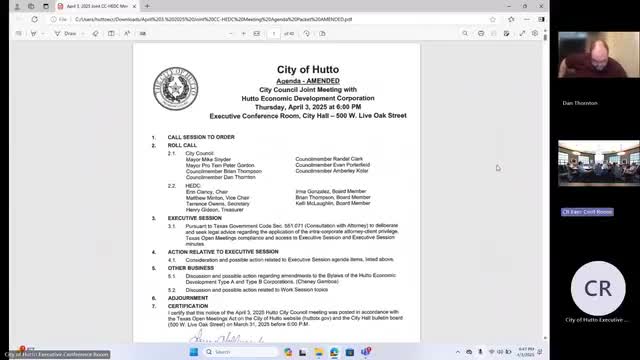
At the April 3, 2025 joint meeting, the Hutto Economic Development Corporation presented proposed amendments to its bylaws to clarify who may attend EDC executive sessions and how council members should request admission.
The draft bylaw language, as described at the meeting, would require any city council member seeking to attend an EDC executive session to submit a written request at least 24 hours before the meeting. Board members and some councilors said that requirement is impractical because EDC meetings are typically posted 72 hours in advance (for example, posted the Monday before a meeting at 6 p.m.), which could force a written request on a Sunday evening when staff are not available to accept it. Speakers also noted the draft used the term "written," which some participants said is distinct from email and could be interpreted to require an in‑person or hard‑copy submission.
EDC board members argued the changes are intended to protect confidential information and to meet fiduciary duties when council members participate in executive sessions. One board member emphasized the need to "put some bumpers around what happens when city council comes into our executive sessions" to avoid early public disclosure of sensitive discussions. Board members said they were not seeking to remove council oversight generally, but to create procedures to preserve confidentiality and limit potential conflicts where a council member might have competing interests.
Council members pushed back on restricting access. Several council members said elected officials serve as taxpayers’ watchdogs and that restricting council attendance risks undermining oversight. One councilor pointed out that state law allows up to four city council members to serve as EDC board members; speakers said a bylaw that limited council representation would have to articulate reasons consistent with attorney general guidance.
Specific points raised during debate included: - The 24‑hour written‑request requirement could be unworkable when meetings are posted 72 hours before the meeting time, creating a Sunday deadline for submissions. - The draft’s use of the word "written" raised questions about whether email qualifies. - The board said confidentiality concerns and past public disclosures motivated the proposed changes; some council members responded that allegations about specific conduct should be taken to ethics or prosecutorial authorities rather than by bylaw changes.
The transcript records robust discussion and disagreement but does not show a final vote adopting or rejecting the bylaw amendments at that meeting. Board members said the board had voted in favor of the proposed language previously; council members said they would need to consider the proposed changes and possible legal implications before approving any amendments.
If approved later, the changes would affect how and when council members can participate in EDC executive sessions and could require the city council and EDC board to adopt a joint procedure for limited public summaries where permitted by law.