Get Full Government Meeting Transcripts, Videos, & Alerts Forever!
Get email alerts on the Building Codes topic
No spam. Unsubscribe anytime.
Kerrville staff proposes six-year cycle for building-code updates, to seek Building Board input
Summary
City staff recommended a formal policy to update Kerrville's building codes on a six-year cadence, adopting new codes two to three years after publication and asking the Building Board of Adjustments and Appeals to review amendments and advise council.
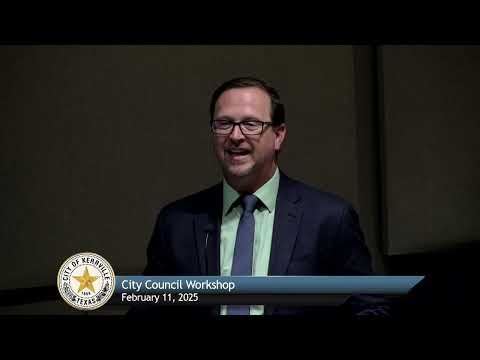
Kerrville City Council workshop presenters on Feb. 11 discussed a staff recommendation to adopt a formal policy that would standardize how often the city updates its building codes. Staff advised council to move to a six-year frequency that would adopt new International Code Council (ICC) codes two to three years after publication, rather than adopting every three-year code cycle.
The recommendation, presented by Drew Paxton, is intended to keep Kerrville ahead of the Texas state minimum while avoiding the immediate adoption of code provisions that local contractors and suppliers might not yet be able to implement. "What staff would recommend for consideration is every other code cycle, so a 6 year frequency to review codes, adopt the code 2 to 3 years after publication," Paxton said.
Why it matters: code cycles affect life-safety requirements, resilience measures and the availability of compliant materials. Paxton told council that FEMA reviews recession/reimbursement against the most recent two code cycles and that the proposed schedule would keep Kerrville within FEMA recommendations and several cycles ahead of current state minimums.
Key points from the presentation: - ICC and the National Fire Protection Association publish model codes on a three-year cycle; the state minimum cited by staff currently reflects the 2012 building code and the 2015 energy-efficiency code. - Staff noted trade-offs between adopting the newest codes immediately and practical concerns such as availability of materials and local contractor capacity. "We wouldn't want to stay right, you know, 2024 adopt the brand new code. We'd want to space that out a little bit," Paxton said. - Staff recommended adopting the 2024 publication on a 2026 schedule, then skipping the 2027 cycle and next considering 2030/2032 under the proposed cadence. Paxton summarized that approach as leaving time for other communities and industries to work out early implementation issues before adoption in Kerrville. - Implementation steps proposed: send the proposed policy and the actual code amendments to the Building Board of Adjustments and Appeals (BBAA) for review and a formal recommendation to council. "They represent the building community and they know better than I would," Paxton said.
Discussion and next steps: Councilmembers asked whether an eight-year gap (current to proposed) was too long; Paxton responded that the city already handles specific cases (for example, using engineering design requirements where a specific new chapter is not yet adopted) and that staff will take the proposed policy to the BBAA and return to council with a drafted policy for formal consideration. No formal action or vote occurred during the workshop.
The workshop record shows the issue will proceed to the Building Board of Adjustments and Appeals for comment and then return to council as a draft policy for action.