Get Full Government Meeting Transcripts, Videos, & Alerts Forever!
Get email alerts on the Body Worn Cameras topic
No spam. Unsubscribe anytime.
Medford Police present first full-year body‑worn camera report; audits flag training and process gaps
Summary
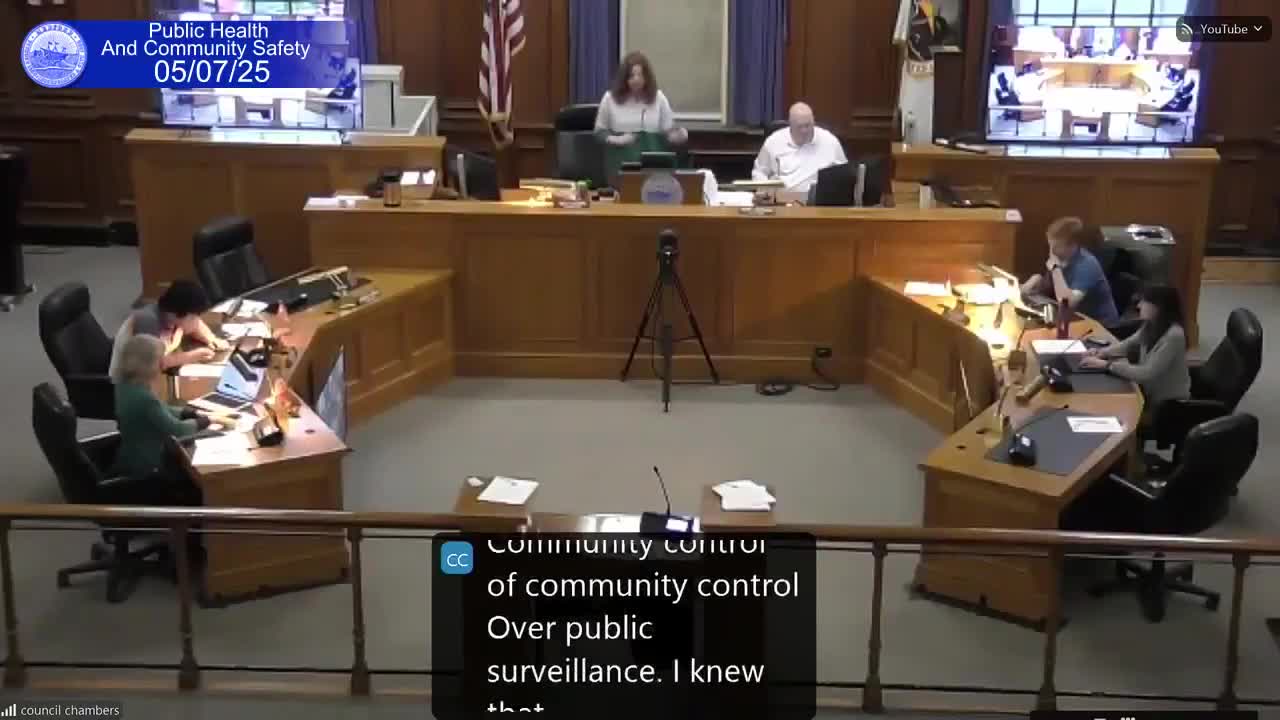
The Medford Police Department on May 7 presented its first full 12‑month body‑worn camera annual surveillance report to the City of Medford Public Health and Community Safety Committee, saying the program met its operational goals but that internal audits found repeated training and process gaps.
The Medford Police Department on May 7 told the City of Medford Public Health and Community Safety Committee that its first full year of body‑worn camera (BWC) operation produced more than 31,000 video files and “is accomplishing all of the…objectives” the department set for the program.
Chief Buckley, who presented the 2024 annual surveillance report, said officers produced roughly 31,326 videos in 2024; about 1,803 of those were related to arrests, and 342 files were provided to the district attorney’s office as part of criminal discovery. The department logged 32 public‑records requests related to BWC footage in 2024; the chief said four requests were legally withheld because they involved domestic‑violence cases.
But the department’s internal audits also identified patterns it plans to address. Lieutenant Pat Duffy and Officer Frank Casarino—who run the BWC unit and conduct audits—told the committee the most frequent problems are human‑behavior issues: officers forgetting to take or turn on cameras during a shift, and failing to tell people they are being recorded. "In aggregate in 1 in 3 cases, the officer did not advise all of the residents in their vicinity that they were being recorded," Vice President Collins said, summarizing the audit; Lieutenant Duffy explained that some audited clips show officers who were the second, third or fourth responder and may have assumed an earlier officer gave notice.
The access audit produced fewer concerns. Lieutenant Joe Casey, the department’s public‑records access officer, described controls that limit who may view footage in the evidence library: detectives assigned to a case, and the officer’s chain of command (sergeant, lieutenant, captain, chief) have access; an audit reviewed high‑profile calls to confirm viewers had legitimate cause. "There really is no desire from...the majority of supervisors over the year. They don't wanna look at any videos that they don't have to," Casey said.
The committee and the public asked for additional detail in future reporting. Members of Medford People Power and other public commenters requested data on whether camera use has produced disparate impacts by race or ethnicity, figures on post‑hoc recordings and prohibited recordings, how often officers request redactions themselves, and whether the department documents if force captured on video was later judged justified.
On redaction and costs, the department said it follows Massachusetts public‑records procedures for large redaction workloads. Lieutenant Casey said the city may charge for redaction under state rules: beyond an initial two hours, the department follows the supervisor of public records process and files a petition when it proposes to charge for redaction time; those petitions have been approved in the department’s experience. The department also said there is no charge when an individual requests a redaction under the department’s internal privacy process and the department is not releasing video as part of a public records request.
The report noted equipment and operating costs. Chief Buckley said the police planned to buy five additional body‑worn cameras at a cost of $10,926 to replace churn and outfit new hires; overtime and personnel costs are the largest recurring expenses. He said the department is not seeing major budget changes year‑over‑year related to the program.
Committee members pressed the department on remedies. Chief Buckley and audit staff said they will increase training, continue random audits, and often call officers in for remediation when repeat issues appear. The audit team said more detailed follow‑up of multi‑officer incidents (checking whether an earlier responder provided notice) would be time‑consuming; councilors suggested the department sample some incidents more deeply next year to reduce statistical ambiguity. "We will continue to work on that," Chief Buckley said.
During public comment, residents asked for (1) more time to review the report when it is submitted to the committee, (2) future reports to include explicit lines for record‑after‑the‑fact entries, prohibited recordings, and improper use, even if zero instances are found, and (3) clearer data on whether redaction costs create access disparities. The committee voted to delay its council compilation and tasked Vice President Collins with drafting the City Council’s annual public surveillance report for the May 27 council meeting so constituents would have extra time to review and comment.
The department did not propose any policy changes or new ordinances at the meeting; it recommended continued training and auditing and promised more granular detail in next year’s report where feasible.