
Planning committee refers Medford Square, West Medford and ADU zoning updates to Community Development Board
Get AI-powered insights, summaries, and transcripts
Sign Up Free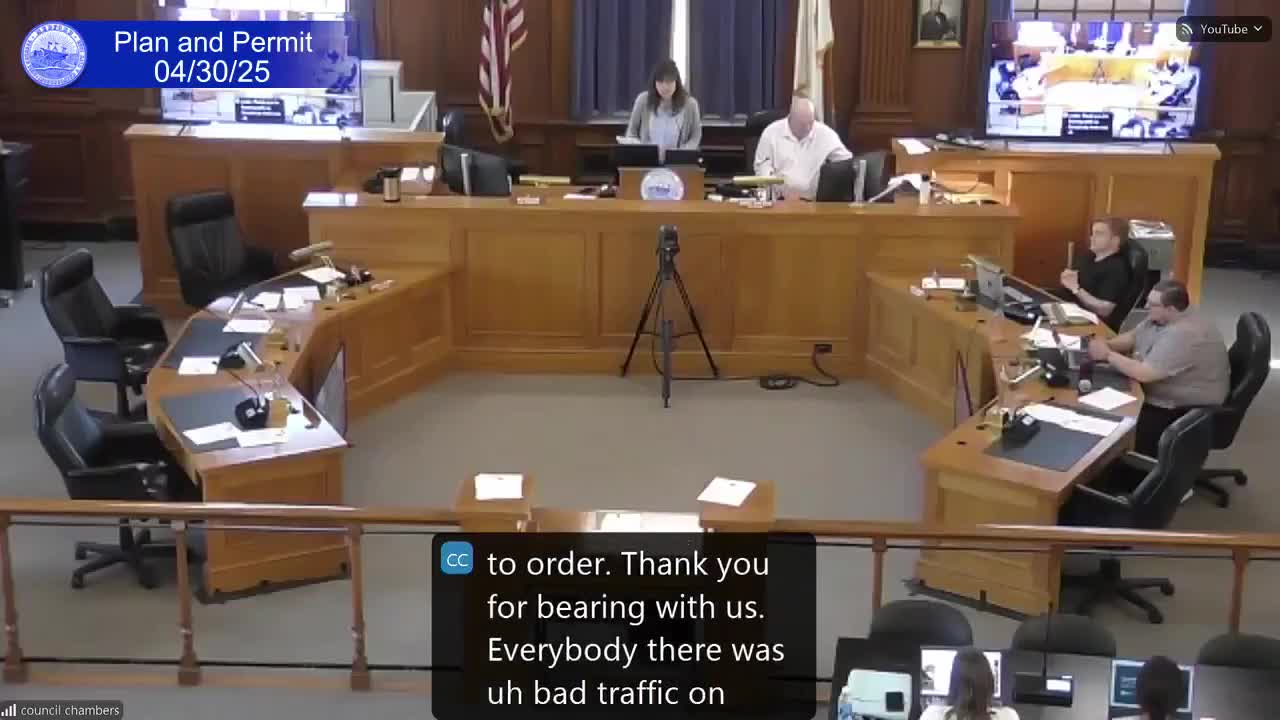
Summary
The Medford City Council Planning and Permitting Committee voted 4-0 (1 absent) to report updated zoning proposals for Medford Square, West Medford Square and accessory dwelling unit (ADU) rules to the Council for referral to the Community Development Board, after discussion of heights, incentive zoning, daylight standards and parking.
The Medford City Council Planning and Permitting Committee voted 4-0 with one member absent April 30 to report updated zoning proposals for Medford Square, West Medford Square and proposed changes to accessory dwelling unit (ADU) rules to the City Council for referral to the Community Development Board.
The vote forwards map changes that raise by-right heights in multiple mixed-use subdistricts, add incentive-zoning floors developers may seek in exchange for community benefits, and propose development standards intended to protect neighboring residential areas. The committee also reviewed proposed ADU rules that implement recent Massachusetts state law and set local parameters for additional ADUs.
Why this matters: the changes would alter the baseline development capacity at two neighborhood centers and change where ADUs are permitted across residential neighborhoods. That affects property owners, developers and nearby residents, and will shape future site plans and community review before any building permits are issued.
Key elements discussed
- Height and incentive zoning: Presenters explained a shift in by-right heights for mixed-use districts inside the squares. Under the current proposal, Mixed Use 1 (MX1) would allow 4 stories by right (plus 1 incentive floor), MX2A 5 stories by right (plus 2 incentive floors), MX2B 7 stories by right (plus 2 incentive floors), and MX3 8 stories by right (plus 4 incentive floors). Consultants said the incentive floors are intended to be negotiated when a developer provides community benefits such as green-building measures or transportation demand management (TDM).
- Location-specific changes: The proposal switches several parcels immediately east of Clippership Drive (adjacent to I‑93) from MX2 variants to MX3, placing the greatest by-right height next to the highway. Presenters said the area’s parcel configuration makes combining lots practicable there and that locating taller buildings near the highway reduces impacts on abutting residential fronts.
- Development standards to protect neighbors: Staff and consultants described two proposed development controls to limit impacts on nearby houses: a 45-degree height plane measured from lot lines and a “minimum daylight” standard (a daylight study requirement drawn from national examples) intended to guarantee a baseline of winter daylight for adjacent properties. Presenters said these measures, together with setback, lot coverage and parking rules, are intended to constrain what can actually be built, even where height is increased on the map.
- Parking and public lots: Committee members and residents discussed preserving public parking around City Hall and the Chevalier Theatre. Committee members noted that redevelopment of city-owned lots around City Hall is already proceeding through a request-for-proposals process and that parking requirements and mitigation will be addressed in site-plan and redevelopment steps. Staff said parking requirements will continue to vary by proximity to high-frequency transit (within a half-mile) and by lot-specific site plan review.
- West Medford Square changes: The West Medford map expands the square boundary in several places, upgrades some corridors from MX2A to MX2B and proposes commuter-rail–focused incentive language encouraging building entries and public parking that improve access to the West Medford station.
- ADUs (accessory dwelling units): The committee reviewed an ADU approach that follows state law while giving the city local discretion in some cases. The package discussed: • Protected ADUs: units required by state law to be allowed by right in districts that permit single-family dwellings. • Local ADUs: a local option the committee proposes to permit in Urban Residential 1 (UR1) and Urban Residential 2 (UR2) in addition to the protected ADU allowance in single-family districts. • Second ADU: a second ADU on a lot would be allowed only by special permit. • Size limit: staff proposed 900 square feet as the maximum for most ADUs (noting the state model sometimes uses 1,200 square feet) and said exceptions for historic accessory structures could be considered, likely via special permit.
Direct quotes from the meeting
“Why there are some in South of High Street…there are a lot of historic buildings. So we would like to preserve that front as historic,” said Paola (staff member presenting the maps), describing the rationale for limited upzoning near certain historic fronts.
“The difference is when you transition from stick built to steel,” said Emily Ennis of Ennis Associates, explaining why changing the by-right height can influence whether developers opt for the extra incentive floors.
“Given the proposed density in Medford Square, I also strongly support prior resident comments to upzone properties close to but outside the formal boundaries of Medford Square,” said Daniel Murdock (resident), summarizing a frequent public comment calling for a gentler step-down between the squares and adjacent neighborhoods.
Vote and next steps
Councilor Lemming moved to report the Medford Square, West Medford Square and ADU rezoning proposals favorably to the regular City Council meeting for referral to the Community Development Board; the motion was seconded and the committee approved it 4-0 with one absence. Roll-call results recorded at the meeting showed Councilor Lemming, Councilor Scarpelli, Vice President Collins and President Bares voting in favor; Councilor Callaghan was marked absent. The committee’s action sends the proposals to the City Council, which will refer them to the Community Development Board for public hearings and recommendations before the council votes on any ordinance changes.
What remains: staff and consultants said the draft uses table and dimensional standards will be updated and reposted ahead of coming public Q&A sessions. The committee promoted a schedule of upcoming public engagement: May 7 (Community Development Board hearing on residential districts), May 8 (public Q&A on the squares and ADUs), May 29 (corridors), and June 9 (parking and TDM). Members and staff emphasized that zoning establishes a framework but that site-specific studies (traffic, shadow/daylight, parking) and the site-plan review process will be used to evaluate particular development proposals before permits issue.
Ending: The committee’s referral advances the three packages to the CDB stage, where formal public hearings and written comments will guide possible revisions before the City Council considers an ordinance vote.