Get Full Government Meeting Transcripts, Videos, & Alerts Forever!
Get email alerts on the Public Health topic
No spam. Unsubscribe anytime.
Medford health department seeks general-fund support as grants wind down, highlights inspections, outreach and rodent control
Summary
The Board of Health presented a proposed FY26 budget that shifts two ARPA-funded positions to the general fund, expands food-safety inspections under a regional grant and warned of looming cuts to federal and state prevention grants; councilors pressed for more inspectors and off-hours animal control data.
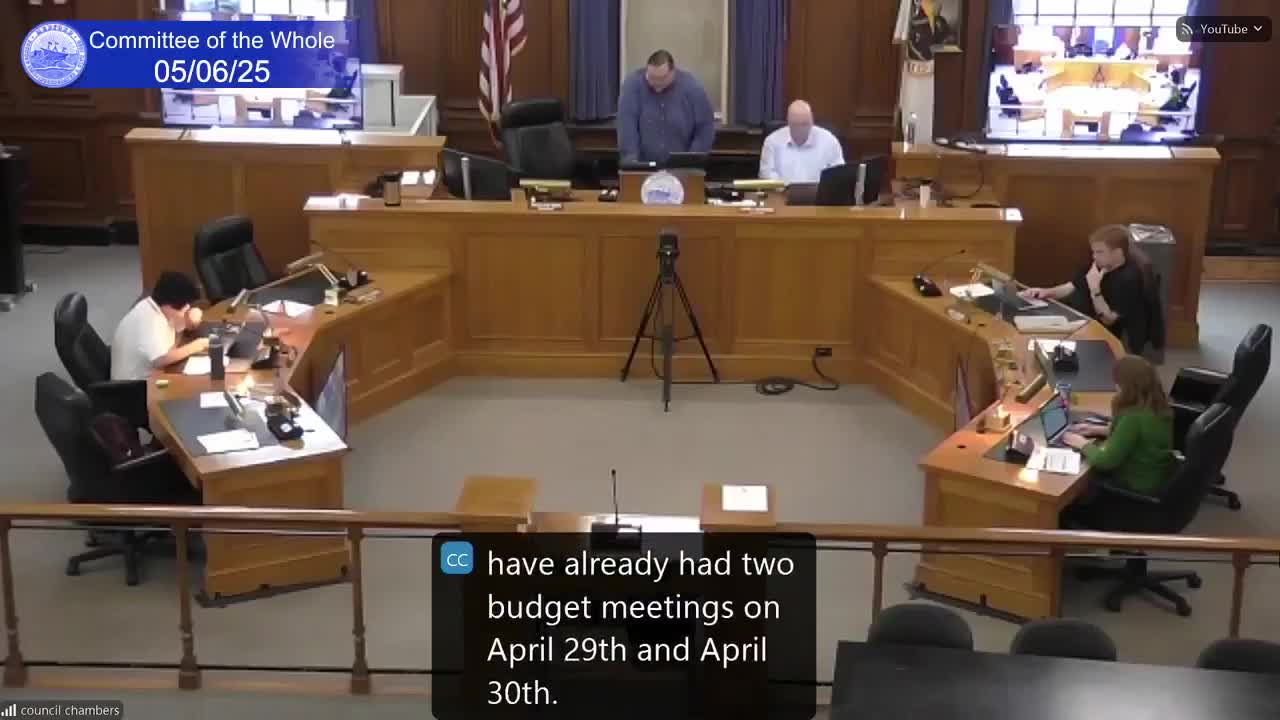
The Medford Board of Health told the City Council Committee of the Whole on May 6 that its proposed fiscal 2026 budget would rise from $810,978 to $955,579 largely because two positions previously paid from ARPA would move onto the city’s general fund and because of routine cost-of-living and step increases.
Health Department staff said the department separated mosquito control and canine services into distinct line items this year after a 4% invoice increase for mosquito control and a rise in kennel costs as more dogs were housed. “We are already over budget this year, with the number of dogs we’ve had to deal with,” the department representative said.
The department highlighted a series of grant-supported expansions this year. Participation in a regional Public Health Excellence Grant allowed the city to fund inspection consultants and training: all three environmental inspectors completed Tier 2 food-safety training and one inspector is Tier 3 trained. Staff said that, with grant support, they conducted “over 551 restaurant inspections this year.” Public health nursing delivered more than 800 flu and COVID vaccinations at clinics and performed 49 homebound vaccinations; school-related vaccine and TB testing work was also noted.
The Office of Prevention and Outreach described community engagement work supported by municipal and philanthropic grants: an expanded Community Connectors team ran more than a dozen citywide events reaching more than 500 residents, a multilingual access line handled approximately 150 calls in Spanish, Haitian Creole, Portuguese and Arabic, and staff logged 540 community-liaison contacts and 121 social-service navigation cases across five languages. Staff are also developing ties with Bunker Hill Community College for ESOL and work-readiness programming.
The department reported new recovery-coach services funded in part by opioid-settlement money and two RISE Foundation grants; staff said recovery coaches help with transportation, gym memberships and scholarships. The department also noted they contract with North Suffolk for recovery coaching and run a program for city employees on de‑escalation and support.
Councilors pressed for staffing detail and capacity. The department said it currently has three full-time inspectors, an administrative clerk, an environmental head clerk, a prevention/outreach manager, a social worker, an 80%-Bar-Foundation-funded health equity coordinator, a part-time (18-hour) recovery coach and five community liaisons and five connectors, most grant-funded. When asked how many additional staff would be needed “in a perfect world,” staff said they would add at least one more inspector (possibly 1.5), another animal-control officer with off-hours coverage, and additional social-service and recovery staff — and emphasized that added positions require recurring funding beyond head count.
Rodent control drew sustained attention. Staff said the city contracts with Yankee Pest Control (paid from a restricted account funded by fees) and uses carbon monoxide treatment rather than rodenticide in the city program. The rodent-control ordinance currently allows fees and fines; staff said fees are being collected into a restricted account but that fines would require ordinance changes. Construction and dumpster permits now require an integrated pest-management (IPM) plan from a licensed pest-control contractor; staff are monitoring compliance and collecting fees into a restricted account for future use on rodent control work.
Animal-control issues prompted a formal request from councilors: the council moved to ask Police Chief Patrick Buckley for data on how much officer time is spent responding to animal-control calls outside normal business hours. The motion was referred to the administration, the paper was kept in committee and the motion passed on a 5-0 roll call (Councilors Lazaro, Lemming, Scarpelli, Singh and President Baerz voting yes; two members absent).
Staff and councilors also discussed backyard chickens. The health department said it currently opposes permitting chickens because of rodent risks, disease potential, noise and space constraints; staff argued the city should get the rodent problem under control before expanding permissible animal keeping.
Nut graf: The Board of Health’s FY26 request reflects a shift of two previously one‑time or ARPA-funded positions into the core budget, expanded inspection and outreach work enabled by regional grants, and continuing operational questions about rodents and animal control; councilors pressed both for more permanent staff and for data to measure off-hours police responses tied to animal-control needs.
Background and next steps: Department staff warned that some regional and federal prevention grants face reductions — specifically naming a BSAS (Bureau of Substance Abuse Services) regional grant that was cut from $250,000 to an expected $150,000 or possibly $125,000 — and that the loss of those funds would shrink prevention and school-based programming. The council voted to request police response data and to keep the matter in committee for follow-up.
Ending: Health department staff said they plan to move more permitting online (CitizensServe for dumpster and hollow permits initially, with food permitting targeted later), continue hazardous‑materials and recovery partnerships, and monitor grant funding; councilors signaled interest in reviewing fines/ordinance language and the data requested from police before making further budget decisions.