Get Full Government Meeting Transcripts, Videos, & Alerts Forever!
Get email alerts on the School Infrastructure topic
No spam. Unsubscribe anytime.
Medford council approves $5 million free-cash appropriation, advances $25.775 million school HVAC and roof bond
Summary
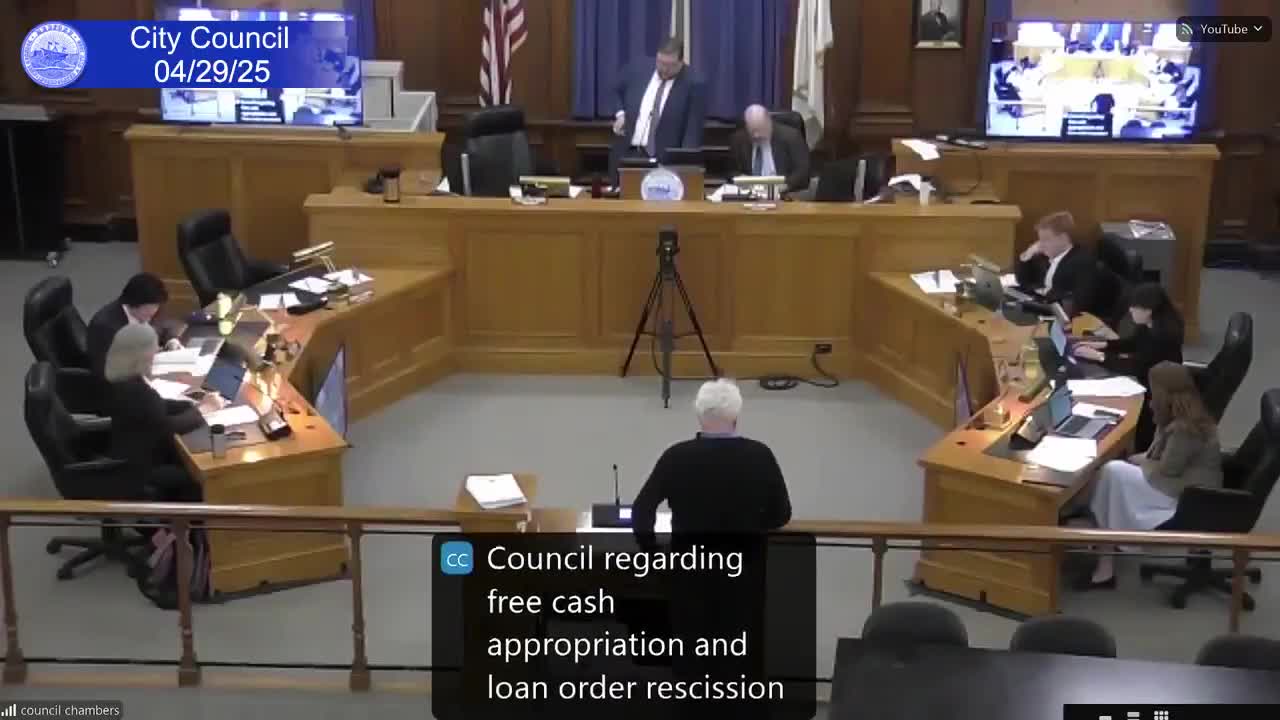
The council voted April 9 to appropriate $5 million of certified free cash to cover early purchases for HVAC and roofing work at McGlynn and Andrew schools and approved the related $25,775,000 loan order on third reading; the total project estimate is $30,775,000.
The Medford City Council on April 9 approved a $5,000,000 free-cash appropriation to cover early purchases and reduce borrowing costs for a multi-school HVAC and roof project, and subsequently advanced the related loan order for the larger project on third reading.
The mayor’s letter requested the appropriation to replace boilers and cooling systems with condensing boilers and heat pumps, install associated controls and perform roofing work and solar-panel installation at McGlynn and Andrew schools. The city estimates the total project cost at $30,775,000; using $5 million in free cash will reduce the amount to be permanently borrowed and lower future annual debt-service payments by an estimated $300,000 per year.
Director Dickinson (City finance/administration) explained the financing mechanics: the city planned short-term borrowing to start work in FY2025 and then convert to long-term bonding after final costs are known in mid-2026. “If we borrowed $5,000,000, we’re looking at about 4% interest rate on a 1-year short term note,” the director said, noting the free-cash appropriation avoids a roughly $200,000 FY2026 debt-service impact.
Assistant Superintendent Peter Cushing and capital project manager Brenda Pike described project contingencies and cost drivers. Pike said most of the increase in the overall estimate is being held in contingency for uncertainties such as tariffs, potential second-shift work to meet schedule, and ADA-related adjustments. “The majority of that increase is actually in… projections for things that we actually don’t know right now, but we’re holding in contingency,” Pike said.
Council discussion emphasized the distinction between recurring operating revenues and one-time capital expenditures: several councilors noted free cash is an acceptable source for one-time capital projects while operating costs should come from recurring revenue sources. Councilors also asked whether shifting from a loan order to free cash would delay the project; city staff confirmed no delay.
The council approved the mayor’s appropriation request by roll call, and later approved the loan order on third reading so the city can proceed with procurement and long-term financing planning. The appropriation and loan order do not change program scope; staff said the next steps include final procurement, construction scheduling and ongoing budget reporting to the council.
The council asked the administration to provide more detailed plans for remaining free-cash and stabilization fund uses as part of the upcoming budget process to clarify priorities for other capital needs across the city.