Get Full Government Meeting Transcripts, Videos, & Alerts Forever!
Get email alerts on the Central Business District Zoning topic
No spam. Unsubscribe anytime.
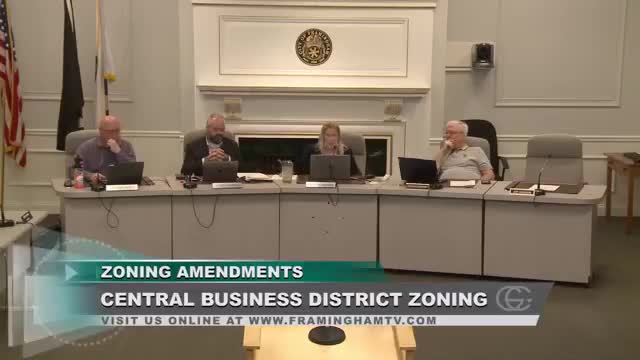
Planning board urges City Council to take no action on proposed Central Business District map change, calls for citywide zoning review
Summary
After a lengthy public hearing the Framingham Planning Board recommended that the City Council take no action on a proposed trimming of the Central Business (CB) District map and asked the planning department to begin a broader citywide zoning analysis, citing MBTA-compliance risk and state-identified zoning problems.
The Framingham Planning Board voted on May 15, 2025 to recommend that the City Council take no action on a proposed amendment that would significantly shrink the city’s Central Business (CB) District map. The board also asked the planning department to begin a broader, citywide zoning analysis to address zoning, MBTA community compliance, and downtown-scale questions.
Planning staff and board members said the proposed map changes risked undermining the city’s MBTA Communities compliance and raised technical problems flagged by the state. A staff presentation summarized state review comments and other concerns: the state had identified provisions in the existing CB bylaw that can’t lawfully limit the number of bedrooms or require a cap on building permits and questioned certain unit-size and occupancy rules; the staff presentation also noted the CB district as submitted could produce several thousand units under the state formula and that trimming the district without careful substitution or height adjustments could put the city out of compliance.
Public testimony at the hearing was sharply divided. Doug Stefan, a member of the newly formed Economic Development Corporation, said the EDC voted “unequivocally opposed to the changes” and warned that developers the EDC interviewed would not build under the proposed limits. Christopher Connolly, representing the Framingham Business Association and a longtime local business owner, told the board, “please do not recommend these changes to the city council,” and said reduced height and unit caps would make projects unfinanceable given current construction costs. City Councilor Lior Malek urged attention to a specific neighborhood pattern north of Route 135 and flagged the risk of isolating recently approved projects on Beach Street if the CB district were pared back in the proposed way.
Board members debated the proposal’s merits for more than an hour. Some members argued the trimming and a reduction in maximum height to four stories would better fit nearby residential neighborhoods and slow development, while others — including members of the business community and some board members — said lowering heights and shrinking the CB district as proposed would damage downtown economic development and make projects financially infeasible. Planning staff explained the state (reviewing MBTA compliance) raised “red flags” including restrictions on bedroom counts, restrictions on studio shares, and bylaw language limiting the number of mixed-use residential units permitted in a calendar year (examples the state said would conflict with the MBTA communities law and other housing rules).
After discussion, the board passed a motion instructing the City Council to take no action on the referred CB map amendment and directing the Planning Board and Planning Department to commence a citywide zoning analysis and report back; the motion passed by roll call. The board’s recommendation and the requested citywide process will be forwarded to the City Council for its consideration.
Ending: The action preserves the status quo for the CB district pending a more comprehensive planning and zoning review; the board signaled it supports further, broader work on zoning rather than piecemeal legislative map changes that may affect MBTA compliance.