Get Full Government Meeting Transcripts, Videos, & Alerts Forever!
Get email alerts on the Facilities Capital topic
No spam. Unsubscribe anytime.
Facilities director flags large uncertainty on Marion community center and old courthouse costs in FY26 briefing
Summary
The city’s facilities and capital projects presenter told the finance subcommittee on May 8 that the FY26 operating request includes personnel and energy increases and that the Marion Building (proposed community center) and a potential transfer of the old courthouse carry large, unresolved cost questions.
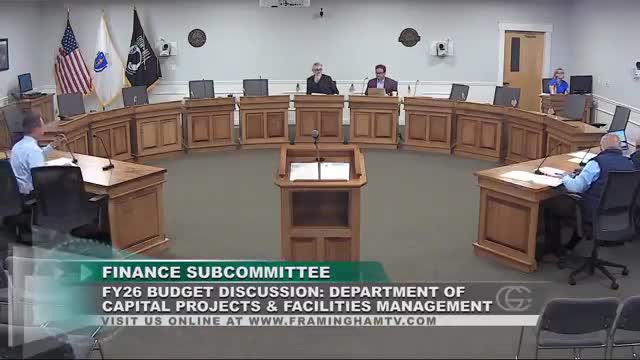
The City of Framingham’s facilities and capital projects division presented its FY26 operating request at the finance subcommittee meeting on May 8, 2025, and warned that cost uncertainty for the Marion Building community center and a potential transfer of the old courthouse remains significant.
The presenter reported an FY26 operating request (personnel, energy and operating lines) and provided a high‑level portfolio summary covering municipal buildings, commons and grounds. The operating presentation noted personnel, energy and operating subtotals and described a broad set of building assets that include schools, parks, public safety and facility maintenance responsibilities.
Committee members asked for ballpark figures and risks for two large projects: the Marion Building community center and the old courthouse that the state has proposed transferring to the city when the new courthouse is completed. The facilities representative said the eventual Marion Building cost would depend heavily on the final program, finishes and mechanical systems; he gave a range of “anywhere from $20 million to $45 million” depending on options and emphasized that funding and design choices would materially change the estimate. On the old courthouse, the administration said there is an earlier agreement with the state that the building could be transferred to the city at no cost after the state vacates it, but the city is under no obligation to accept the building if remediation or rehabilitation costs are too high.
The facilities presenter emphasized that some project costs can be offset by external grants and utility incentives and that current market conditions have in some trades reduced recent bid prices; however, he cautioned that other trades remain expensive and that tariffs and supply‑chain disruptions could change pricing. The presentation listed ongoing sustainability grants, municipal incentives and rebates received since 2019, and gave an up‑to‑date revenue snapshot for building rentals and related activity.
Committee members asked for a more detailed facilities spreadsheet with key metrics (annual energy costs, maintenance cost estimates, conditional liabilities), and the facilities presenter agreed to provide more granular, building‑level data to the facilities working group and to the committee. There was no formal vote on capital projects at the May 8 meeting; councilors asked administration staff to return with clearer cost estimates before the council takes further funding decisions.