
Amherst board hears statewide coalition presentation on EdChoice vouchers and pending lawsuit
Get AI-powered insights, summaries, and transcripts
Subscribe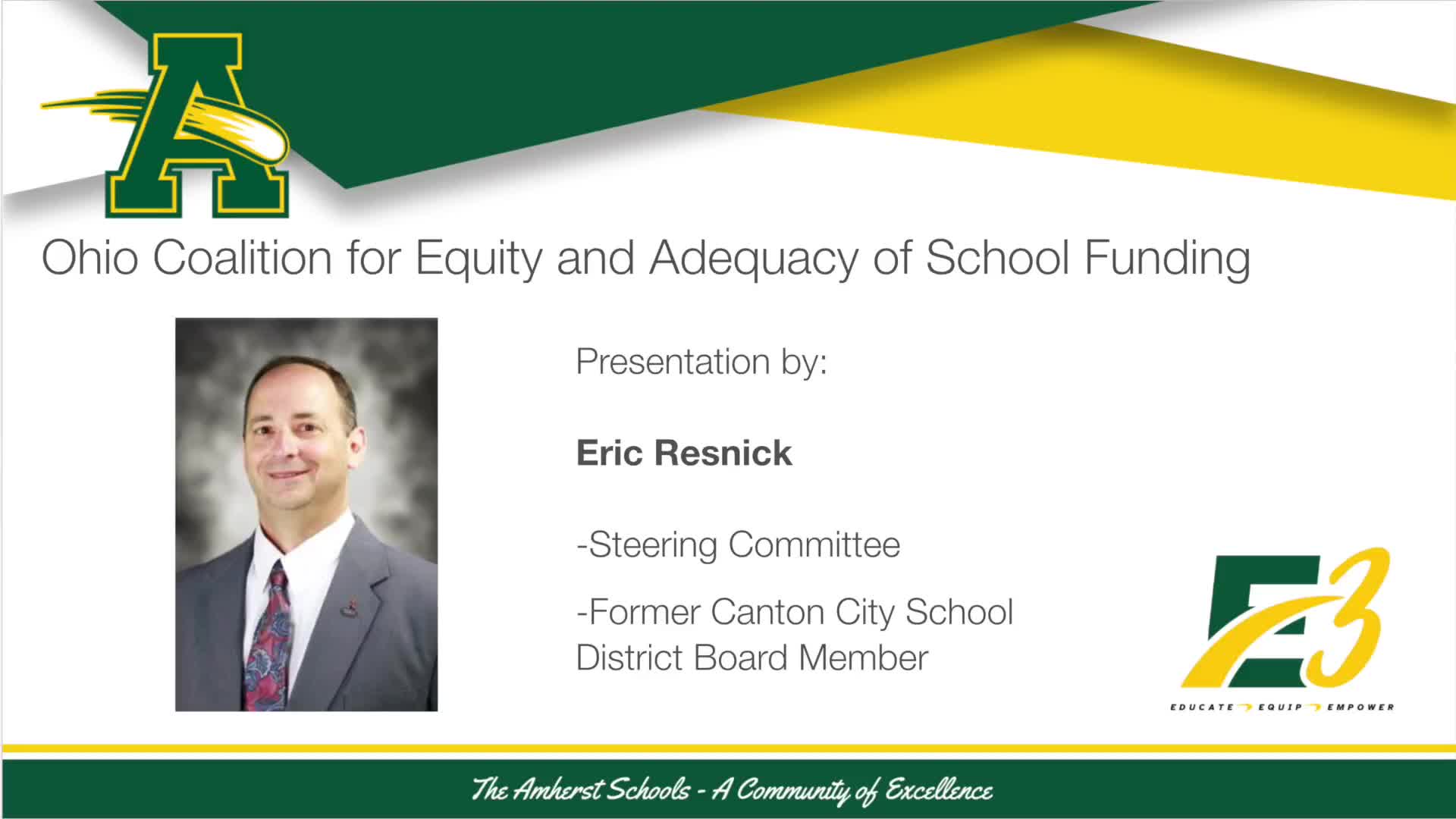
Summary
A representative of the Ohio Coalition for Equity and Adequacy urged the Amherst Exempted Village Board of Education to join litigation and public engagement against the expanded EdChoice voucher program, citing district-level student losses and a pending Franklin County lawsuit.
Eric Resnick, a member of the Ohio Coalition for Equity and Adequacy of School Funding steering committee, told the Amherst Exempted Village Board of Education that the district has lost hundreds of students to the EdChoice voucher program and urged the board to join a statewide legal and public-engagement campaign to challenge the expansion of vouchers.
Resnick said vouchers sent 37 Amherst students out of the district in fiscal 2021 and rose to 235 in fiscal 2024, and that "$1,295,320 of your taxpayer money walked out of this district to voucher private schools." He said the expansion has shifted voucher recipients from mostly low-income students to a majority who are not low income, adding that in one recent year 84.7% of vouchers in the district went to students who were not low income.
The presentation described a two-part campaign, "Vouchers for Ohio": a legal strategy to sue the state over the constitutionality of the EdChoice expansion and a public-engagement effort to change public opinion before the case reaches the Ohio Supreme Court. Resnick cited Article VI, Section 2 of the Ohio Constitution while explaining the coalition's legal theory.
Bill Phyllis, introduced during the presentation as a long-time coalition leader who previously worked on the DeRolph school-funding litigation, detailed the scope of participating districts and litigation timing. He said the pretrial schedule in Franklin County was underway and that the coalition had won most substantive pretrial motions. Phyllis described the complaint as raising five counts, including claims that vouchers create a separate system of common schools, segregate students by race, and divert public funds to religious schools.
Board members asked specific questions about how vouchers work, which private schools accept them, whether tuition increases follow voucher expansion, and what costs the district would face to join the coalition. Resnick and Phyllis responded that vouchers can be used at any accepting private school (including many Catholic schools in the region), that some private schools have raised tuition in response, and that joining the coalition would cost "$2 per student per year." Board treasurer and staff confirmed Amherst’s enrollment figure used in the presentation when attendees calculated the total cost.
Following questions from board members, coalition representatives said the trial timing remains subject to the judge's rulings on pretrial motions and that, if successful, the remedy sought is to declare the EdChoice expansion unconstitutional and halt voucher payments, not to ask the legislature to redesign funding.
The board did not vote to join the coalition during the meeting. Board members asked staff to circulate the sample resolution and materials for further review and discussed placing the item on a future agenda so the board can consider a formal decision.
The presentation and accompanying discussion occupied substantial time on the agenda and prompted follow-up comments from the superintendent and treasurer about timing and next steps for the board to consider a formal resolution.