
Framingham schools present $184.5 million FY26 request; $1.4 million gap with mayor’s proposal
Get AI-powered insights, summaries, and transcripts
Subscribe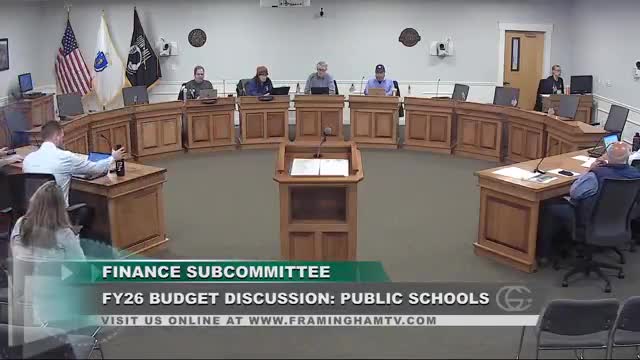
Summary
Framingham school officials presented a $184.5 million fiscal 2026 operating budget to the City Council finance subcommittee on May 10, saying the request represents a 6.89% increase and that a roughly $1.4 million gap remains between the school committee’s number and the mayor’s $10.5 million local contribution proposal.
Framingham school officials presented a $184.5 million fiscal 2026 operating budget to the City Council finance subcommittee on May 10, saying the request represents a 6.89% increase and that a roughly $1.4 million gap remains between the school committee’s number and the mayor’s $10.5 million local contribution proposal.
Why it matters: The schools’ request centers on personnel costs, expanded in‑house busing and new or expanded student programs that officials argue are intended to keep students in Framingham and reduce longer‑term costs for out‑of‑district placements.
Lincoln Lynch, director of finance and operations for Framingham Public Schools, told the subcommittee that “the current request is a 6.89% increase. It's a hundred and $84,500,000, an $11,896,000, increase.” He said the district has taken cuts during the school‑committee review (including eliminating one central office fine‑arts coordinator position and one capital project manager) and that the request still includes seven new positions, higher transportation costs tied to bringing busing in‑house, and other items.
School department leaders identified personnel as the main driver: the schools budget about $145 million for salaries and benefits, roughly 78.8% of the total. Lynch said the district budgeted $5.75 million in turnover savings and budgeted for a $7.2 million in‑house busing operation for FY26. He also described a plan to bring one special education program for students aged 18–22 in‑house at the Farley building, a change the department projects will save about $324,342 in the first year and roughly $1.1 million over three years by reducing out‑of‑district tuition.
Dr. Tremblay, speaking for the school leadership, framed several of the proposed changes as both educational and cost‑avoidance measures. On keeping students in the district she said, “Keeping Framingham kids, in Framingham public schools in our community is ... a sound investment,” and added the 18–22 program would start with roughly seven students in year one and could grow.
Committee members pressed for detail. Councilor Steiner asked whether the $184.5 million figure was final; Lynch and school committee members said more work remained but that the number reflected multiple reductions taken at recent school‑committee meetings. Councilor Cannon and others questioned academic performance and asked which metrics the department planned to use to measure returns on the investments. Tremblay pointed to measures such as graduation‑age program enrollment, chronic absenteeism, and participation in alternative pathways (including an expanded evening/virtual academy) as areas the district will track.
Teachers and residents who spoke during public comment urged the committee to preserve school‑based positions and instructional coaches. Teacher Sarah McKeown said school‑based staff “should never ever be reduced to data points or numbers on a paper,” and Jamie Dobson, a resident, provided a school‑level snapshot showing coaches’ direct instruction and advising roles and arguing cuts would affect large shares of students in Tier 1–3 interventions.
The subcommittee requested follow‑up information from the school department. Councilors asked for: a line‑by‑line list showing which positions remain under consideration; a list of nonunion salaries (FY24 paid, FY25 budgeted, and FY26 proposed) to mirror similar requests for city staff; and more specific metrics the district will use to assess new programs such as the 18–22 in‑district program and the virtual academy. School leaders said they would provide those materials. No formal vote on the school budget occurred at the May 10 meeting.
Context and next steps: School leaders said the school committee reduced the initial budget request through several votes and that the mayor’s office has proposed a lower local contribution ($10.5 million); the subcommittee must reconcile those numbers before sending recommendations to the full City Council. The committee discussed scheduling—public hearings and subsequent votes—to reach a recommendation ahead of city council deadlines.
Details and figures cited in the meeting: the FY26 request of $184,500,000 (6.89% increase); $11,896,000 total increase versus FY25; seven new positions (about $500,000); in‑house busing projected at $7,200,000; special‑education in‑house program projected to save $324,342 in year one and $1.1 million over three years; pre‑K partner contracts totaling $992,250 (for partner seats); projected budget gap versus the mayor’s proposal about $1.4 million.
Ending note: School officials said they expect additional line‑by‑line work in the coming days and asked the finance subcommittee for specific questions and data needs as the group moves toward the city council hearing schedule.