Get Full Government Meeting Transcripts, Videos, & Alerts Forever!
Get email alerts on the Zoning Mbta topic
No spam. Unsubscribe anytime.
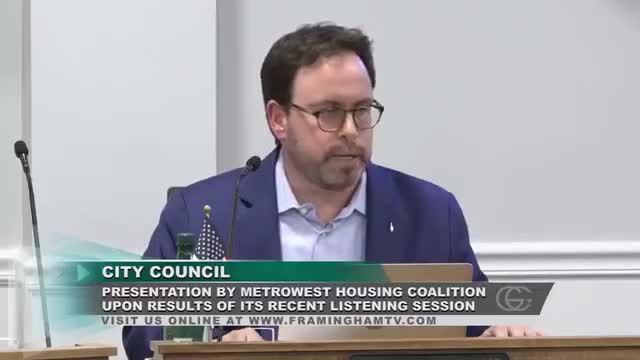
Council continues debate on shrinking Central Business District to meet MBTA zoning compliance
Summary
The council continued a public hearing about reducing the Central Business (CB) District to comply with MBTA zoning requirements; councilors debated whether removed parcels should revert to prior zones or be given transition zoning, and the council agreed to continue the hearing to allow the planning board report.
The Framingham City Council on May 6 continued a public hearing on a planning and zoning subcommittee proposal to shrink the Central Business (CB) District to meet MBTA zoning compliance.
Councilor Long, speaking for the planning and zoning subcommittee, summarized the plan: it would reduce the CB district acreage and limit the areas where six-story construction could be placed on side streets, recommending a 40-foot commercial-height limit in many areas and prohibiting variances for buildings larger than 10 units. The proposal was developed following neighborhood concerns about traffic, parking and building scale, Long said.
Council debate focused on implementation approach. Several councilors, including Councilor Long and former Councilor John Stefanini, argued that for the speed and clarity required by MBTA-compliance timelines the council should revert affected parcels to their previous zoning (which would prevent an immediate spread of taller buildings onto side streets) and address a longer-term transition zone through a separate, more deliberative planning process. “I still feel strongly that this should just be reverted back to what they are,” Long said, pointing to neighborhood objections to taller buildings on narrow side streets.
Other councilors warned that automatic reversion to prior zones could create a patchwork of preexisting nonconforming properties and urged the planning board and staff to develop a transition-zone concept that would provide a measured step-down between downtown heights and adjacent neighborhoods. Councilor Ward asked the planning department and planning board to draft possible transition solutions; Planning Director Sarkisian said the planning board would discuss the matter at its May 15 meeting and would issue a recommendation afterward.
Because the city must meet MBTA zoning deadlines and to allow the planning board’s input, the council voted to continue the public hearing; Councilor Long moved to continue the hearing and Councilor Bridal seconded. The council voted unanimously to continue the matter to a future council meeting so the planning board report could be included in the record.
Ending: The council left open the question of a later transition-zoning process; staff and the planning board will return recommendations and the council will consider final action after the required comment period and receipt of the planning board report.