Get Full Government Meeting Transcripts, Videos, & Alerts Forever!
Get email alerts on the Housing Affordability topic
No spam. Unsubscribe anytime.
Metro West housing survey: 56% of Framingham respondents reported unstable housing; coalition urges renter protections
Summary
Metro West Housing Coalition told the Framingham City Council that 56% of residents interviewed in 2024 reported unstable housing; the coalition urged the council to preserve affordability, consider local protections for renters, and plan for rent-stabilization authority if state legislation passes.
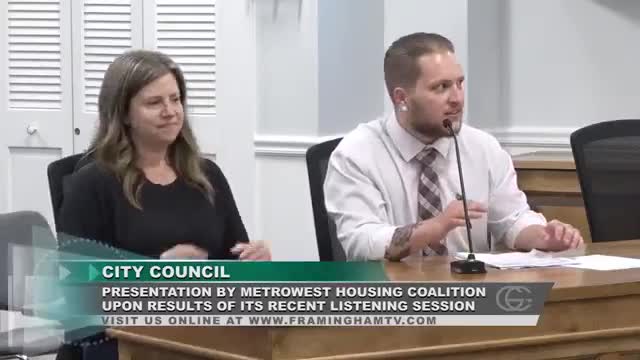
The Metro West Housing Coalition told the Framingham City Council on May 6 that more than half of the 66 Framingham residents it interviewed in 2024 reported unstable housing and that financial barriers were widespread.
The coalition’s presentation, led by Caden Davis of the Metro West Care Connection, summarized findings from community listening sessions and program data. “56% of the residents we spoke with reported an unstable housing situation,” Davis said, defining unstable housing to include shelters, temporary stays with others, sleeping in vehicles and renting units people cannot afford.
The coalition’s nut graf: the listening sessions and supporting referral data show a growing, urgent local need for affordable and stable housing. The coalition offered three near-term priorities for the council: preserve existing affordability, explore local protections for renters and small landlords, and prepare for municipal authority to pursue rent stabilization if state legislation grants it.
Davis described financial barriers in more detail: 65% of respondents faced financial obstacles to housing (high market costs, low or fixed incomes, limited supply of affordable units and limited rental assistance), and 76% reported having to choose between paying rent and other essentials such as food or medication. He recounted a case example: a resident recently released from incarceration said his unstable housing risked his recovery.
The coalition also presented program-level data. Metro West Care Connection’s navigation line recorded a 23% increase in Framingham residents calling for housing help in 2023–24 and a 50% rise in referrals for rental assistance and shelter access over the same period, Davis said. The coalition cited a 2023 Metropolitan Area Planning Council (MAPC) report showing high rates of institutional investor purchases in Framingham (47% of investor purchases 2004–2019, 57.5% in a South Framingham census tract), which the coalition said contributes to rent pressure and reduced opportunities for homeownership.
Councilors pressed for follow-up data and local options. Councilor Ward asked for updated investor-purchase figures beyond the MAPC study and raised the idea of a residential tax exemption to discourage large investor purchases. Councilor Steiner asked whether condo purchases for rental purposes were quantified; Davis said the MAPC report may not break out condo ownership in that way but offered to provide the source and underlying maps.
Councilors and community members also highlighted groups the coalition targeted during outreach (people with behavioral health challenges, those recently released from incarceration, non-English speakers and older adults with accessibility concerns) and urged more granular demographic breakdowns (by household type, disability status and neighborhood) to better align services.
The coalition urged the council to consider local incentives such as tax breaks for small, locally owner-occupied landlords who keep rents reasonable, and to support state rent-stabilization bills that would permit municipalities to adopt local measures. It also recommended exploring ordinances and resolutions to protect renters from displacement while supporting responsible small landlords.
The presentation closed with council praise for the coalition’s outreach work and requests from councilors for the coalition and city staff to share the underlying report, program referral counts and maps so the council can consider policy responses and budget priorities.
Looking ahead: the coalition said it would follow up with the full MAPC report, raw counts from Metro West Care Connection’s navigation line, and the MassTrails-style funding/advocacy options discussed during the meeting. Councilors asked staff to bring more detailed counts, neighborhood breakdowns and potential pilot programs to upcoming budget discussions.
Ending: The council did not take formal action on Metro West’s recommendations at the May 6 meeting but asked staff to return with data-needed items and to coordinate with the coalition on follow-up reporting.