Get Full Government Meeting Transcripts, Videos, & Alerts Forever!
Get email alerts on the Fy2026 Budget topic
No spam. Unsubscribe anytime.
Framingham finance subcommittee reviews FY 2026 budget proposal: $383.2 million operating budget, questions on technology and procurement
Summary
The finance subcommittee received a presentation of the City of Framingham’s FY 2026 operating budget proposal—$383,163,048 excluding enterprise funds—and asked for follow-up on technology costs, procurement software, insurance increases and staffing decisions.
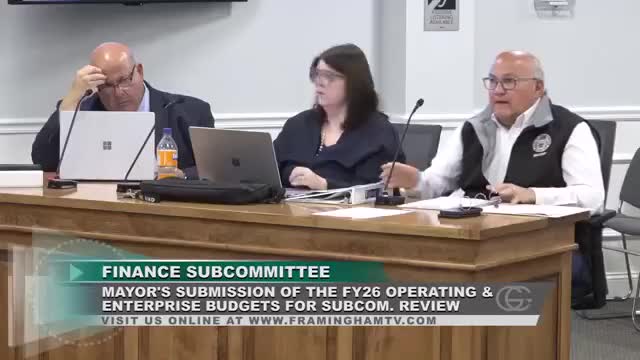
The Framingham City Council Finance Subcommittee on May 1 heard a detailed presentation of the proposed FY 2026 operating and enterprise budgets, including a recommended operating budget of $383,163,048 (exclusive of enterprise funds) and multiple department-level staffing and capital recommendations. The committee directed staff to review detailed line items over the coming weeks and scheduled department-level presentations beginning the next Saturday.
The city’s budget presenter, identified in the meeting as the Chief Financial Officer, said the FY 2026 recommended operating budget totals $383,163,048, an increase of approximately $23.9 million, or 6.7%, over FY 2025. The presenter said applying a 2.5% tax levy would generate $230,370,391 and projected the average single-family tax bill would rise to $7,956 from $7,761 in FY 2025. “The FY 26 budget presented a significant challenge to prioritize resource allocation and meet essential needs within [a] limited revenue landscape,” the Chief Financial Officer said.
Key budget figures and proposals discussed
- Total operating budget (exclusive of enterprise funds): $383,163,048 (proposed), +$23.9 million (+6.7% vs. FY 25). - School department recommended allocation: $183,109,620 (about 47.8% of the operating budget as presented). - Municipal departments: $82,247,000 (about 21.5% of the operating budget). - New growth revenue estimate: $22,200,000. - Proposed use of $10,000,000 in free cash to balance the budget. - Enterprise funds (water and sewer) combined increase roughly 5.6% over FY 25; sewer enterprise proposed at $33,365,048 and water enterprise proposed at $27,499,000.
Staffing and position changes cited in the presentation included targeted funding of some vacant positions and deferral of others. Examples provided by the presenter included adding a grants manager to the general fund at $115,000, partially funding firefighter positions for six months, and adding a part-time electrical inspector. The presentation also detailed multiple vacant positions that the administration proposed not to fund as a savings strategy.
Technology and procurement drew sustained committee attention. The Technology budget includes an increase of about $480,000 over FY 2025, driven in part by software maintenance and new modules. The presenter described a proposed expansion of the city’s OpenGov platform to include a procurement module; the presenter said the procurement piece accounts for about $135,000 of a roughly $150,654 total OpenGov line-item increase. “The procurement module, really streamlines all of that and it allows you to go in and it has all the templates already set up,” the Chief Financial Officer said, listing current multiple tools (Smartsheet, Vendor Registry, Laserfiche, Munis) the city uses and characterizing the procurement module as a consolidation.
Councilors asked for further detail on expected savings, staffing impacts and whether the procurement purchase had been evaluated against alternatives. One councilor asked, “Has a dollar number been put on that savings and does the incremental cost that’s going to be annualized outweigh the cost to staff?” The CFO said staff would provide a deeper breakdown and the technology director will attend a future meeting to present specifics.
Committee members also questioned insurance and benefit cost projections—health insurance was presented at $46,760,000, an increase of roughly 10.8%—and a projected unemployment-insurance increase presented as 70% (the CFO clarified a separate insurance figure earlier in the meeting had been 0.8%). The school department’s requested increase and the CFO’s proposed funding were discussed: the initial school request was described as an $18 million increase; the recommended allocation to schools in the CFO’s proposal was $10.5 million above FY 2025. Committee members indicated they will request deeper line-item detail from the school department at upcoming review sessions.
Why it matters: The FY 2026 budget proposal sets tax and spending priorities for municipal services, schools, public safety, capital projects and enterprise funds. The committee signaled particular interest in technology spending and procurement modernization, sizable insurance increases, the effect of school department decisions (including planned in-house busing) on health insurance and retirement costs, and vacant vs. funded positions across departments.
Next steps: The subcommittee scheduled department-level reviews over the following three weeks, beginning with a session on Saturday. Staff committed to providing more detailed line-item and rationale documents, a technology breakdown (including the OpenGov procurement module), and further information about position funding and the school department’s final requested figures.