Get Full Government Meeting Transcripts, Videos, & Alerts Forever!
Get email alerts on the Adaptive Reuse Prd topic
No spam. Unsubscribe anytime.
Owner seeks PRD text/map change to convert vacant Clarks Hill office building to mixed use with residential floors
Summary
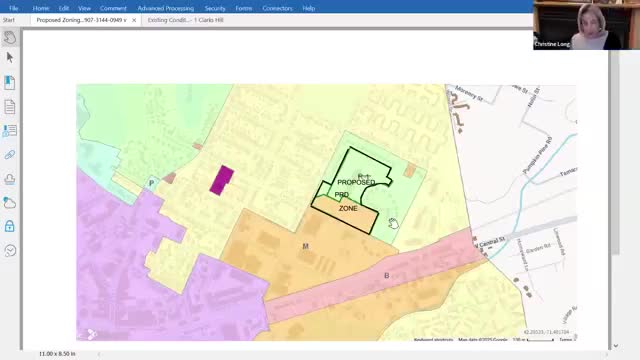
The owner of the mostly vacant 100,000‑square‑foot office building at 1 Clarks Hill Lane proposed using a Planned Reuse District (PRD) map/text amendment to allow mixed use and convert the top two floors to multifamily while retaining ground‑floor commercial uses, including an existing Social Security office.
The owner of the three‑story office building at 1 Clarks Hill Lane told the Planning and Zoning subcommittee the property is mostly vacant and that converting the top two floors to multifamily could reuse existing structure, add housing and improve safety and activity at the site.
Presenter (listed in the transcript as "Bios") said the building contains roughly 100,000 square feet across three stories, about 500 parking spaces, and current tenants include the Social Security Administration. He told the committee the building has been largely vacant for about nine years and that the market does not support full office re‑tenanting given required tenant improvement costs and low achievable rents.
City staff and the owner discussed a zoning approach that would add a Planned Reuse District (PRD) for the site and accompanying text amendments: to permit mixed use in a PRD, and to allow privately owned sites to qualify for PRD treatment where the ordinance presently reads more narrowly. Attorney Garahan and staff explained that under current rules multifamily and commercial uses may appear in a PRD but the ordinance language would have to be clarified or amended to explicitly allow mixed commercial/residential reuse and private‑owner eligibility.
Councilors and staff signaled support for the idea while asking for careful drafting of text changes. Councilor Phil (Agliani) and others suggested municipal uses (police substation, municipal office) could be allowed under revised PRD language so the building could continue to host the Social Security office while adding residential units above. Councilor Bryant urged caution about broad ordinance wording and asked staff and the owner to meet for more detailed review.
Presenter background: the owner said he purchased the building after foreclosure, remedied code violations, and invested in repairs but has been unable to secure long‑term office tenants aside from the Social Security office. He described floor plates of roughly 15,000 square feet and said tenant improvement costs make full office reuse economically infeasible. "It's sitting there on its own alone, surrounded by two families, Bishop Garden condominiums, and multifamilies all around it," the presenter said, arguing adaptive reuse as residential would activate the site.
Next steps: staff and the owner will meet to craft specific text and map amendment language. Councilors asked to see proposed ordinance text and details about how municipal uses, parking and safety will be handled. If drafted, the change would proceed through public hearings, site plan review and inclusionary housing requirements for residential units.
Why it matters: The proposal would repurpose an underused downtown‑adjacent office building into housing without expanding the building footprint and could restore economic activity at a site with long vacancy. Councilors noted the idea could address local housing supply while preserving an existing structure.