Get Full Government Meeting Transcripts, Videos, & Alerts Forever!
Get email alerts on the Municipal Real Estate topic
No spam. Unsubscribe anytime.
Framingham mayor and COO outline purchases, progress and concerns on Marion High School community center
Summary
City officials reported on four recent property efforts — including the former Marion High School purchase intended for a community center — and detailed spending under ARPA/OPERA funds, demolition work, and a timeline for design and weather‑proofing, while councilors asked for a broader asset plan for municipal properties.
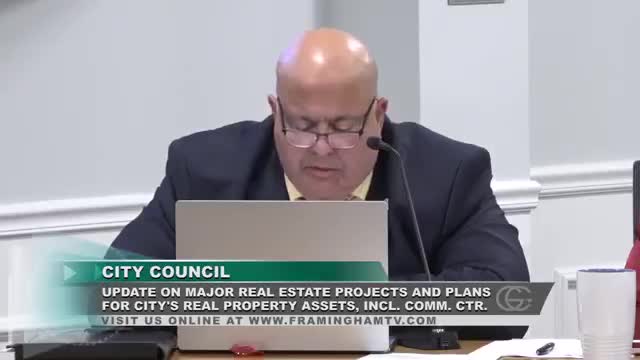
Framingham officials updated the City Council on April 15 about four municipal real‑estate matters, including the city’s purchase of the former Marion High School at 273 Union Avenue, and the planned use of existing ARPA/OPERA funds to stabilize and weather‑proof the building while design work continues.
Chief Operating Officer (COO) and city staff reported that the City purchased 273 Union Avenue to create a citywide community center with performing‑arts, indoor sports and programming space. The administration said it completed interior demolition and hazardous‑materials abatement, removed a freestanding convent building on the site, and is now undertaking a second phase using OPERA funds to install a solar‑ready roof, masonry repairs and new windows. Officials said about 100,000 square feet of the building will be gutted and made weather‑tight using OPERA funds before the end of 2025, after which the architect will produce updated cost estimates.
The COO said no city funds have been spent on the Marion project other than a construction sign; ARPA/OPERA funds and designated grant accounts have covered work to date. Officials also reported on other recent real‑estate moves: the city purchased 188 Concord Street (next to City Hall) to house the new Middlesex Regional Emergency Communications center (MRAC) on upper floors, retain a leased parole office, and move a public‑health clinic onto the first floor; that MRAC grant first‑year award was cited at $4.1 million for design and construction work. The city also described two smaller purchases (499 Central Street and 84 Walnut Street) bought with subdivision mitigation funds to be occupied by qualifying affordable tenants.
Councilors pressed the administration for a unified asset stewardship plan and a capital needs assessment across the city’s property portfolio. Several council members said they want a clear inventory, prioritized repair needs, and the city’s long‑term vision for major municipal properties such as the former McAuliffe Library, the Amazing Things Art Center, Station 2 (the former fire station), and the Marion property; they asked for a schedule of capital needs, funding sources, and projected revenues or savings tied to each asset.
Why it matters: The Marion property and other holdings represent large capital commitments and potential ongoing operating costs; councilors sought visibility on how the city will prioritize projects and the extent to which the city will need recurring funding or public‑private partnerships.
What’s next: Officials said construction bids for MRAC would go out in summer 2025, that the Marion building will be weather‑tighted in early 2026 using available OPERA funds, and that the city will continue public outreach on programming options while the project team develops final cost estimates.