Get Full Government Meeting Transcripts, Videos, & Alerts Forever!
Get email alerts on the Procurement topic
No spam. Unsubscribe anytime.
Policy committee debates vendor-lobbying registration; staff asked to clarify thresholds and exemptions
Summary
Committee members and procurement staff debated a draft policy requiring registration by vendors or parties that engage to obtain contracts. Members sought clearer language on thresholds, exemptions for competitive processes and a plain‑language guide for vendors.
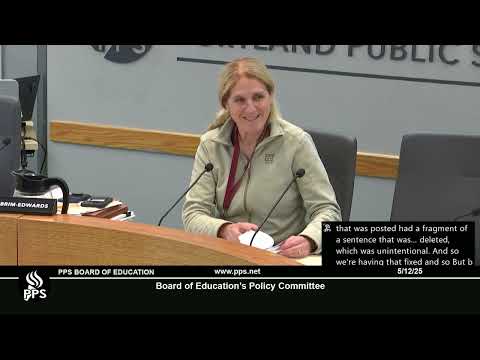
The Portland SD 1J policy committee discussed a redline draft of a solicitation, registration and reporting policy intended to increase transparency when vendors or other economic actors engage district staff or board members to obtain sizable contracts.
Why it matters: Committee members said the policy could "daylight" who is attempting to influence contracting decisions before a public award is made. Procurement staff and legal advisers urged careful drafting to avoid unintended burdens on small vendors or interference with existing procurement rules under Oregon law.
Liz Large, the contracted single legal adviser, walked the committee through a redline dated April 18 that retained a bracketed $100,000 definition for "eligible contracts" and proposed a public vendor registration triggered when engagements exceed a de minimis level (the draft used a five‑hour, per‑calendar‑quarter threshold). The draft would require a public registration listing an individual's name and the general nature of the contractor expenditure and would keep the registration on the website for 90 days after final engagement.
Emily Cortnidge, director of purchasing and contracting, explained how the policy would interact with existing procurement categories under Oregon rules: formal RFPs and invitations to bid are publicly advertised under state law; informal RFPs and competitive-quote processes are not publicly advertised but require outreach to a minimum number of potential providers. Cortnidge said many procurement categories have dollar thresholds and cited examples: direct award thresholds in maintenance procurements (around $25,000 for direct award) and professional services ranges (direct select up to roughly $75,000; $75,000 to $250,000 typically use informal RFP or competitive quotes, with higher amounts requiring formal public solicitation).
Committee members raised several recurring concerns: would the registration requirement capture vendors already performing services as part of an existing contract, and if so, when? Several members asked staff to add clarifying language that routine performance under an existing contract is not "obtaining" a new contract, while outreach that seeks an amendment or extension should be registered. The committee also asked staff to provide plain-language definitions or hyperlinks (for example, linking to the contracting manual or the relevant Oregon Revised Statutes) so vendors unfamiliar with procurement terminology could understand whether they must register.
Members discussed the policy's intended scope: the draft was modeled on a similar Metro policy and is meant to be a light-touch transparency measure rather than a full lobbying-registry burden like some state systems. Board members and procurement staff agreed that minority and small businesses should not be deterred by the process; staff described existing efforts to recruit small and minority‑owned firms.
No formal policy vote was taken. The committee asked staff to (1) draft clearer language distinguishing routine contract performance from outreach to obtain amendments or future work, (2) add plain-language descriptions or links to procurement categories and thresholds, (3) clarify how the district's registration would coordinate with state ethics/procurement statutes, and (4) return an updated draft for further review.
Quotes in the record included Emily Cortnidge's description of her role: "We facilitate all of the district's purchases, contracts and competitive solicitations for goods and services," and committee members' repeated request that the policy be explained in lay terms for vendors who do not work in public procurement.
The committee did not adopt the policy at this meeting and directed staff to return with clarifications and suggested implementation text for a registration webpage and vendor-facing guidance.