Get Full Government Meeting Transcripts, Videos, & Alerts Forever!
Get email alerts on the Enrollment topic
No spam. Unsubscribe anytime.
Policy committee stalls change to kindergarten cut‑off, directs staff to improve outreach and data
Summary
The Portland SD 1J policy committee declined to advance a change to the district's kindergarten entry date but directed staff to improve outreach, provide clearer enrollment options and return data on capture rates and prekindergarten capacity.
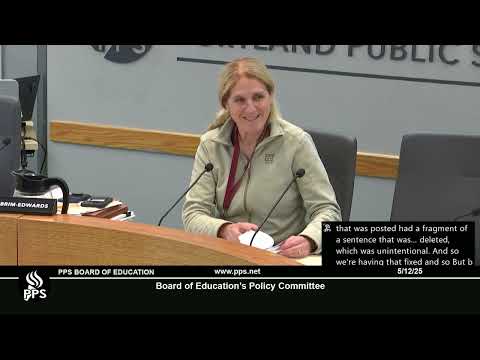
Policy committee chair Julia Brehm Edwards told the Portland SD 1J policy committee that she would not move a formal change to the district's compulsory enrollment date but asked staff to bring follow-up information and operational fixes to make the district feel more welcoming to families who miss the September 1 cutoff.
Why it matters: The committee discussed falling enrollment and a declining capture rate in Portland Public Schools (PPS), and members said small changes in practice and clearer family-facing information could help retain students and reduce the district's revenue impact from lower enrollment.
The committee spent its allotted time on next steps rather than pursuing a policy change. Julia Brehm Edwards, policy committee chair and board member, said she did not see support for changing the fixed kindergarten entry date but called for a different approach to avoid losing students who fall just short of the cutoff.
Emily, an enrollment and early learning staff member, outlined a set of operational responses the district could use if families request early entry. "We want you in our system. Let us help you find a bridge," Emily said, describing a model in which school secretaries and principals could link families quickly to the district's early learning enrollment team or to partner providers when a local pre‑K slot is available.
Committee members and staff noted several quantitative details during the discussion: the district reported roughly a 10% enrollment drop since 2019, compared with the state's approximate 6% drop, and the district's capture rate for kindergarten-age children has fallen into the seventies (percent). The district currently operates about 910 PPS prekindergarten seats across 14 sites, and committee members said there are approximately 2,900 kindergartners in the district currently.
Board member Patty Sullivan cautioned against solving enrollment declines by "putting kids in school too early," and others said any response should be accurate and implementable; staff said pre-K availability is nuanced, with priority populations and site-by-site variation in openings. Emily said pre-K enrollment is handled centrally by the district's early learning/enrollment team, and recommended that any front-line staff who receive inquiries be trained with an up-to-date contact and script so families receive honest, consistent answers about eligibility and availability.
Discussion items the committee asked staff to follow up on included: a map and list of the 14 PPS pre-K sites and which are "Preschool for All" or Head Start slots; precise capture-rate data that the board could review in budget documents; a short, consistent set of talking points or a script for front-line staff that sets expectations about the likelihood of available pre-K slots; and integration of this work with the district's larger enrollment campaign led through district leadership. Brehm Edwards said she would not pursue an immediate policy change and emphasized that staff should return with written, implementable options rather than informal verbal reassurances.
The discussion made a clear separation between three types of outcomes: (1) discussion of the policy rationale and district data, (2) direction for staff to prepare materials and operational changes, and (3) no formal policy vote to change entry dates. Members asked that staff report back with the requested materials and that enrollment-campaign leads provide periodic updates to the board.
The committee flagged community and system-level causes for the decline, including demographic shifts, pandemic-era disruptions and competition from other providers, and agreed the district should treat enrollment as a cross-departmental priority.
The committee did not adopt any ordinance or formal policy change at the meeting; instead it directed staff to return with clarifying documentation and outreach plans.