Get Full Government Meeting Transcripts, Videos, & Alerts Forever!
Get email alerts on the Fire Emergency Services topic
No spam. Unsubscribe anytime.
West Chester Fire Department outlines path to national accreditation, flags staffing and response gaps
Summary
Fire Chief Rick Prince and accreditation manager presented the department's multi-year Commission on Fire Accreditation International (CFAI) process, reporting completed community risk assessment, recommended station relocations and a new medic unit to address stretched resources and response-time gaps.
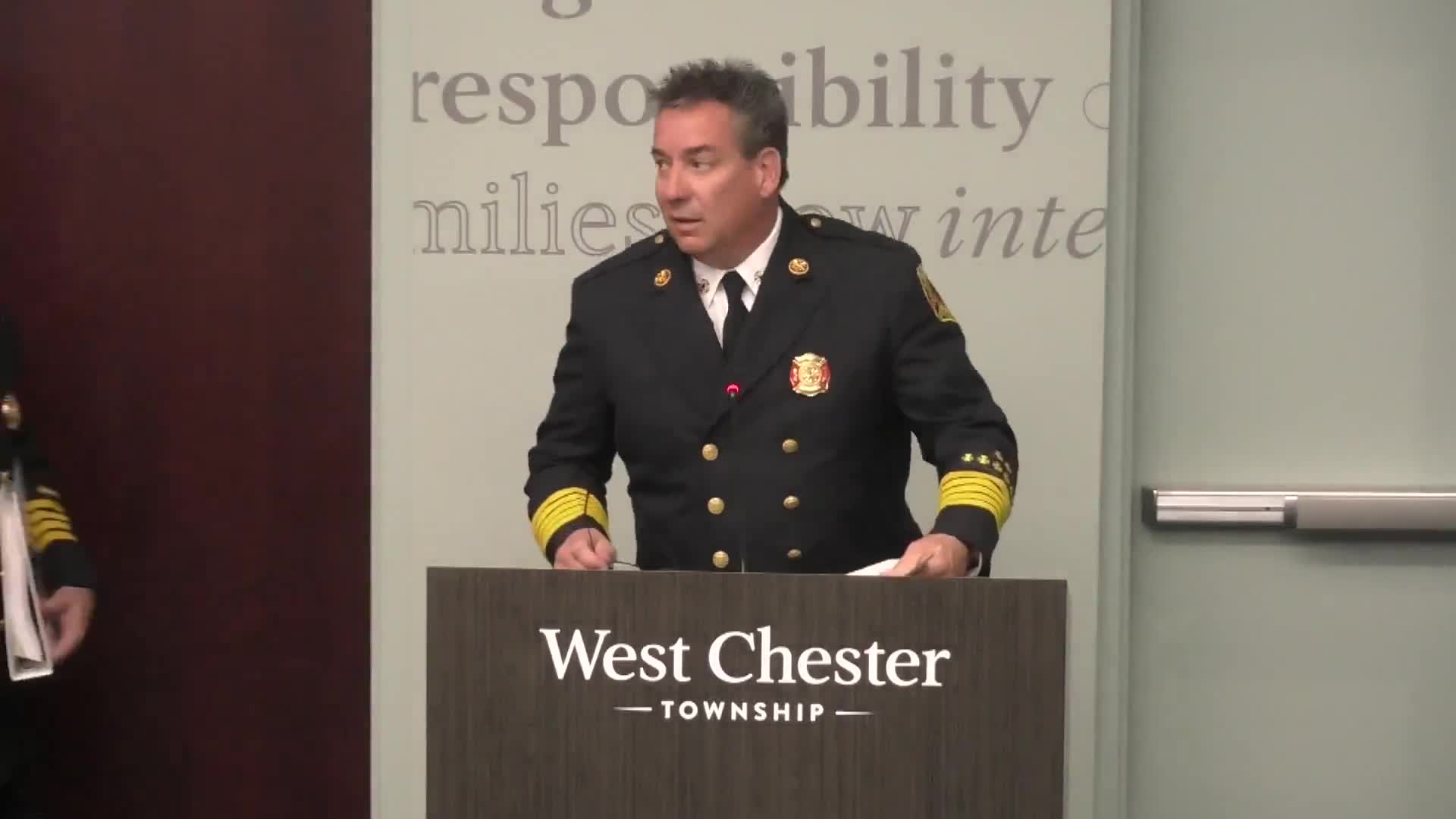
West Chester Township Fire Chief Rick Prince told the Board of Trustees on May 13 that the department is pursuing accreditation from the Commission on Fire Accreditation International and expects a site assessment after submitting materials in September, with a final accreditation appearance before the board projected for March 2026.
The presentation explained why the department completed a community risk assessment and strategic plan, tested about 200 core competencies, and is now preparing documentation for peer review. Assistant Chief Hafen, the department’s accreditation manager, said accreditation “enhances our community alignment” and establishes a continuous quality-improvement process that “provides data supported decision making.”
The nut graf: trustees heard that West Chester’s population and built environment have changed over two decades and that the department’s current resources are increasingly stressed, prompting recommended investments in facilities, apparatus and personnel planning to maintain response time and service levels.
Chief Prince and Assistant Chief Hafen described specific findings: 57% of township addresses fall within five minutes of a fire station today; an option to add one station would raise coverage to roughly 90% of addresses in five minutes. The department reported growth in multifamily housing and mid‑rise buildings that require larger first-alarm staffing—an initial response to some multifamily incidents requires about 34 firefighters and certain mid‑rise responses were modeled at the equivalent of 51 personnel. The department also reported rising concurrent call volume: roughly 1,100 days in 2022 had three or more simultaneous calls, and instances with five concurrent calls increased about 200% between 2020 and 2022.
Hafen said the department is testing options to reach community expectations for total response times expressed during public input: 6 minutes 45 seconds for EMS incidents and 8 minutes 30 seconds for fires. He told trustees that achieving a four‑minute arrival time across the township would be impractical without tearing down and rebuilding most stations, so planners prioritized a compromise deployment that would yield large coverage gains with fewer new facilities.
Recommended strategic improvements presented to the board include relocating Stations 74 and 75, adding a Station 76 (north‑central township), adding a fourth medic unit, investing in a dedicated training facility, accelerating apparatus replacement schedules and implementing succession planning for department leadership. Chief Prince said relocation and one additional firehouse produced the largest improvement in coverage per dollar in the department’s models. He also noted station construction costs and land acquisition as factors: trustees and staff discussed land, construction and equipment estimates of roughly $6–8 million per new station (as discussed in the meeting).
Trustees thanked the chiefs for the presentation, and several emphasized the tradeoffs between community expectations and budgetary limits. Trustee comments acknowledged the department’s work and asked for additional detail on costs and phasing; Chief Prince repeated that accreditation is not a mandate to buy specific assets but a process to identify strategic priorities for the community to consider.
Ending: The board did not take formal action on the accreditation presentation at the May 13 meeting; trustees directed staff to continue working with the fire department as it completes the CFAI documentation and prepares for peer review and on‑site assessment scheduled after submission in September, leading to a March 2026 accreditation appearance.