Get Full Government Meeting Transcripts, Videos, & Alerts Forever!
Get email alerts on the Assessment Map topic
No spam. Unsubscribe anytime.
Portland Public Schools reports mixed midyear MAP growth; district outlines interventions
Summary
At a special April 22 board meeting Portland Public Schools presented midyear MAP (Measure of Academic Progress) results showing stronger math growth than reading, continuing subgroup gaps, and district steps — including curriculum-aligned interventions, instructional coaching and school visits — to accelerate student progress.
Portland Public Schools (Portland SD 1J) presented midyear results from the district's Measure of Academic Progress (MAP) assessments at the April 22 board meeting and described steps schools are taking to respond.
District leaders said math growth exceeded expectations across most grades this winter, while reading growth met but did not substantially exceed the district's 50% growth benchmark that indicates students are, on average, making at least the expected progress toward grade-level standards. The district also reported persistent variation in growth by race, English-language status and disability status.
Chief of Equity and Accountability Dr. Adams led the MAP presentation and said the data come from the winter assessment window (Jan. 6'Feb. 14) and therefore represent midyear growth. Chief Academic Officer Christina Howard and Senior Director of Schools Dr. Isaac Cardona described how schools analyze those results and adjust supports.
Why this matters: MAP measures growth (two scores in a single year) as distinct from state test proficiency. District staff stressed that a large share of students may be showing growth yet remain below grade level; sustained, above-expected growth across years is needed for students to reach grade-level standards.
Key findings and timeline - The winter MAP window was conducted Jan. 6'Feb. 14; MAP enables midyear growth measurement because each student has two scores in the same school year. - District presenters said math growth was higher than reading growth overall and that math growth increased across all tested grades compared with last year; reading growth rose in grades 4 and 8 but declined at several other grades compared with last year. - Growth percentages varied by student subgroup; staff highlighted gaps by race/ethnicity, special education status and multilingual learner status.
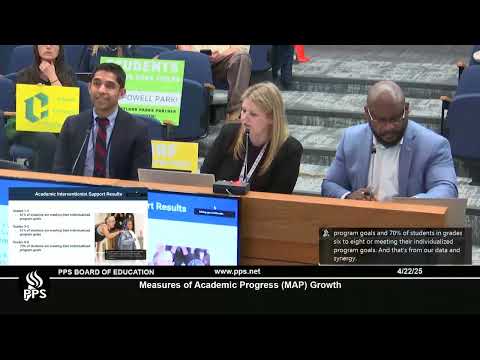
District response and interventions - After MAP releases, principals, instructional coaches and teachers use data-analysis protocols to regroup students, adjust interventions and set new goals. Dr. Adams and Christina Howard described a tiered system of supports, including daily ‘‘WIN/What I Need'blocks," small-group reteaching during core time, and targeted interventions delivered by academic interventionists, special educators or English-language development staff. - Elementary schools schedule 30' to 45-minute WIN blocks for personalized instruction; interventionists monitor progress with embedded curriculum checks and enter progress into the district's Synergy tracking system. The district reported that recent Synergy data show 61% of students in grades 1'5 and 70% in grades 6'8 were meeting individualized intervention goals. - The district has instituted cross-functional instructional walk teams (school performance, teaching and learning, student support services, principals and instructional coaches). Senior leaders said the teams visited more than 1,000 classrooms this year to observe curriculum use and instructional practice and to help schools develop both short- and longer-term action plans. - School-level supports described include facilitated step-backs with instructional teams, schoolwide resets on PBIS (positive behavioral interventions and supports), on-site professional learning tied to curriculum implementation, enhanced classroom coaching, PLC (professional learning community) support, and side-by-side classroom coaching.
Assessment and curriculum notes - Presenters said MAP is intended as a system-level snapshot; curriculum-based unit assessments and daily formative checks should inform teachers' day-to-day instruction. The district is working toward aggregating classroom-level curriculum assessments so leaders can view those data districtwide in future years. - Chief Academic Officer Howard and Dr. Cardona said not all teachers have fully adopted the district's adopted curricula; they described professional learning and PLC work to increase fidelity of implementation. The district emphasized the distinction between growth (MAP) and proficiency (state OSAS results), noting that the two measures can diverge when students are accelerating but remain below grade level.
Family communication and follow-up - Staff said families receive reports after fall conferences and again after winter assessments; reports are also available through ParentVUE and some schools send printed letters. Board members pressed staff on consistency of family communication and on supports for families who cannot attend conferences; staff said distribution practices vary by school and that improvements to reach all families are under discussion.
Board questions and next steps - Board members asked how MAP results feed whole-class instruction versus individual interventions, what interim checks exist between assessment windows, how curriculum-based assessments are used, and how the district will reduce reliance on large-sample assessments by aggregating unit-level data. - District leaders said the goal is to strengthen curriculum-based assessment use and teacher collaboration in PLCs so adjustments happen in time for students to benefit within the same school year. Staff stated the district hopes to provide some version of aggregated classroom assessment data districtwide next year.
Ending: District leaders said MAP results and subsequent instructional walks inform 6' to 8-week continuous improvement cycles at schools. The board and staff agreed to continue work on clearer, consistent family communications and on technical steps to aggregate curriculum-based assessments.