Get Full Government Meeting Transcripts, Videos, & Alerts Forever!
Get email alerts on the Police Accreditation topic
No spam. Unsubscribe anytime.
Westerville police outline continuous CALEA accreditation cycle, on-site assessment set for June
Summary
Westerville Division of Police staff described the department’s 4-year CALEA accreditation cycle, the workload of maintaining compliance across 85 standards, and an upcoming on-site assessment in June ahead of a November reaccreditation decision.
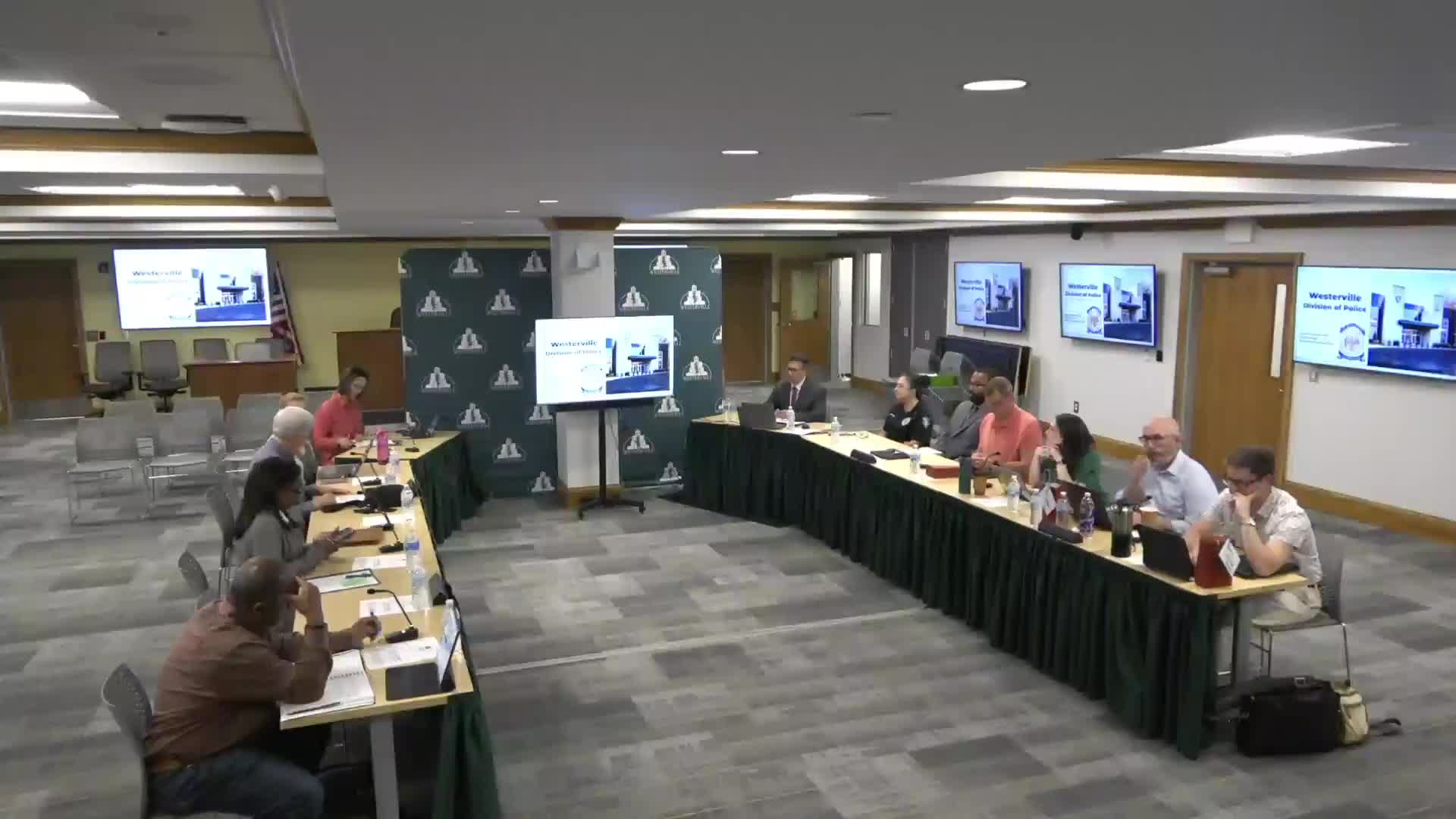
Westerville officials told the City Council work session that the Westerville Division of Police is in an ongoing reaccreditation cycle with the Commission on Accreditation for Law Enforcement Agencies (CALEA) and will host an on-site assessor in June, with the commission’s reaccreditation decision expected in November.
The accreditation manager, Dave Magnatelli, said CALEA requires written policies plus documented proofs that the division follows those policies. “In order to comply with that standard, you have to have 2 things. You have to have a written directive. That is your policy, your plan, your procedure. On the other hand, you also have to have proof of compliance,” Magnatelli said.
CALEA accreditation for law enforcement covers operations, ethics, training and public service. Magnatelli told council members the division works within a 4‑year cycle: initial accreditation, annual web‑based audits in years 1–3 (the team reported passing a recent web‑based audit in May), and an on‑site assessment in year 4. He said the division received initial accreditation in November 2021 and will begin the next 4‑year cycle if reaccredited this fall.
Magnatelli outlined the scale of the compliance task: CALEA lists 85 standards for the division, which in that presentation included 459 subcomponents, a total the presenter summarized as 644 discrete items to track. He said the department uploads roughly 700–1,000 “proofs” per proofing year (the proofing year the presenter described runs from June 9 to June 10). He described the division’s policy and proof management using the PowerDMS software and said the system also supports training delivery and comprehension checks.
Council members asked about staffing and sustainability. Magnatelli said smaller agencies often lack capacity and noted the work requires a dedicated accreditation manager and support from command staff; he said part of why Westerville met its timelines was city and command‑staff support. “You put your resources where you place your value,” he said.
On costs, the presenter said CALEA participation involves an annual fee (he stated it is about $4,500) and that the fee also covers assessor travel. Council members and staff discussed succession planning for accreditation responsibilities and the potential to pursue additional CALEA disciplines later (the division currently holds law‑enforcement accreditation and is working toward communications and academy accreditation).
Council members and police leaders also noted regional context: the presenter listed Central Ohio agencies with CALEA law‑enforcement accreditation and said only a small share of U.S. agencies have any CALEA accreditation. He emphasized that CALEA requires continuous year‑to‑year proofing rather than a single four‑year compliance push.
The work session included questions about whether accreditation reduces liability and improves outcomes. Magnatelli said accreditation requires the division to analyze use‑of‑force incidents, pursuits, traffic enforcement and similar topics annually, producing trend analysis that helps identify patterns and reduce risk.
No formal council motions or votes were taken on accreditation during the work session; council discussion was limited to questions and staff presentation.