Get Full Government Meeting Transcripts, Videos, & Alerts Forever!
Get email alerts on the School Libraries topic
No spam. Unsubscribe anytime.
Pulaski board approves three-year library plan, highlights digital learning and equity
Summary
The Pulaski Community School District board approved a three-year library long-range plan that emphasizes digital learning, coaching, equity across buildings and a K–12 digital citizenship scope and sequence funded in part by Wisconsin common school funds.
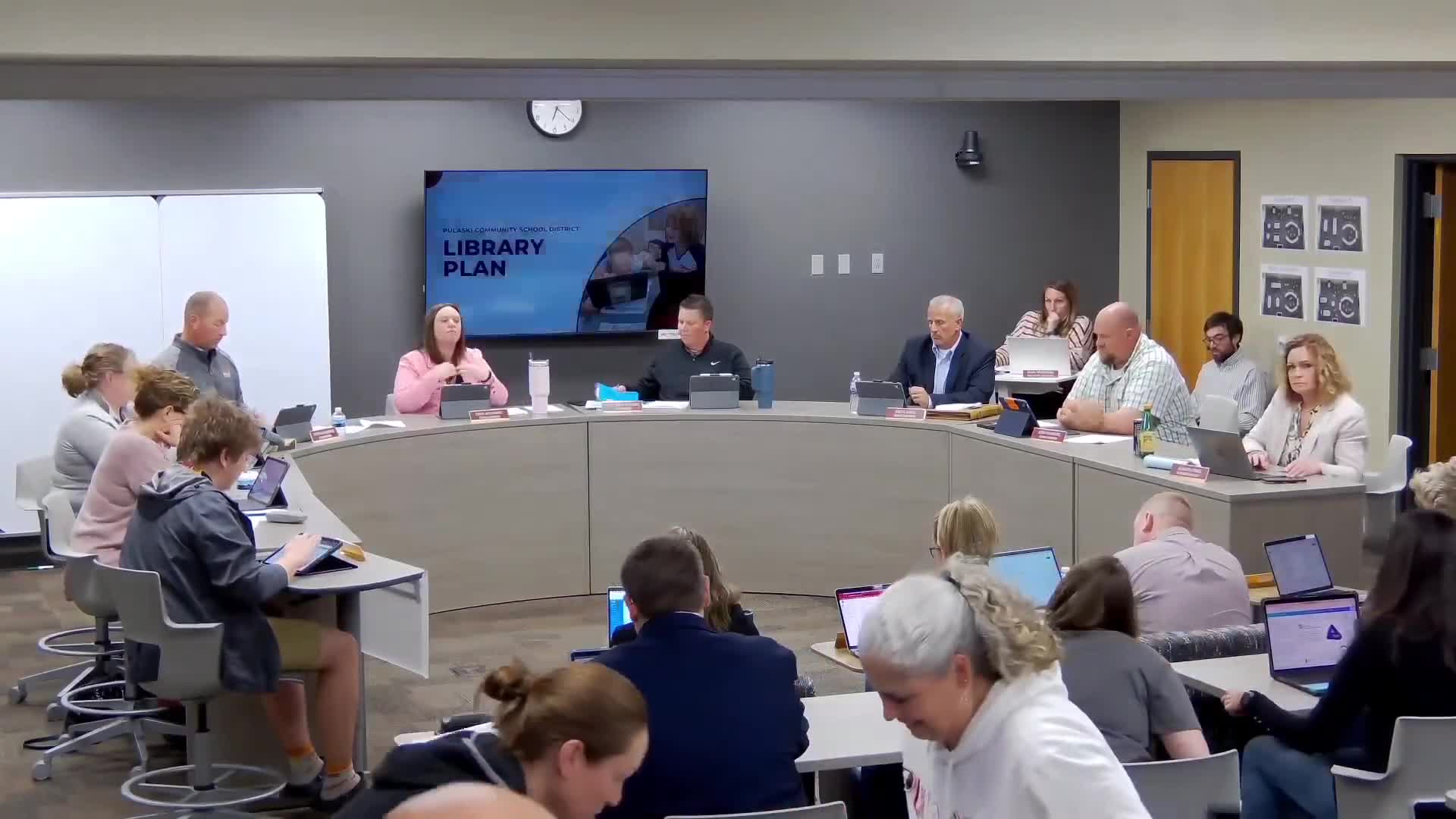
The Pulaski Community School District Board of Education approved a three-year library long-range plan Tuesday that the district says will expand digital learning, align library goals with district curriculum goals and clarify how state common school funds are used.
The plan, presented by the district library and digital learning team, passed on a motion and unanimous consent after a short presentation and questions from board members.
District library staff said the plan was required by Wisconsin administrative code and will guide use of common school funds — state money managed by the Board of Commissioners of Public Lands — for purchases such as print books, ebooks, software subscriptions, makerspace resources and hardware. "That money needs to be used for specific purposes," a presenter said, noting the fund's growth in recent years.
Members of the district library and digital learning team described three priority goal areas: curriculum, instruction and assessment (including technology-integrated unit plans tied to ELA and math); collaborative leadership and coaching to support teachers; and digital citizenship with a K–12 scope and sequence emphasizing data and privacy. Presenters said the team will use standard crosswalks to integrate technology skills into content-area instruction and create choice boards and unit plans that marry HMH literacy modules with technology tasks.
Board members who asked questions focused on the balance of print and digital materials, equity of access across buildings and how librarians coordinate shared collections. Presenters said most elementary collections remain primarily print because many elementary students do not take devices home; when ebooks are used it is often to provide multiple simultaneous copies. They also described an interbuilding spreadsheet and a lending process that allows students district-wide access to titles housed in different buildings.
After discussion the board approved the plan. The presenters said approval keeps the district eligible to use common school funds for library purchases and satisfies the state requirement for a written long-range library plan.