Get Full Government Meeting Transcripts, Videos, & Alerts Forever!
Get email alerts on the Municipal Finance topic
No spam. Unsubscribe anytime.
Redmond updates investment policy as yields fall; council adopts FIN-111
Summary
The City of Redmond reviewed market conditions, reported higher-than-expected interest revenue, and adopted an updated investment policy (FIN-111). Finance Director James Wood and adviser Lauren Brandt presented a laddered, cash‑flow driven strategy constrained by policy limits (weighted average maturity ~2.5 years, maximum 5 years).
At the May 20 council meeting the City of Redmond’s finance team briefed council on macroeconomic conditions and the performance of the city’s investment portfolio, and the council approved an updated investment policy (FIN‑111).
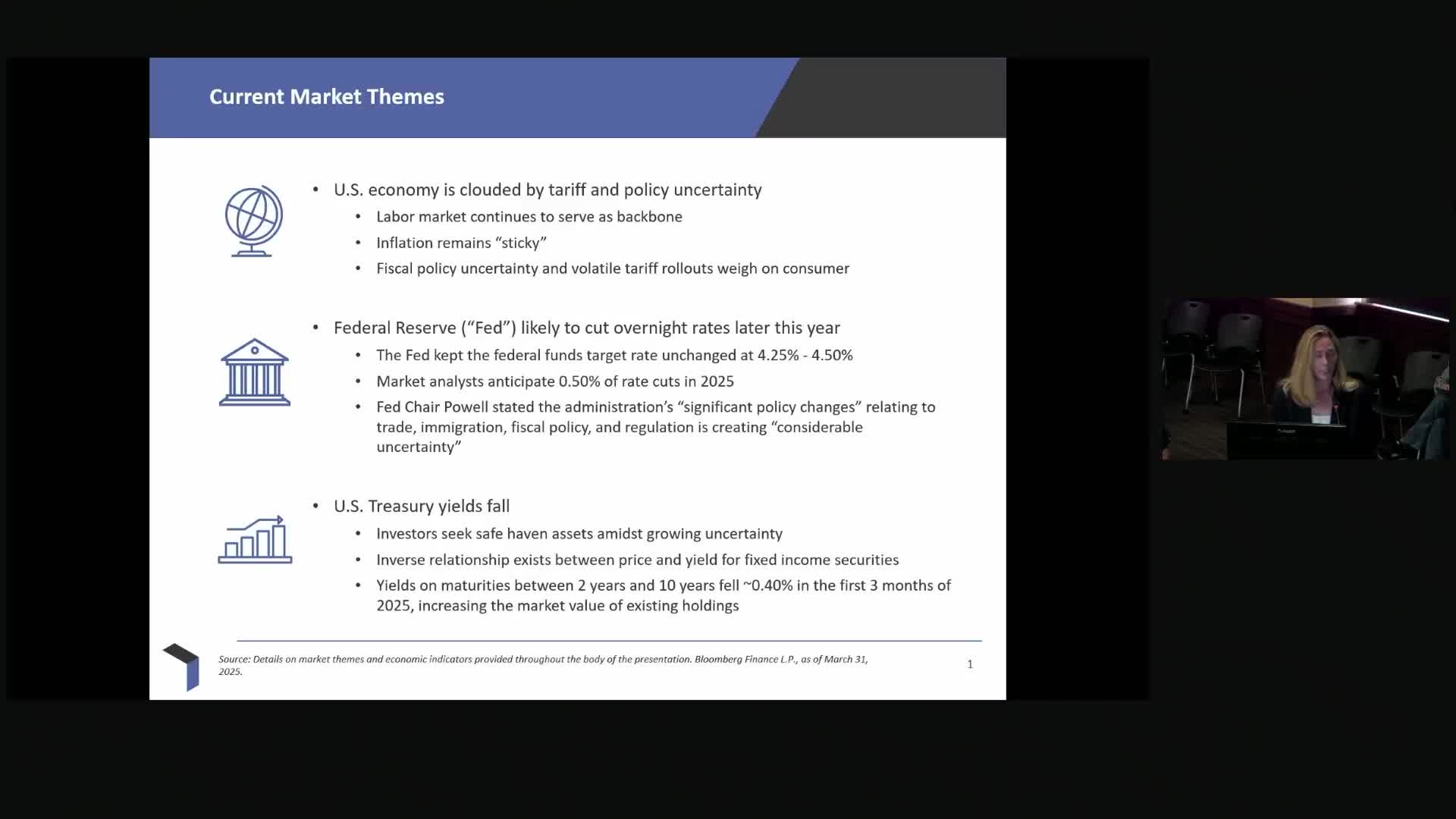
Finance Director James Wood presented the city’s objectives: preservation of capital, liquidity, diversification and a measured return. Wood said interest revenue has grown materially in the city’s budget projections — from roughly $600,000 in fiscal year 2023 to an estimated $6.5 million — and stressed the importance of a disciplined approach. Lauren Brandt, the city’s investment adviser from PFM, summarized the national economic backdrop: uncertainty driven by tariff announcements, a strong labor market, inflation still above the Federal Reserve’s 2% target and lower Treasury yields as investors sought safe havens earlier in the year.
Wood described the city’s ‘‘laddering’’ strategy and cash‑flow model: investments are staggered so maturities occur regularly and provide liquidity while capturing higher yields when prudent. The policy limits investments to debt instruments (U.S. Treasuries, federal agencies, LGIPs, bank instruments), forbids equities, limits individual maturities to five years and sets a portfolio weighted average final maturity of about 2.5 years. Wood and Brandt showed that, under those constraints, the city’s returns have tracked between the state LGIP and the 2‑year Treasury benchmark and outperformed several peer agencies over the recent period.
Councilors asked about extending allowable maturities to capture higher yields if the yield curve continues to normalize; Wood said the council could direct staff to return with an amendment to policy language to lengthen the allowable maturity horizon in future months.
The council moved to adopt the investment policy (Finance Policy FIN‑111) and approved it by voice vote.