Get Full Government Meeting Transcripts, Videos, & Alerts Forever!
Get email alerts on the Community Development topic
No spam. Unsubscribe anytime.
Permitting levels ease from pandemic highs; building and planning funds show healthy reserves
Summary
City planning and building officials told the committee permit volumes are returning toward pre-pandemic levels, commercial valuation spiked due to large industrial projects, and building and planning funds retain multi-month reserves even under conservative revenue assumptions.
Planning Director Kyle Roberts, Building Official Alex Sabin and Deputy City Manager Steve Ashworth presented trends in land-use permits, building permits and the community development budget.
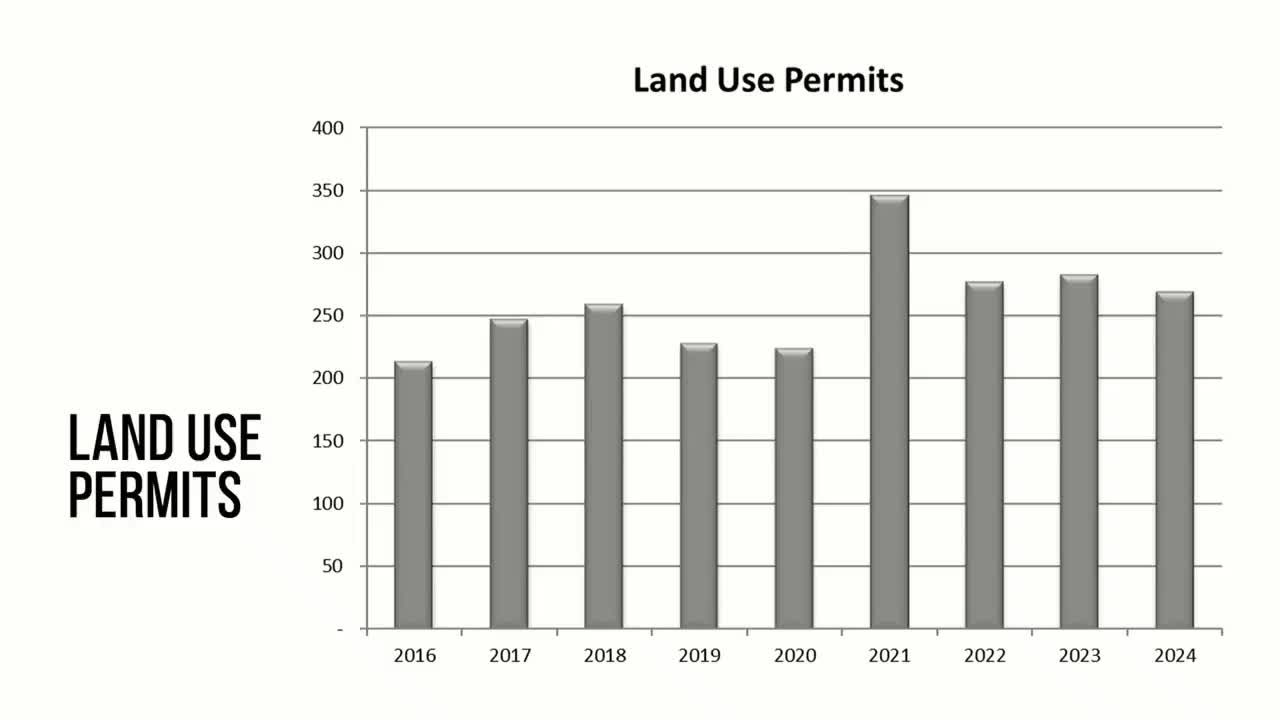
Roberts said the city averages about 261 land-use permits per year over the last nine years and that recent years have been above that average. He said pre-development applications have held steady — a sign of continued developer interest — and that several sizable private development applications have either been submitted or are expected soon.
Alex Sabin said building permit activity is trending back toward pre-COVID levels; the team conservatively budgeted for roughly 150 single-family and 150 multifamily units for the upcoming year. Sabin said the building division maintains a healthy reserve (about a 24–29 month reserve reported in the slides) and noted the city has not increased permitting fees since 2016.
Officials told the committee commercial permit volume was roughly average but that several recent industrial projects drove up commercial valuation substantially this year. The presenters said they survey major builders and hold frequent pre-development meetings to gauge timing; officials said those conversations currently indicate some scaling back to mid-2016–2017 activity levels but that significant master-plan projects remain in the pipeline.
Committee members asked about the state “shot clock” proposals (shorter review timelines). Roberts said Redmond’s current performance should meet anticipated reductions and Sabin noted state statute allows an option for applicants to use third-party reviewers when local review timelines are not met; city staff said they would consider interjurisdictional support if neighboring jurisdictions need assistance.
Community development staff also summarized other programs: Northpointe infrastructure assistance (the city is carrying some funding to help with on-site electrical service and project-management professional services), waste cleanup and illegal-camping enforcement costs (partly reimbursed this year by state funding), and HUD Community Development Block Grant (CDBG) pass-through funding with continuing reporting requirements.
Officials said CDBG allocations are expected to be similar to the prior year but cited some outstanding HUD guidance that could affect awards and compliance; staff said they expect to know appropriations timing in mid-May.