Get Full Government Meeting Transcripts, Videos, & Alerts Forever!
Get email alerts on the Comprehensive Plan topic
No spam. Unsubscribe anytime.
Middleburg commissioners review Chapters 2 and 3 of comprehensive plan; discuss wells, green energy and historic resources
Summary
At a Middleburg work session, commissioners and staff reviewed proposed edits to Chapters 2 (natural and environmental resources) and 3 (historic resources) of the towncomprehensive plan, discussing local groundwater geology, stormwater storage, green-building language and updates to historic designations.
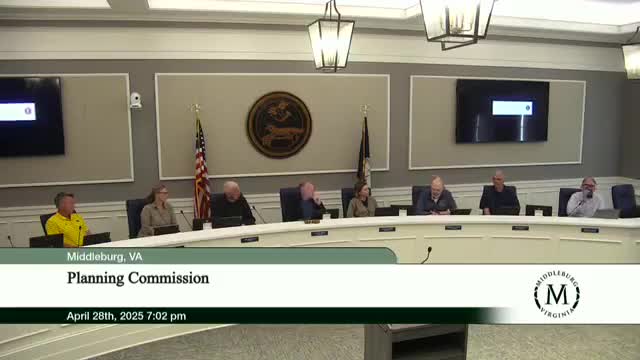
Middleburg planning commissioners and staff reviewed proposed edits to Chapters 2 and 3 of the towncomprehensive plan during a work session, focusing discussion on groundwater geology, stormwater storage, green-building language and historic-resource references.
The review began after staff circulated a set of draft changes. Will (staff member) told commissioners the edits were a starting point: "this is not intended to imply that this is all that we need to be changed in these chapters or that the language I have proposed is exactly what it should be. But, just some basic things that I thought were worthy as a starting." Commissioners then discussed technical and editorial updates.
Why it matters: The comprehensive plan guides long-term land-use decisions and infrastructure priorities. Commissioners said updating technical context (for water supply and stormwater) and institutional names in the historic-resources section will keep the plan aligned with projects and programs already under way in town.
Key discussion points
- Groundwater and the Marshall formation: Commissioner Basinger urged adding language about the Marshall formation, the local granite unit that supplies much of the townwell water. Basinger said the formation is important because "most if not all, of our well water comes through fissures and cracks in the Marshall Foundation," and suggested adding one or two sentences to the plan to reflect that source-water context.
- Stormwater storage and treatment: Will described the towninstalled baffled storage units that hold stormwater during large storms and slowly release and treat the water: "there's a kind of a bioprocess that the water, as it's discharged, has to go through to help remove some of those contaminants." Commissioners discussed clarifying language to explain how on-site stormwater treatment and storage operate under current development regulations.
- Green energy and building systems: Staff proposed adding more technical language describing HVAC and other systems meant to reduce fossil-fuel use. Will said the town did not pursue formal LEED certification because of the cost and documentation burden but that the building was designed "as though you would have been seeking this certification." He also noted the roof was designed to accept solar panels in the future: "the roofing system [was] designed such that it could accept the load of solar panels, in the future if we decided to add that on." Commissioners supported adding a short, encouraging sentence that "wherever possible new construction or renovation, the town encourages the use of solar panels" or similar soft language to promote green practices.
- Tree and streetscape programs: Commissioners suggested referencing local programs in the chapter, including the townTree City USA recognition from the Arbor Day Foundation. One commissioner proposed adding language about the streetscape committee and volunteer planting programs that other towns use to plant and maintain street trees.
- Historic resources and naming: Commissioners noted that references to the Mosby Heritage Foundation should be updated to reflect the current name, "Virginia Piedmont," and discussed the role of the Historic District Review Committee. Will described the HDRCs advisory role for property owners seeking State Historic Landmark Register recognition: the committee may provide letters of support that accompany state applications.
Next steps and direction
Commissioners directed staff to continue chapter-by-chapter review. Will recommended focusing on one chapter at the next meeting (population and housing) because it requires more demographic updates tied to the 2020 Census and the American Community Survey. Commissioners also discussed walking the town with the chapter text to compare on-the-ground conditions with plan graphics and descriptions.
Ending
Commissioners agreed to continue the comprehensive-plan review at an upcoming meeting and to narrow the next session to the population-and-housing chapter to allow more time for demographic and housing-policy discussion.